Our discussions of knowledge and constructivism often focus on the elusive idea of truth. And it’s not surprising, because so much of our lives depend on the truths that others have decided for us, and the truths we have made for ourselves. For example, when people experience conflict, we ask them what actually happened, and they are often judged and given consequences based on the information they provide, despite the fact that the limitations of human cognition mean that we will almost inevitably be missing, misconstruing, or misrepresenting information. The emphasis on truth also isn’t surprising, because some of our earliest philosophical musings about what constitutes knowledge defined it as “justified true belief” (Pritchard, 2014, p. 22).
Constructivism is a framework for explaining how people learn. Cobb points out two main trends in constructivist research: one that students are actively constructing an understanding of the worlds of their personal experience; the second that focuses on the “social and cultural”-ness of everything that we do (2005, p. 87). Although these views can seem conflicting, neither directly addresses the concept of truth.
Over the millennia that humans have been questing after it, we have developed some significant methods for determining theoretical truths thanks to the use of the scientific method and other well established and rigorous patterns of logic and observation. To borrow from Dr. Taber, we can build a good picture from clues, and we can test these expectations against future experience and make revisions. And from this, we can learn a lot about the world (2020).
Perhaps part of the problem is that both knowledge and belief have instrumental value, with knowledge typically being seen as having greater value (Pritchard, 2014, pp. 12-13). This value is not just inherent; it is socially constructed and reinforced. When we hold a particular belief and find ourselves within a community that shares that belief, we derive a sense of belonging, validation, and even identity from it. Even if a belief is later found to be inaccurate, the process of altering that belief can be complex and emotionally taxing, not merely because of cognitive inertia but also due to the social ramifications it may entail. Taber (2020) hinted at this when he spoke of how we often interpret our experiences to fit our inherent cognitive biases. This is where constructivism’s emphasis on the social dimension of learning becomes crucial.
Constructivism posits that learning isn’t merely an act of individual reflection and experience; it also involves a dynamic interplay with one’s physical and social environment. In essence, our thoughts, and thereby our learning and knowledge, are influenced by our culture. However, they also challenge it, gradually altering its boundaries (Fosnot & Perry, 2005, p. 71). Some theories draw parallels between evolutionary processes and individual learning, suggesting that personal learning can be understood as a result of activity and self-organization. This, in turn, leads to the development of cognitive structures (Fosnot & Perry, 2005, p. 79). As learners engage with their community, they may initially form beliefs based on shared experiences or the prevailing views of that community. The task for educators, then, isn’t just about correcting misinformation but facilitating environments where learners can collaboratively refine, challenge, and cross-check these beliefs. Through rigorous reflection, social interactions, and further experiences, these beliefs can then be transformed into more robust knowledge. Recognizing the social weight of beliefs and their potential to evolve underscores the importance of fostering learning environments where beliefs can be openly tested, questioned, and refined into truths that are more universally applicable.
I think one of the things that I will take from this course is the understanding that I must continue to question things. What do I consider acceptable forms of knowledge; what are acceptable ways to show and share it? The ideas that I have privileged may be the products of social and cultural beliefs rather than rationally supported understanding. Barbara Stewart Edwards spoke to this in her week 7 post : “Within diverse classrooms rich with ‘funds of knowledge,’ constructivist strategies that utilize diverse knowledge well, will not only serve to engage all its learners, but cultural understandings and sensitivity will also develop. Empathy, a trait said to be lacking in many of our 21st century learners, will be awakened.”
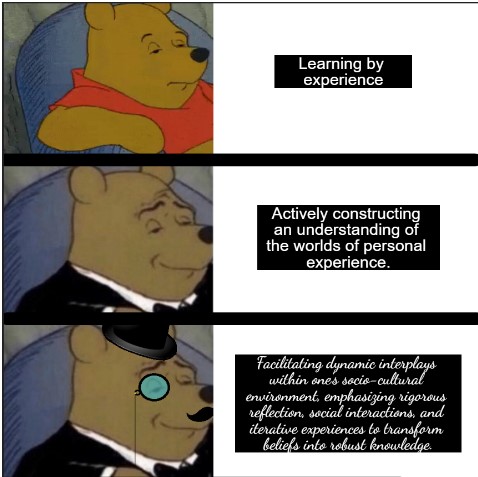
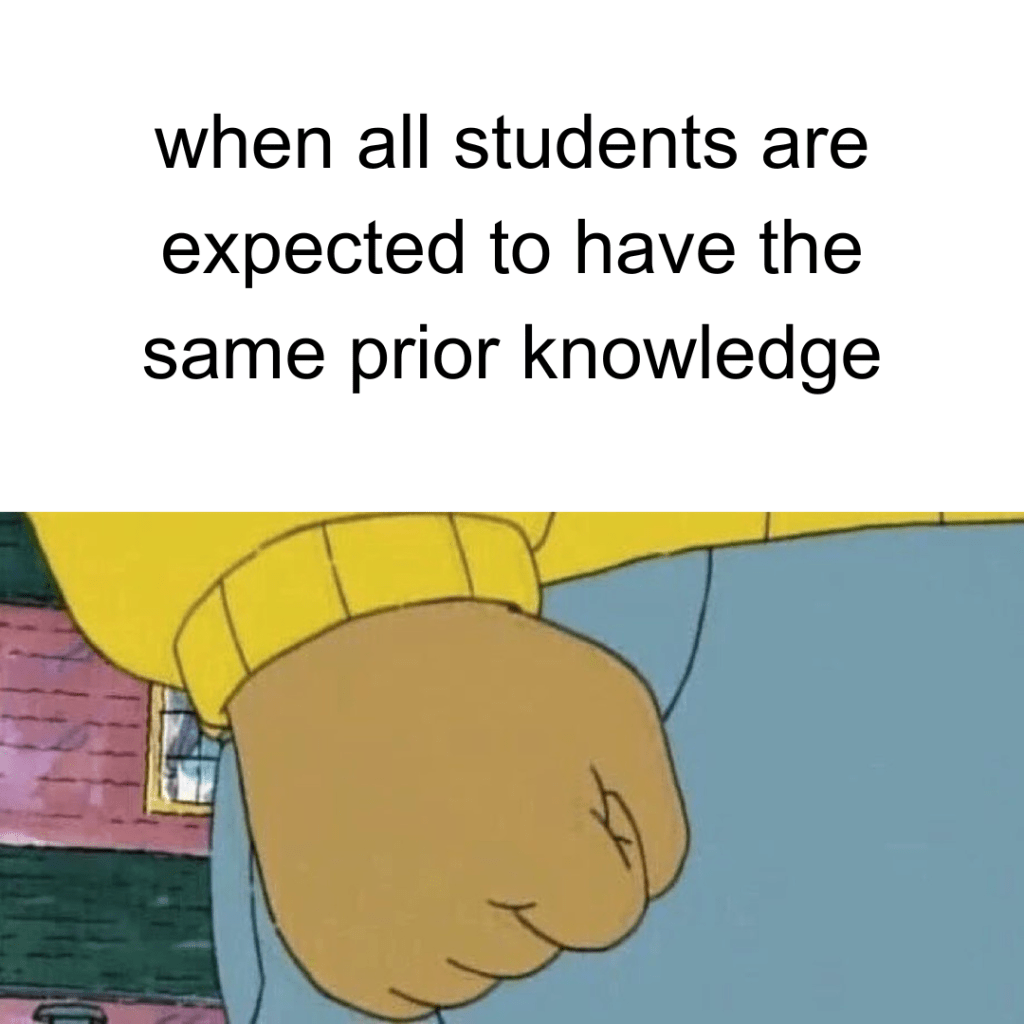
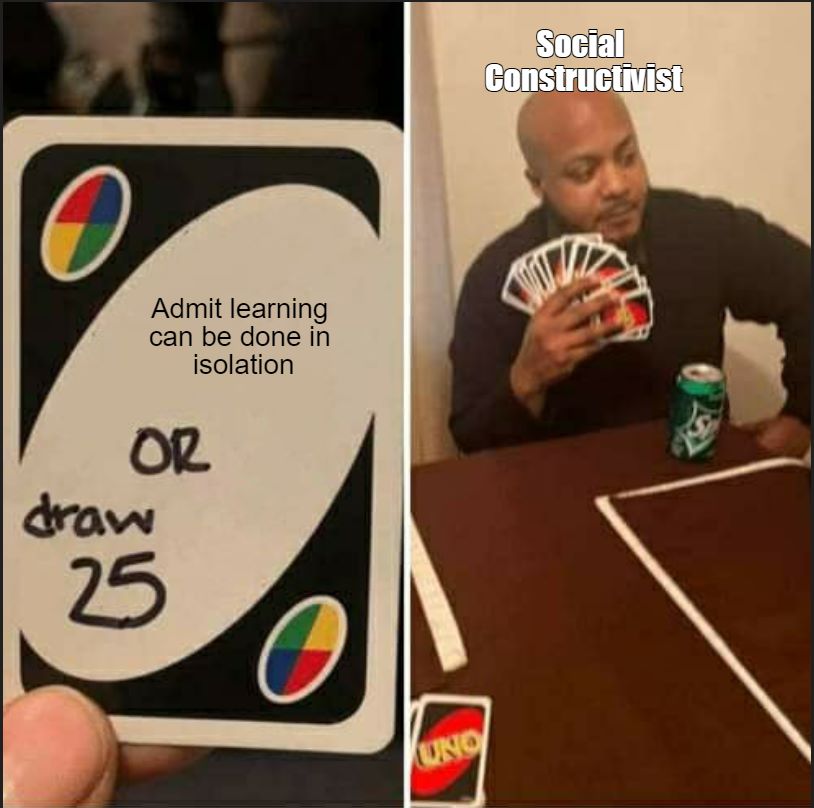
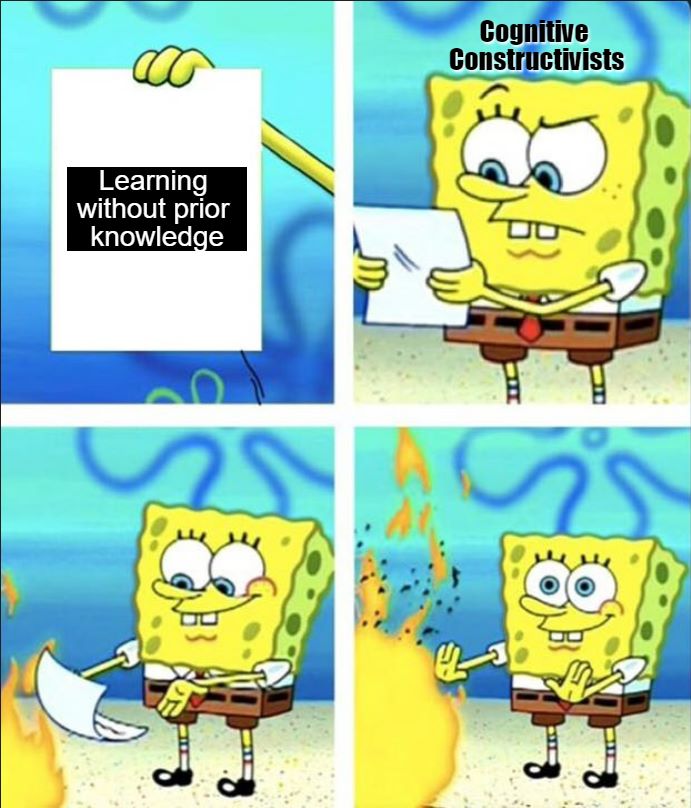
Please enjoy these memes that I created based on constructivist principles and in synthesis of course readings.
References
Cobb, P. (2005). Where is the mind? A coordination of sociocultural and cognitive constructivist approaches. In Constructivism : Theory, Perspectives, and Practice. Teachers College Press.
Fosnot, C. T., & Perry, R. S. (2005). Constructivism: A psychological theory of learning. In Constructivism : Theory, Perspectives, and Practice. Teachers College Press.
Pritchard, D. (2018). What is this thing called knowledge? Routledge.
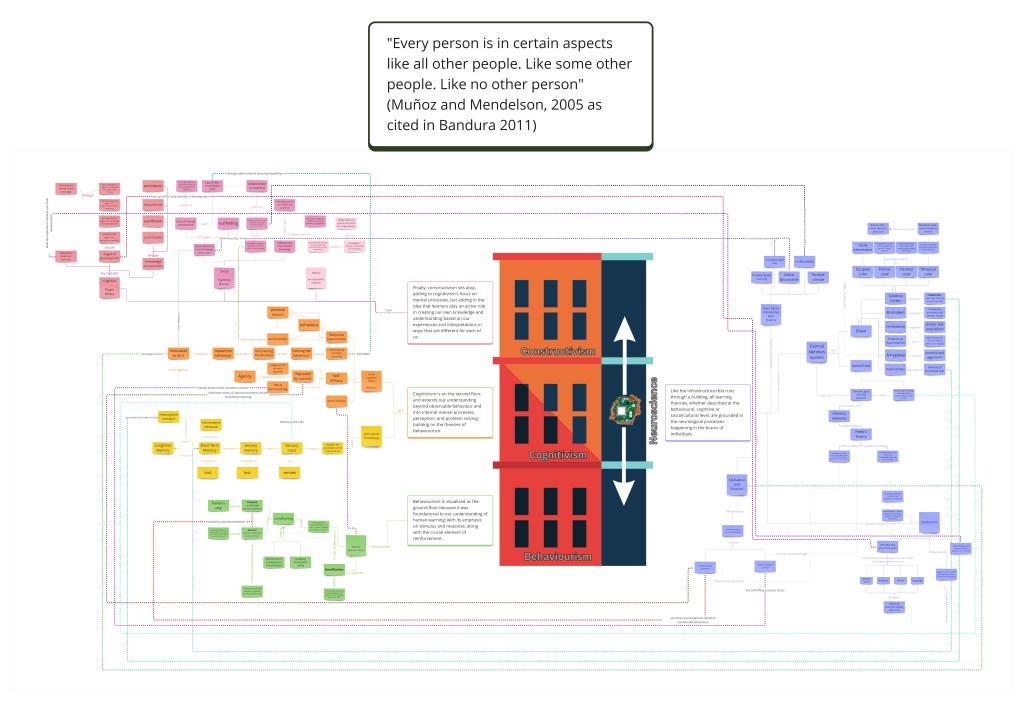
It’s been awhile! Since finishing up my T-L post-bacc through UBC I’ve started up on my Master’s Degree, also through UBC in their Educational Technology (MET) Program. And I spent so much time putting this Learning Theory Concept Map together that it should get to see someone else’s eyes other than my instructor’s.
A glimpse through my thoughts on reference materials in the LLC
These past five weeks have taken us on a crash course of learning, including on a multitude of topics that I will admit I hadn’t thought of before (at least when thinking about our school’s collection). Was I aware of indexes? Yes. But had I thought of ensuring that we have access to them? Not really. I honestly kind of lumped them together with databases in my mind. Taking this course has been necessary for the growth of my understanding and practice. I’ll highlight some key takeaways and thoughts from some of the lessons of this theme below.
Lesson 8: Digital Resources
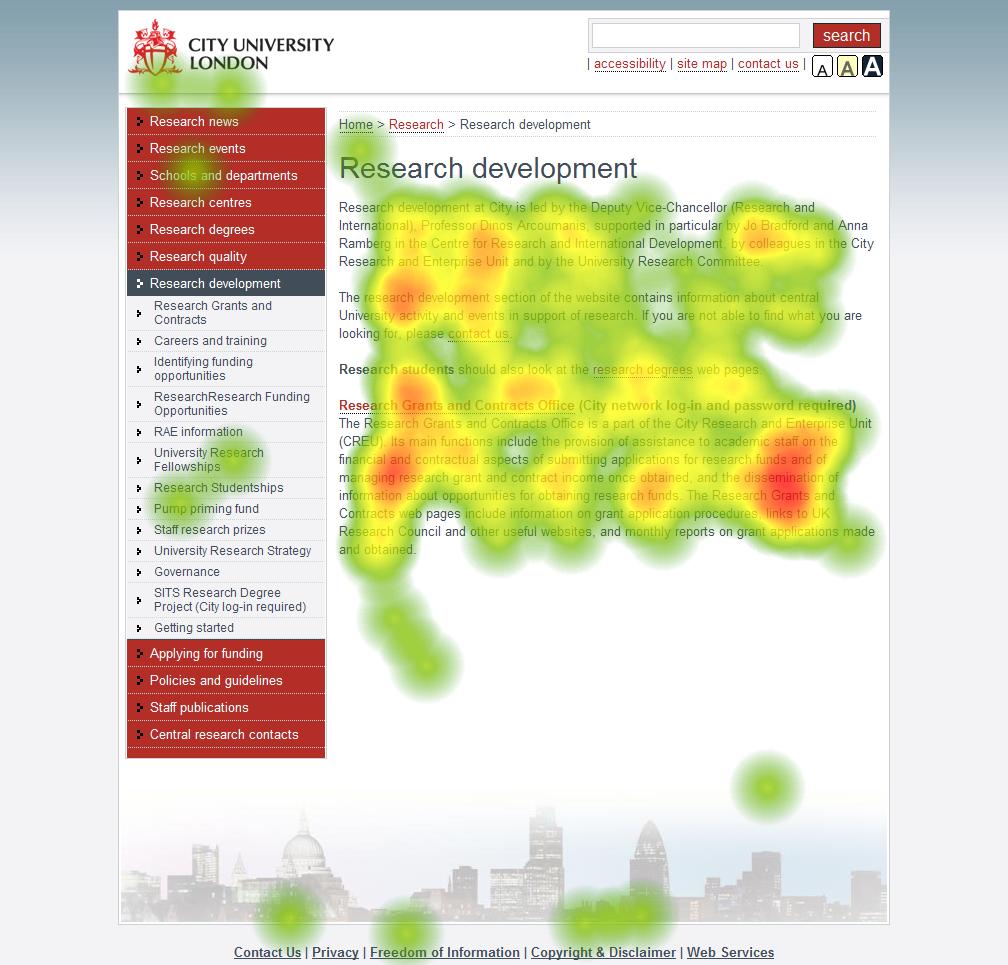
I’m not sure how much the deep web will be applicable to reference collection use in the middle school where I work, but I appreciated the reminder that Google (despite its advertising and market share), does not know all. A significant portion of the web remains hidden from search engines (Research Help: Finding Information on the Web: Invisible Web, 2019). Fundamental search skills need to be taught. This includes vocabulary and keyword searching for use with search engines, but also how to move through a website and find what you are looking for. It reminds me of research that I’ve read on how people view a web page (Pernice, 2017) – and it makes me wonder 1) whether the digital reference resources that we include in our collections have been designed with this in mind and 2) why I’m not teaching website browsing skills more directly.
Eye-tracking studies have provided interesting information about how people look at a web page. What are people missing that better education on online browsing for information could help provide? image CC2.0 from wikimedia commons
Lesson 9: Databases and Lesson 11: Encyclopedias
These modules, although on different content, had me asking some of the same questions – how do we make accessible information a priority?
Both databases and encyclopedias come with some significant readability issues. In my earlier analysis of World Book Online and Encyclopedia Britannica School, even the most basic levels of text were written at a grade 8 level. A search through Explora Canada, an elementary level database from Ebsco that I access through my Winnipeg Public Library card, often only gives HTML full text, which removes any visuals that went along with an article. Both issues severely impact a student’s ability to understand complex text. Translation is less of an issue with digital encyclopedias, but databases still seem to be heavily English only.
A note on Wikipedia
This will be of no surprise to anyone who has read any of my discussion posts; but there’s just something so inspiring to me about Wikipedia. It’s often more general, more readable, and written in more languages than its academic counterparts. The Simple English Wikipedia is especially useful. To me, it speaks to the idealism of the early internet as a place where we could all come together, share and learn, regardless of our educational opportunities or socioeconomic status. I’d agree with Nancy O’Neill that it’s the ideal starting place for picking up the terminology, important names, and to give you a general feel for a subject (Berinstein, 2006).
Lesson 10: Bibliographies, Biographies, and Directories
My biggest takeaway from this theme was that I could be doing more work to support, compile, and develop bibliographies for student research. Many of the bibliographies referenced in the Riedling and Houston text were aimed at more senior students. Finding information on the internet is a complicated process, and I’m beginning to think that we are throwing early middle school students into the deep end to find information on topics that they have little understanding (or interest in) and that it is probably impacting their understanding of that content. Perhaps student directed topics are the place to teach ‘searching for information’ skills. When it comes to more specific content where students may not have the necessary background knowledge, I think that curated resources are more useful.
; bringing the @aallibrary reference collection into modernity and relevance
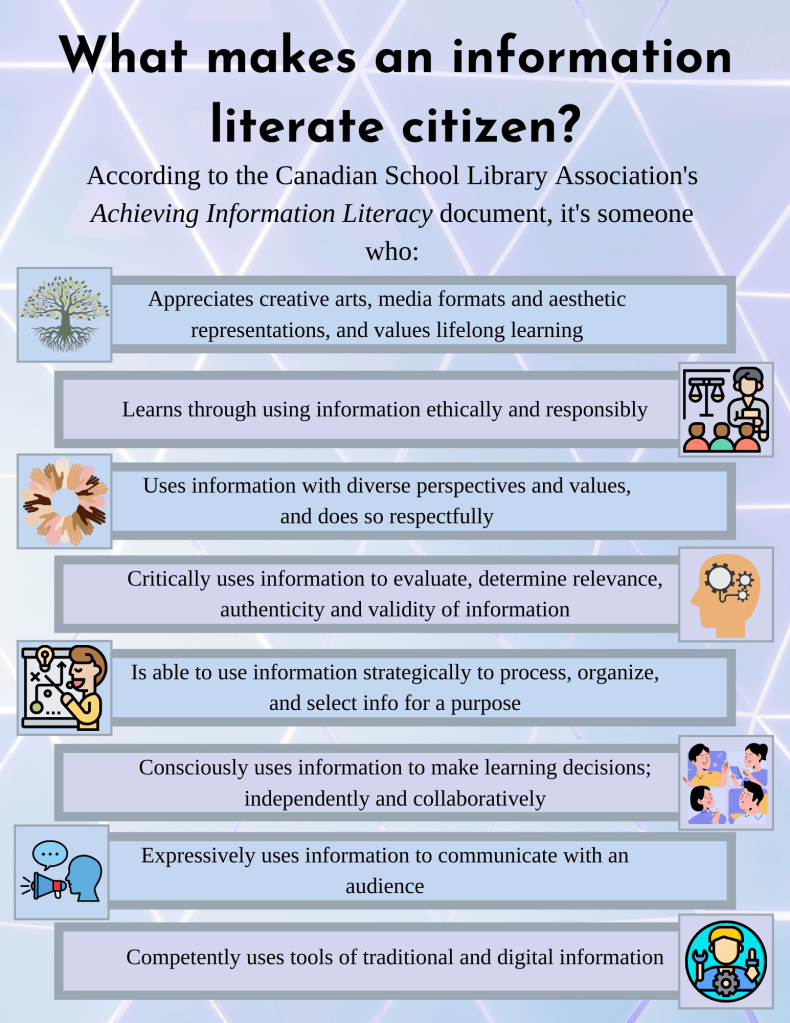
Reference collections and services are an integral part of any Library Learning Commons. The collection itself has traditionally been defined as a physical section of the library that holds print copies of materials that are not allowed to circulate outside of the library, to keep them on hand for client questions and research (University of British Columbia, n.d.). Services include helping define the information needs of users, creating environments for learning and collaboration, teaching students how to use reference resources, and differentiating good reference materials from bad ones (Riedling & Houston, 2018, p. 2). Good reference services require access to a reference collection that meets the needs of a building’s clientele, and the development of all good services is done through conscientious observation, user feedback, planning, and execution. While reference services have been more static over the last 20 years, the reference collection has changed drastically. So how do we support developing library users into informationally literate citizens? The first step is to ensure the building and maintenance of a collection of physical and virtual materials that are responsive to the needs of our school communities. What follows is a plan for the continued development of the AAL Library Learning Commons reference collection in a way that will help guide students towards becoming informationally literate citizens.
(CASL, 2006, pp. 10-17)
When this kind of work is being done, we refer to various standards set by professional organizations that help inform our practice; in this case the Canadian School Library Association’s Achieving Information Literacy (AIL), which sets standards for School Library collections, including reference ones. Another document heavily used in this plan is Riedling and Houston’s 2019 Reference Skills for the School Librarian (Fourth Edition).
Where We Are At Currently
The Physical Reference Collection
Riedling and Houston include the following materials as important to a reference collection; bibliographies; factbooks, directories, almanacs, yearbooks, and handbooks; biographical sources; dictionaries; encyclopedias; geographical sources; periodicals and specialized databases. Only several are present in our current physical reference collection, which has mostly been disbanded over the past five years. Most materials have had their spine labels edited to remove REF and been shelved in the appropriate Dewey section – most notably factbooks like our Guinness Book of World Records. 101 items remain with a REF spine label, which are kept on a bottom shelf at the end of the non-fiction collection. Highlights of this section include,
A Time for Kids Almanac (2017) *
A book on birthdays (2006)*
The Globe illustrated Shakespeare; the complete works annotated (1979)
An unabridged Collins English Dictionary (2011) and abridged Junior Dictionary (2006)*
Several visual dictionaries (1989 – 2011) *
A set of Rand McNally Classroom atlas of Canada and the World (2008)*
A sizeable National Geographic atlas of the world: Eighth edition that invites group viewing (2007)*
An eight-volume set on Diseases, by Grolier Academic Reference (2006)*
A six-volume set, Exploring the World of Mammals, by Chelsea House Publishing (2008)*
Several historical Atlases of Manitoba
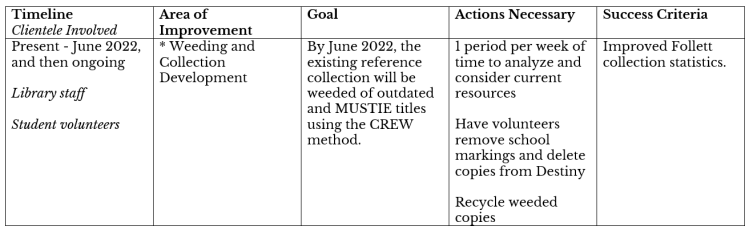
This seems to be a mishmash of materials that have been missed during previous weeding or relocations. Those marked with an asterisk are in need of replacing as they exceed CREW criteria for their Dewey number. For example, the CREW manual recommends that Almanacs should remain in the reference collection for a year, then be moved to the circulating collection for a year and then discarded (2012, p. 39). Only the historical atlases and Shakespeare seem like they deserve to remain.
We have let materials from Reference circulate outside of the library. The sizable (but hopelessly outdated) National Geographic atlas has circulated 12 times, the collection of Shakespeare 15 times, and the unabridged Collins 17 times. The rest show 2 or fewer circulations.
The Virtual Reference Collection
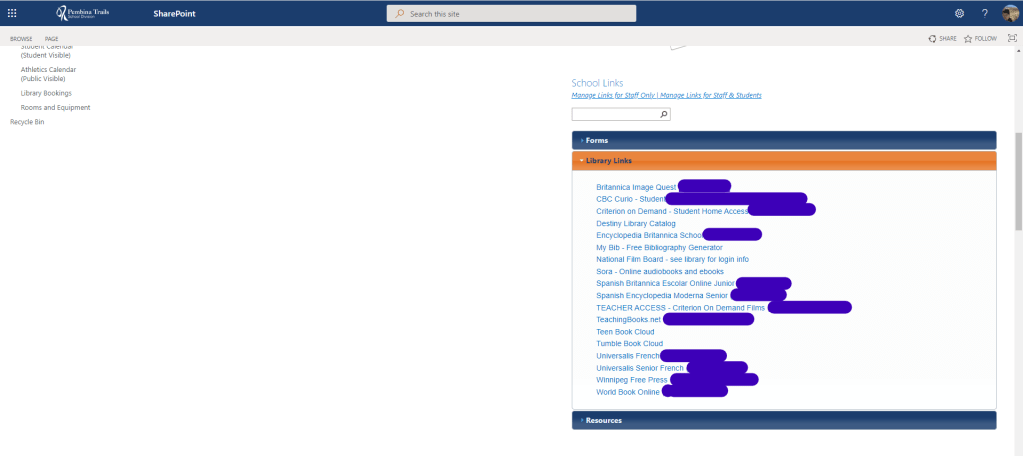
Our virtual reference collection is housed in two separate locations, one mandated by our school division, and the other chosen because of ease of access for students. It provides links to our school catalog and other digital subscriptions, some of which would be considered reference materials.
On the School Sharepoint PortalOn the @aallibrary Edsby page
Available to access through these two locations are the following:
Encyclopedia Britannica School (along with French and Spanish editions)
Britannica Image Quest
World Book Online
Teachingbooks.net (teacher reference)
NFB Canvas
Criterion on Demand
CBC Curio
Destiny Collections built on curricular topics/interest
Magazines through our Overdrive/SORA subscription
Digital access to the Winnipeg Free Press
Areas of Improvement
User Feedback
“Libraries build collections based on what they think faculty and students need”
(Riedling & Houston, 2019, p. 4).
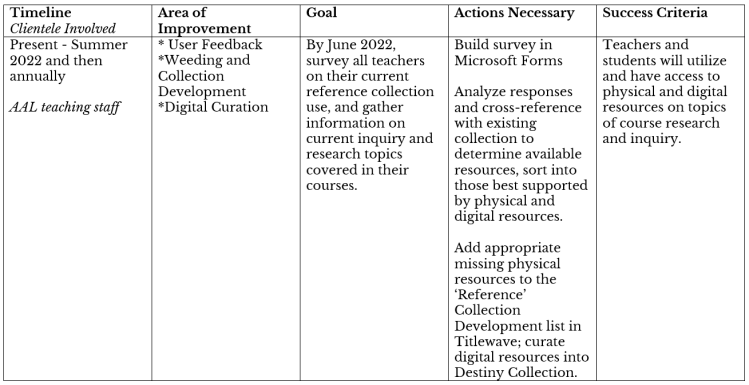
If this is to be truly the case, more time collecting feedback from clientele (both students and faculty) needs to become a focus. This will allow us to meet their needs and encourage growth and development of pedagogy and information literacy more adequately.
Weeding and Collection Development
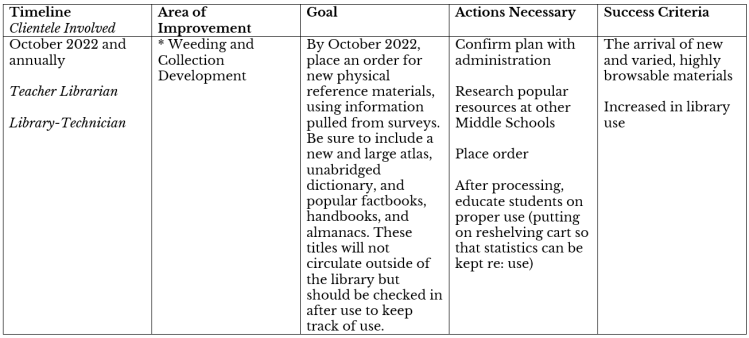
The average age of materials remaining in the reference collection is 17 years (Follett Destiny, 2022). While this is okay for materials of historical relevance, for most this is inappropriate. Those marked above should be weeded from the collection and replaced if there is adequate demand and/or an online option is not suitable. New materials should be purchased based on user feedback, with emphasis placed on highly browsable ones. Popular titles, like the Guinness Book of World Records should be bought in duplicate – one for the circulating collection, and the other for Reference. When considerations are being made for adding resources to our collection, Riedling and Houston’s criteria for that format will be utilized.
Location and Physical Space
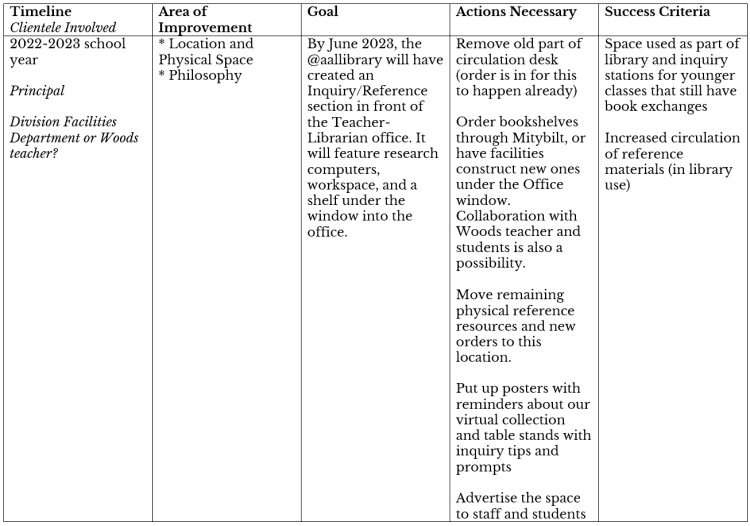
Currently, the remaining parts of the reference collection sit on the bottom of a shelf at the end of the non-fiction collection; a nondescript and unmarked location, suitable for a part of the collection that has been sadly left behind. According to AIL criteria, this meets ‘below standard’ criteria (Canadian Association of School Libraries, 2006, p. 42). While virtual materials are available, they should be curated and advertised more prominently, which could be a prominent feature in a designated reference section.
Philosophy
The most utilized materials in the reference collection are the ones that encourage discovery and collaborative use. Physical materials should be selected to encourage and inspire inquiry and research on topics of student interest. Materials (both physical and digital) should be selected to inspire “questioning, thoughtful investigating, making sense of new information, and developing new understandings.” A section that encourages inquiry also supports a pedagogical shift towards constructivism, where learners build their own meaning through a teacher supported environment that motivates students to question and discover rather than simply retain information (Stripling, 2008, p. 50).
Effective Collaboration at Division Level
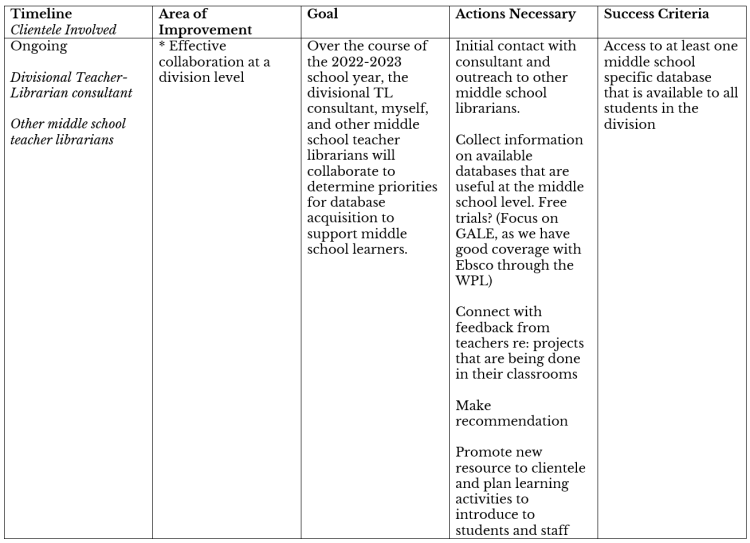
Many virtual reference resources are prohibitively expensive. Access to Middle School Databases would best (and more equitably) be achieved if purchased at a division level, rather than on a per school basis.
Digital Curation
For parts of the collection that are best served by digital means, these should be curated and organized in a way that allows for easy access by both teachers and students. This allows our clientele to access vetted materials that they might not discover on their own. Curation is about getting our students to quality content without throwing them into the wilds of the internet (Valenza, 2017). Students are familiar with Destiny Collections from genre-study collections, so this could easily be carried forward into content area pathfinders.
Connect with the Public Library
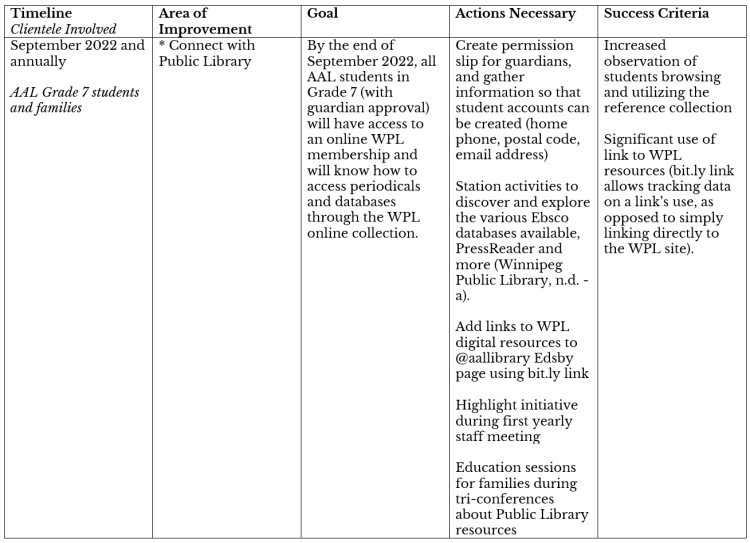
The pandemic has been challenging in a lot of ways, but one benefit has been that the Winnipeg Public Library have created an online membership option that does not require going in to a branch to complete. This gives students access to all virtual databases, audiobooks and eBooks offered by the WPL (Winnipeg Public Library, n.d. – b).
Where We Will Be – The Improvement Plan
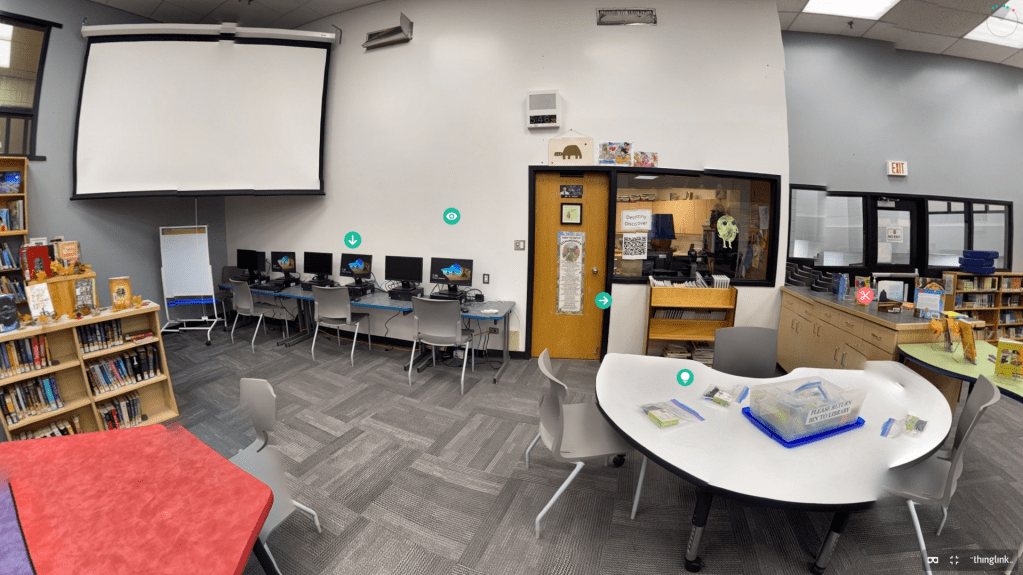
Follow the link in the caption below to view an interactive vision for what an Inquiry and Reference Station (goal 6) could look like in the @aallibrary! Click on the green and red buttons to learn more about what this will look like in the future.
The @aallibrary has significant room for improvement in terms of its reference collection. The above seeks to balance the importance of physical browsing, opportunities for collaboration, curricular demands, student interest, and financial constraints into a plan that once implemented will ensure the continued development of informationally literate community members with access to both a strong reference collection and reference services. From next year forward, an annual budget line will be established to continually enrich the physical collection. The only one time expense is the building/purchasing of shelves to house our new Inquiry and Reference section prominently. These steps will help ensure that Reference doesn’t fall into disrepair again.
University of British Columbia. (n.d.). [Lecture notes Lesson 1: Information Literacy and Reference Services in Schools]. Teacher-Librarianship, University of British Columbia. https://canvas.ubc.ca
; guiding our peers towards growth in their reference collection use
Teacher-Librarians are not just student educators – they also help lead their peers to growth and development in their own practice. But just like student learning, this can be a sensitive task. Our students come to us with a wide range of background knowledge, experiences, interests, and skillsets, and so do all teachers. We know that there is no such thing as a one size fits all approach to student learning, and thus it should be no shock that we cannot develop a OSFA approach to teacher learning either.
But often, with the blinders of our daily lives and the heavy demands of education, we want to describe how to do something before thinking about whether teachers are ready and comfortable to push their practice (Loucks-Horsley, 1996 as cited in “The Concerns-Based Adoption Model”). Change is a slow process, and what one teacher is ready for, another will find inconceivable. Barriers can exist regarding teaching experience, content area knowledge, technological proficiency, on top of each person’s own learning experiences or what is going on in their lives outside of school. Pushing people to try and do things that they are not ready for is an invitation for stalling growth in practice.
So, how do we apply this knowledge to encourage teacher growth in the use of our library reference collections? Fortunately, we have the Concerns-Based Adoption Model to guide us in building effective coaching and growth opportunities for teachers across a wide range of readiness for innovation.
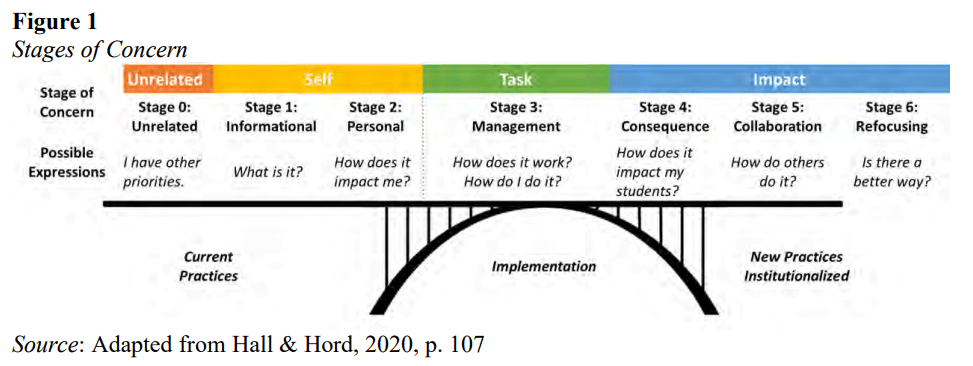
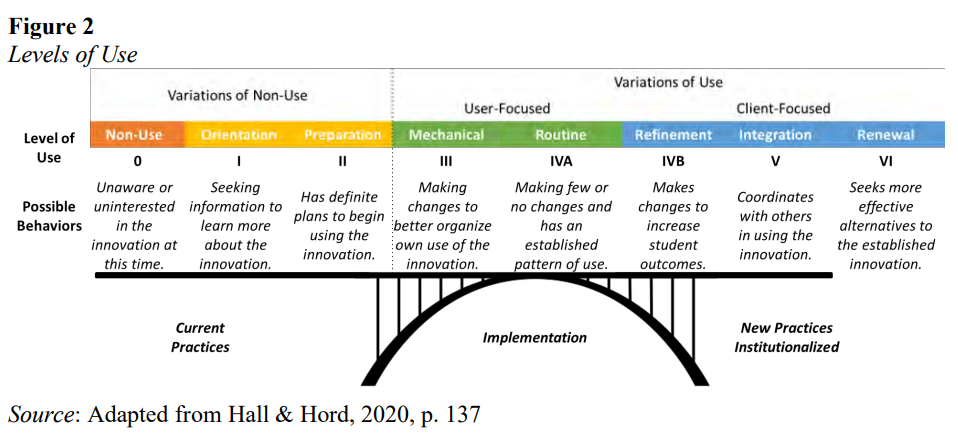
Stages of Concern and Levels of Use from the CBAM (Olson et al., 2020)
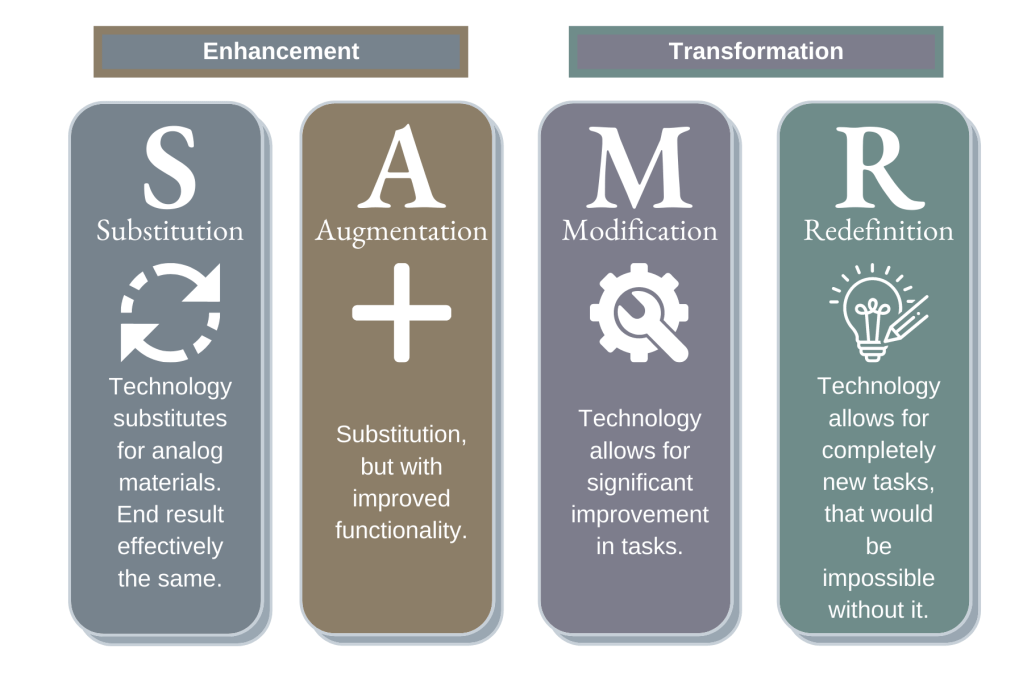
Also worth considering when planning teacher learning is Dr. Ruben Puentedura’s SAMR model.
These two models have been considered when designing personalized learning opportunities for the two fictional staff below.
Teacher A
Who is Teacher A?
Teacher A has been teaching Grade 7-9 students at Imaginary School for close to 40 years. Almost all that time has been spent as a math and science teacher. Generations of community families have had A as a math/science teacher and for the most part, students have all done the same assignments across that time. Their teaching style matches a more traditional lecture method, and many of the learning resources that they use for their courses have not changed dramatically over the decades – their motto being “if it’s not broke, don’t fix it.” Their walls are lined with out-of-date textbooks, from which they will still occasionally pull a page or two – last week we chatted in the office while they were photocopying from a textbook with a copyright date of 1984. All students in their classroom receive the same learning materials. Teacher A has strong classroom management skills and an engaging personality that helps them connect with students despite the sometimes-dry nature of their materials. While not an adept user of technology, A has shown significant growth over the pandemic, and it has made them more likely to incorporate what they know into their teaching. They have five laptops in their classroom that students use for basic research and typing up documents and making posters. When materials, resources and information are shared by e-mail, Teacher A does not respond.
Because of the sharing of project ideas between members of the Grade 7 and 9 Teams, small projects have been incorporated into most of the year’s science units, and students are expected to use digital resources to complete their research. Previously Teacher A reports using physical copies of encyclopedias that were in our collection, but since these materials have been weeded, they have not moved to their digital counterparts, and they are not using print resources in our general collection either. When asked, they were unable to identify any virtual resources. However, students are often left to ‘Google’ on their own, with little guidance on how to effectively find reliable information online or how to navigate various websites.
Evaluation
CBAM
In terms of ‘Stage of Concern’, Teacher A sits at the Awareness stage of development, as outside of the things that they know and are aware of, they have little interest in learning more about a resource.
Regarding their ‘Levels of Use of Innovation,’ they sit at the Non-Use level, showing no interest and action towards expanding their use of our reference collection.
SAMR
While Teacher A does have his students use technology in his classes it is usually done at the Substitution level, where students are simply typing up written work or collating materials for posters that will be printed out and displayed in the classroom.
Evolution Plan
Because presentations introducing materials or new technologies at staff meetings and occasional email updates have not pulled Teacher A towards freshening their practice, a more direct approach will be necessary. Based on my observations, our online encyclopedia subscriptions would be most useful, but pathfinders (Centeno, 2021) or other collections of materials may prove to be just as practical. Making a point to pop in and see the teacher during their prep time and discover what units and projects their students have upcoming is a first step to determining what parts of our reference collection will be useful to support them and their classes. Once this has been determined, I can provide them with a brief overview of what is in the collection that will be of best use to their students and offer to provide support for them and their students when it comes time to research by booking the library as a research space for their class. These small workshops using pre-existing assignments will provide an opportunity to tweak Teacher A’s practice without having them completely redesign their practice. These actions should help move Teacher A from the Non-Use level to the orientation level of CBAM’s eight Levels of Use.
While this assignment is regarding the Reference Collection, I think a similar model can be used to move Teacher A’s use of technology to a level of Augmentation. Because the teacher is not comfortable with technology themself, pulling a small group of students and providing instruction on a graphic design platform like Canva, which allows for embedding videos and other multimedia, could be a useful way to nudge them towards transforming their use of technology. Students can then present and share their projects and lead their peers in utilizing the technology on other assignments. I would also suggest the work of Fontichiaro to nudge A’s worksheets towards inquiry, without requiring a complete overhaul of their practice.
Teacher B
Teacher B has been teaching Grade 5/6 students at Imaginary School for the last 4 years, with several years of experience in other schools on term contracts previously. As a core teacher, they are responsible for teaching ELA, Social Studies, Science, Math, and Art. Teacher B is adventurous and willing to try new things without necessarily having proficiency in the skill themselves, and student learning is often guided by students’ own interests. While there are textbooks available to use in the classroom for Social Studies class, B does not use them often, as they find that they are often much too advanced for many students in the class to understand. Their class actively uses their small set of laptops and iPads, and frequently borrows from others as they need them over the course of each day. Teacher B reaches out to the Teacher-Librarian for collaboration and unit planning, often inviting them in for small group instruction or other lessons. Materials shared in staff meetings, PD, or emails are often seen incorporated into this teacher’s practice.
While aware of our digital encyclopedia collections, Teacher B had less awareness of other reference materials in our collection like CBC Curio, NFB Campus and teachingbooks.net
Evaluation
CBAM
In relation to the parts of reference collection they use and the CBAM ‘Stages of Concern’ Teacher B is at the Collaboration stage, where they are mostly comfortable with the resources but are considering how others are using these resources to improve their own practice.
In terms of ‘Levels of Use of Innovation’ they would be at the Routine level, where they are using the reference materials, they are aware of regularly but are making few changes to that use.
SAMR
I would assess Teacher B’s technology integration at the Redefinition level, where they are using technology to create transformative learning experiences like podcasts or multimedia presentations that would have been impossible (or much more difficult) 20 years ago.
Evolution Plan
Because Teacher B tries new things and collaborates frequently with their team, they will need less guided support to evolve their practice. One suggestion I have is to book a weekly collaboration time where B and I can discuss their current and upcoming needs and to co-assess student learning using our reference resources. What is working and what is not? What kinds of materials are we missing? Another suggestion is providing coverages, or requesting release time from administration, for Teacher Bs so that they can go and observe other teachers and their use of reference materials and technology. To raise awareness of the other reference materials in our collection, lunch and learn sessions can be provided to provide brief overviews of what these materials are and some short examples of ready-to-use activities utilizing them.
Olson, K., Lannan, K., Cumming, J., Macgillivary, H., & Richards, K. (2020). The concerns-based adoption model and strategic plan evaluation: Multiple methodologies to understand complex change. Theory and Practice, 31(3), 49–58. https://files.eric.ed.gov/fulltext/EJ1274351.pdf
Lesson 5, which focused on the reference interview, really stood out for me in Theme 2 and left me with lots to ponder. A reference interview is a conversation between a student and a librarian that helps determine what a student’s information needs are, and how to help students find resources that will meet their needs (Riedling & Harlow, 2019, p. 88).
Despite the fact that I do reference interviews every day with students, I hadn’t really ever sat down and thought about the process that I go through when completing them. If I had had to put together a list of my steps for helping students find information, I would have said the following:
01
The Warm Up
Ask students how I can help them, and what it is they are looking for. Look over any documentation that they have for an assignment together.
02
Background Knowledge
Determine what the student already knows about the topic, and what basic understanding is necessary for them to know what they are searching for.
03
Material Format
Inquire about a preference for format (book or digital) and guide them towards the one that will meet their needs the best; I find students often come in looking for a print resource when a digital one would be better suited for their needs.
04
Getting There
Assist student to navigate to the required resource, if available.
I see my role as scaffolding towards having students find the correct information for their purposes, so that in the future they can move towards independence. I found that the example steps provided in the Riedling & Harlow text seemed more like how to find the right information for the students, whereas my approach has generally been to teach students how to find that information; more teacher-librarian, than teacher-librarian, if that makes any sense.
One of the parts that I was glad to see mentioned, but that I didn’t put on my list specifically, was reading verbal (encouragements, rephrasing, open questions, etc.) and nonverbal (gestures, tones, posture etc.) cues to guide the reference interview (Riedling & Harlow, 2019, p. 92). It was a good reminder to be more patient in my responses to students and to make sure that I am focusing on what students need, rather than what I think they need. Being a clear and empathetic communicator is key.
As an aside, I think it’s important for us to be aware of the fact that non-verbal communication can vary in between cultures. While eye contact might be read as a sign that a student is comfortable and engaged in a conversation and is something that we would want to reflect back to the student, in others this is not the case, and it could make a student uncomfortable. For example, in many Indigenous cultures sustained eye contact is not seen as an expected part of communication; often residential school survivors were punished for not maintaining it (Indigenous Corporate Training Inc., 2012).
Eye contact can be a tricky part of communication
Lesson 5 also contained this standout quote from the readings which is worth repeating and recording for posterity:
“When not guided in the use of a process, students tend to approach research as if there is only one answer and fail to use information to construct their own meaning.”
We must help students realize that research is a process and not simply a checklist of answers to be found. The TL’s role in creating Information, Digital, and Media Literate Critical Thinkers cannot be underestimated.
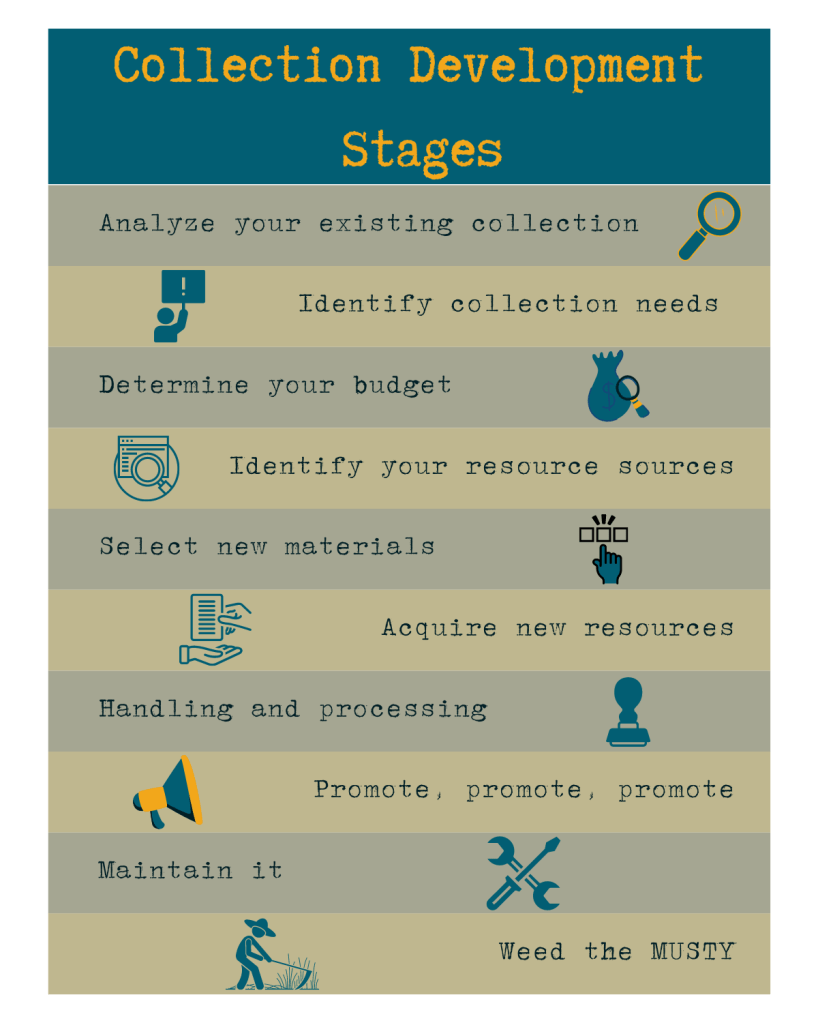
While I’ve spent most of my time discussing the first of the three lessons of this Theme, I will briefly touch on Managing and Evaluation. I feel like I am more aware of these topics because they have been covered in other courses that I have taken towards my diploma. Managing and Developing the Reference collection is done with a process that is parallel to the regular collection development process, although in my case I might be able to piggyback on different budgetary funds, and I would use the collection development stages set forth by Doiron (2002) to grow our collection (as cited in University of British Columbia, 2022).
Based upon the work of Doiron, 2002
In terms of Evaluation, I was struck by this quote from the BC ERAC document, that we
“must ensure that resources are easily accessible by staff and students. The format, cost, and number of learning resources, as well as the personnel and facilities available, will be factors in these decisions.”
(2008, p. 87)
Inspired by this, I will endeavor to survey staff and students on use of our existing digital collection, what materials they would like readily available for students in the library, and frequent topics of research. I think that this information will serve me well in planning for the development of our collection and ensuring that when students come to the library for resources I can point them towards the correct resources more regularly during the reference interview process.
A bonus discussion question
How do we balance the need for efficiencies and financial savings with the importance of supporting local businesses and the local economy?
Although this assignment was officially supposed to be about evaluating one reference material in our collection, and then suggesting how we could upgrade that resource, with our instructor’s support I have shifted my lens slightly. Instead, I will evaluate two digital reference encyclopedias that we have access to in the division in which I am employed; Encyclopedia Britannica School (EB) and World Book Online (WBO).
The division in which I work currently subscribes to two online reference encyclopedias that have completely replaced the gargantuan print copies that were weeded from our collection several years ago. Approximately 5 years ago (just at the beginning of my time in the library) the division moved from World Book Online to EB School as a way to reduce costs. We regained our World Book subscription recently, as part of a move to improve digital collections for online learning. Because we only recently obtained it, I am unfamiliar with World Book’s digital format.
The goal for what follows is not so much for me to promote one over the other, but rather to identify the unique benefits of both so that they can be communicate with the teachers in my division, and effectively used by both staff and students. For those with more limited budgets who stumble across my blog, this could also be used to determine which of the two is a better fit for your program.
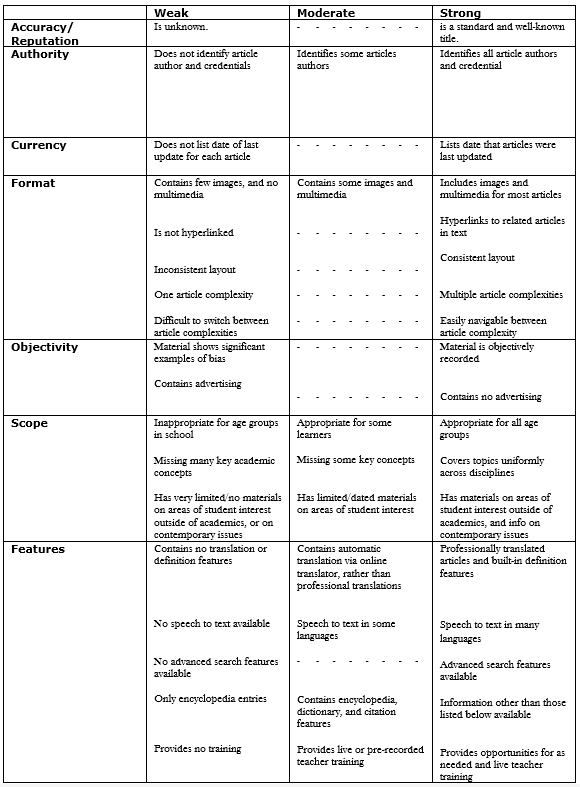
My evaluation of each will be informed by a rubric that has been inspired by Riedling and Houston’s evaluation and selection criteria for Encyclopedias. They suggest the following seven criteria:
Accuracy – is the material correct and well-reviewed?
Authority – who wrote the articles within the encyclopedias and what is their reputation (both publisher and author)?
Currency – how up to date is it?
Format – how is it designed?
Indexing – how do you find information
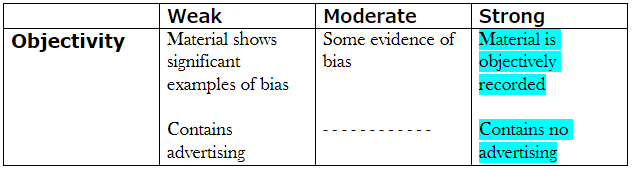
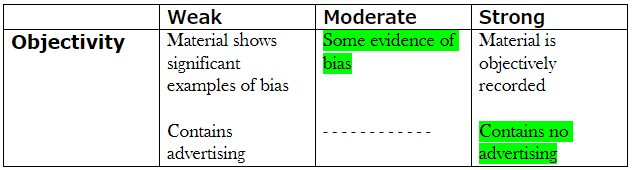
Objectivity – is the material biased, what is emphasized, excluded or not?
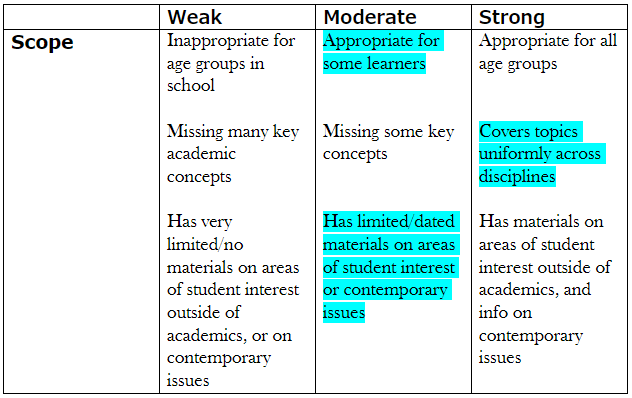
Scope – is it appropriate for its intended audience? (Riedling & Houston, 2019 pp. 66-67)
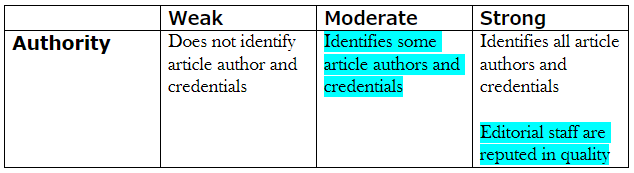
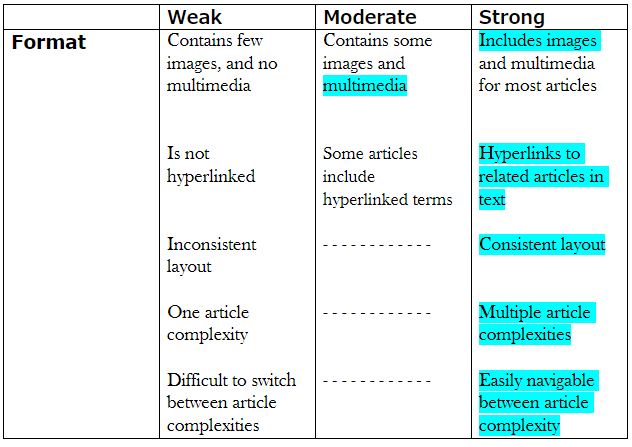
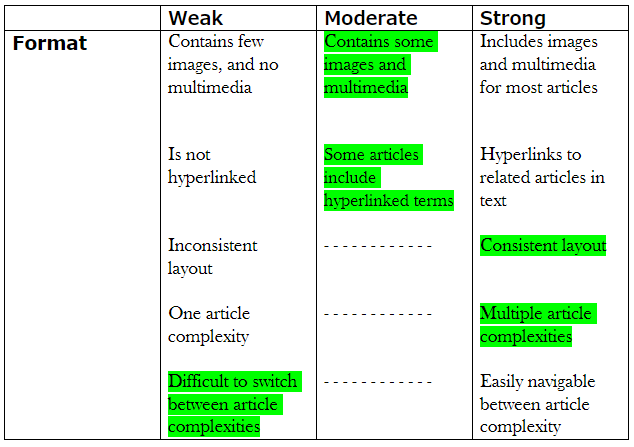
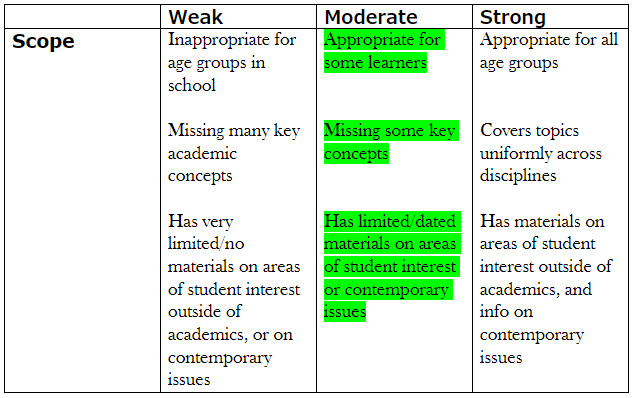
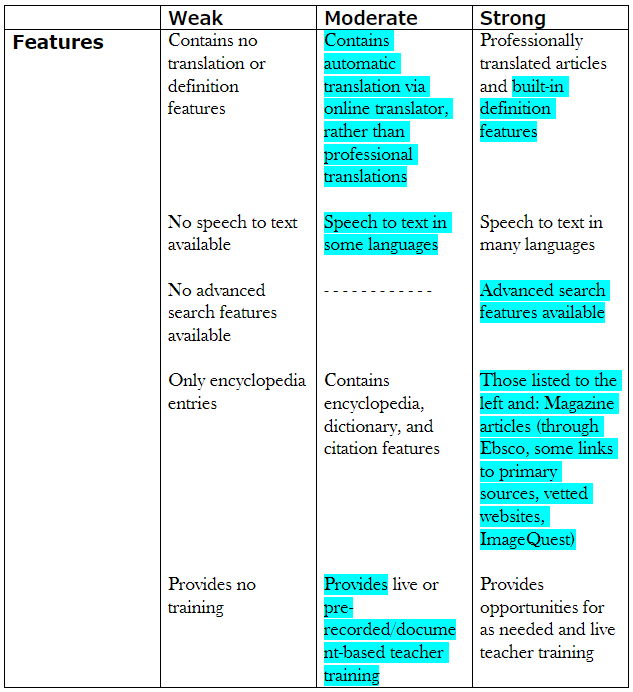
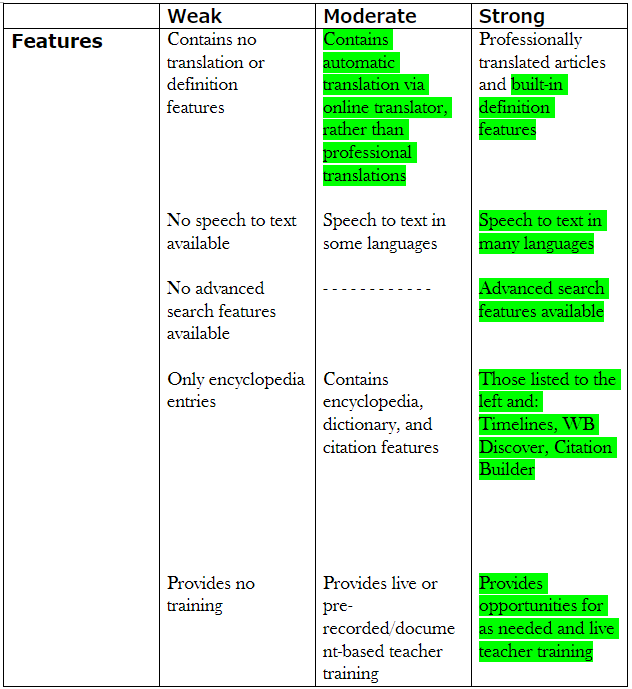
In my rubric below, you will see that I have subsumed the indexing criteria into a new criterion that I have called Features, a section that highlights many of the parts of digital encyclopedias that would be impossible in their analog counterparts. You’ll notice that some criteria only have weak and strong ratings – for these areas I have thought of this rubric as more of a checklist where they either have them or they don’t.
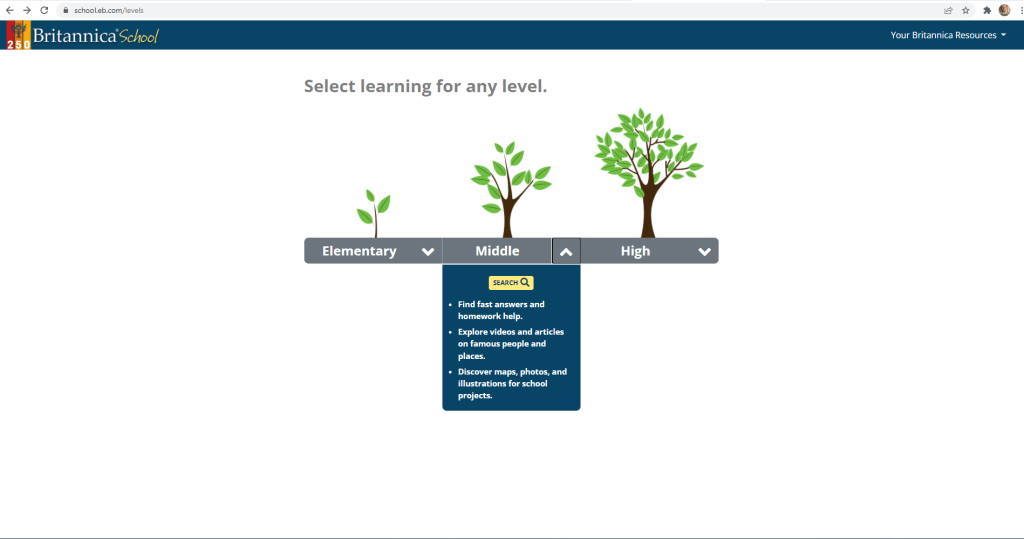
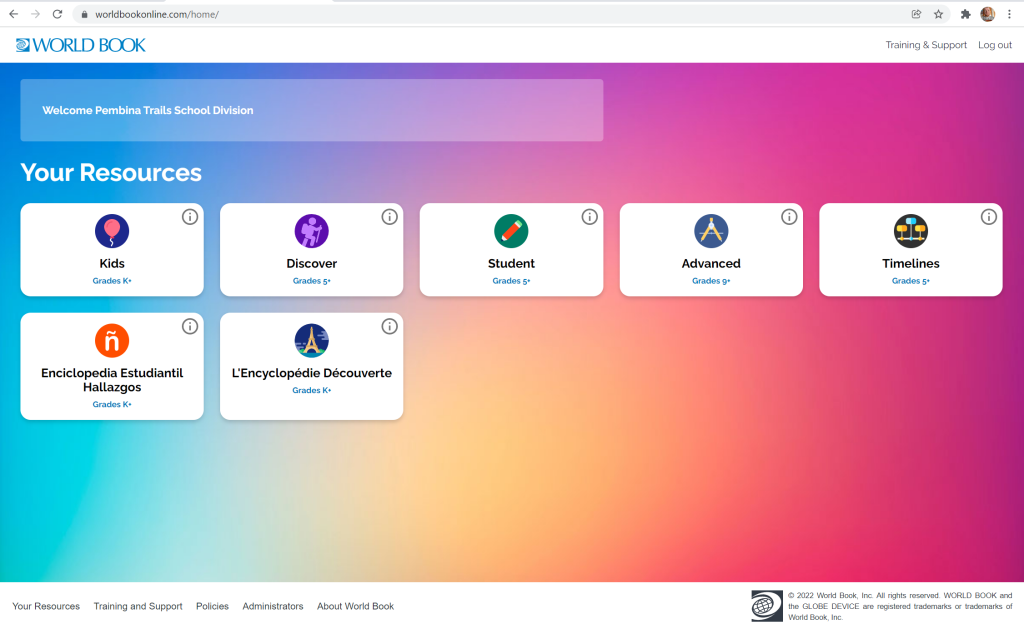
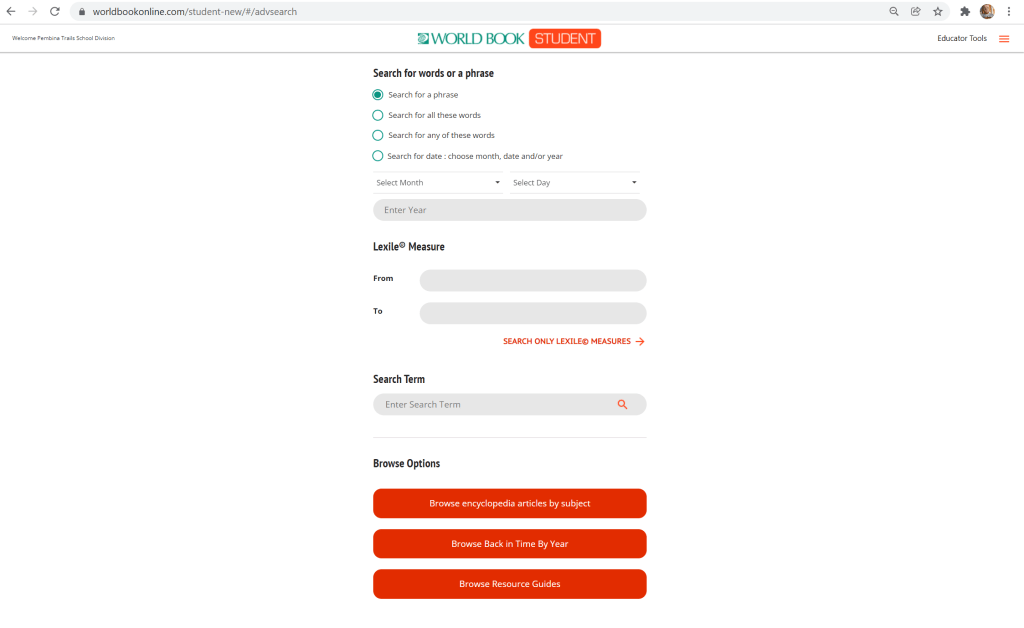
Both EB and WBO contain access to articles at 3 levels of increasing complexity. In the EB ecosystem, this is called Elementary (1), Middle (2), and Secondary (3), while in WBO, it is Kids, Student, and Advanced. The EB main pages allow for searching any level directly from this page, while the WBO one does not.
Access to other features is also available from these main pages:
EB
WBO
ImageQuest (rights cleared search database)
Discover (marketed as differentiated content resource)
Enciclopedia Moderna (Spanish)
Timeline Builder
Encyclopaedia Universalis Junior (French)
Enciclopedia Estudiantil Hallazgos (Spanish)
Encyclopaedia Universalis (French)
L’Encyclopédie Découverte (French)
A table of features contained within each digital ecosystem
Cost
There is a significant cost differential between the two online subscriptions. Our division, which has a student population of around 15000 students, and pays a per student cost for both subscriptions.
Encylopedia Britannica School has a total cost of $7 012 (an approximate cost of $0.47 per student).
World Book Online has a total cost of $15 834 (an approximate cost of $1.06 per student) (M. Carlos, personal communication, February 7, 2022)
The Analysis
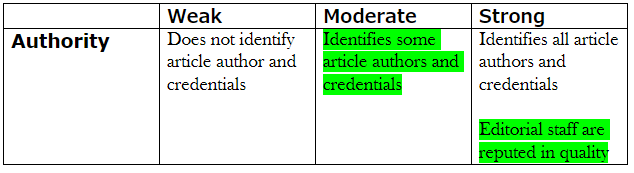
On each picture below, slide the bar up and down to see how EB School (blue) and World Book Online (green) were rated on each criterion.
Accuracy and Reputation
Both of these online encyclopedias have long histories and positive reputations. Britannica’s reputation leans a bit more scholarly than the World Book (Grossman, 2017), but its school version does not outwardly appear to be that way. This one is a coin toss.
Authority
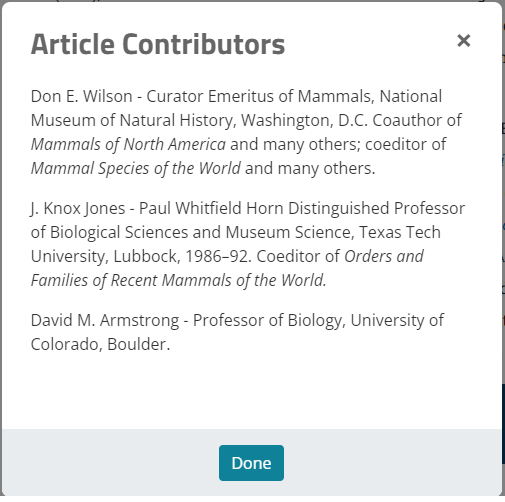
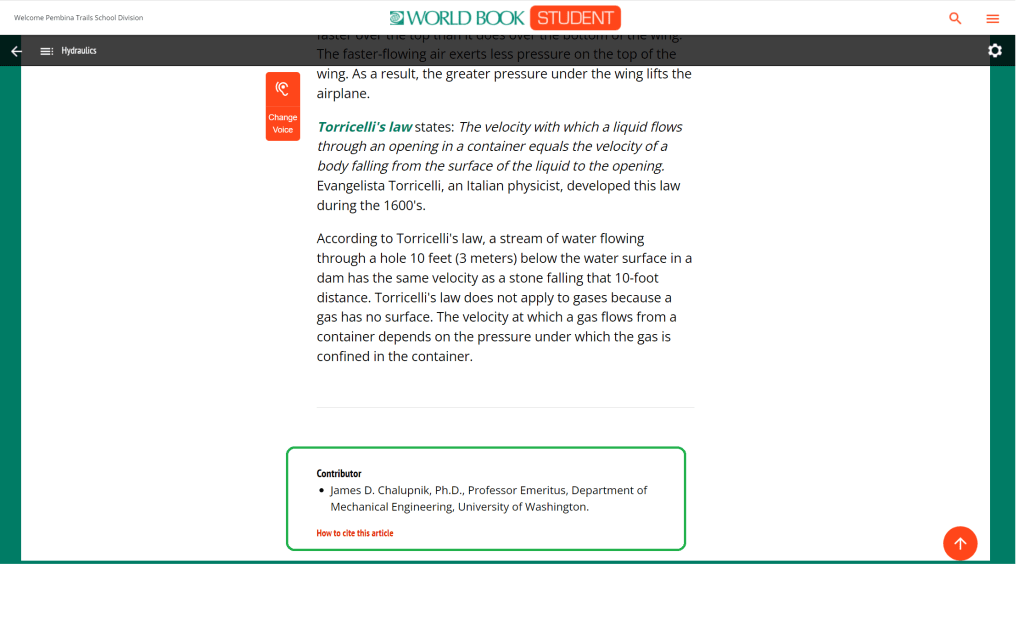
In terms of authority once again, there seems to be little significant difference. Both give author/contributor information for articles written at the most advanced levels, but do not at the Elementary/Kids ones. EB provides slightly more bio materials on the contributors, while WBO does it more consistently at the Middle/Student level. They are both homes to well-respected editorial staff.
Example article contributors listed for the EB School article on Mammals (left) and WBO entry on Hydraulics (right)
Currency
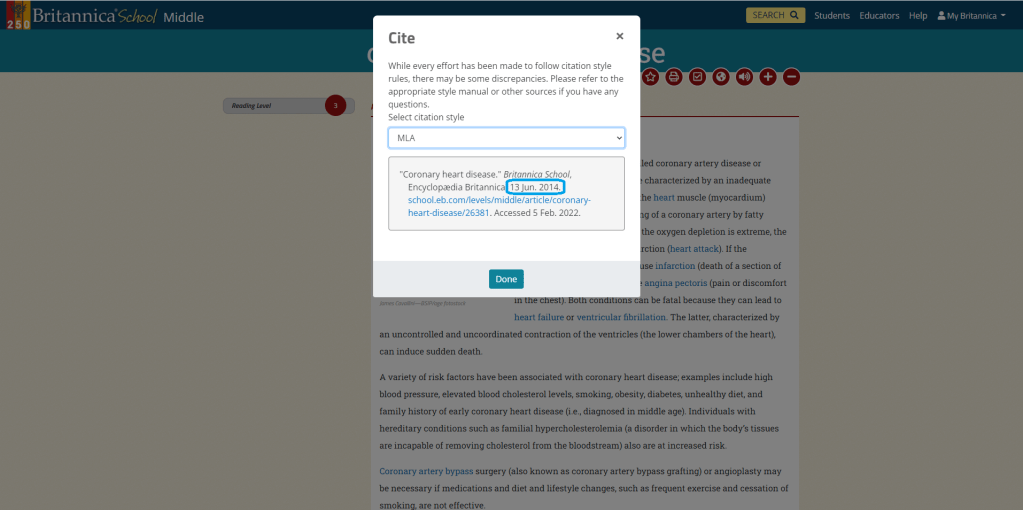
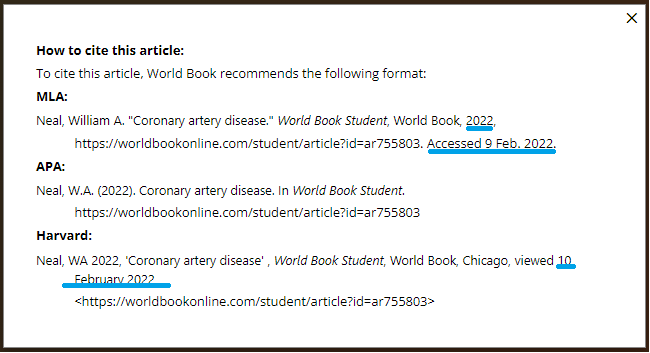
While all of the article citations I checked in WBO are listed as being from the year 2022, it is highly unlikely that they have updated their entire encyclopedia (or at least the 11 random curricular and student interest topics that I used for analyzing) in the one and a half months that have passed so far this year. All EB school entries that I checked, however, were marked with the date that the article was last updated. This is a layer of transparency that is necessary in a quickly changing world.
EB School clearly lists the last time an article was updated for each entry while WBO only lists the date accessed.
Format
The elementary layout of EB school has excellent ways of limiting distractions through the use of drop-downs.
Here Encyclopedia Britannica School gets the edge. Access to ImageQuest significantly improves media access compared World Book. Interestingly, while both have hyperlinks at the upper two levels of complexity, only EB does so at the lowest one. Perhaps this is meant as a way to reduce distractions, or as a way to ensure that the built in dictionary works on all words.
EB School also makes it significantly easier to level up and down through article complexities, which you can view in the video below.
Both of these encyclopedias have significant reputations, and I really debated how to rate World Book in this manner, but I took into consideration Riedling and Harlow’s recommendation to look into coverage of controversial topics (2019, p. 23). To test this, I searched for abortion, transgender, and capital punishment in both, and received the following results:
Topic
EB
WBO
abortion
* no article at Elementary level, balanced articles at Middle/High
* no article at Kids level, balanced articles at Student and Advanced levels
transgender
* articles at all levels
* no article at Kids level, the same article at both Student and Advanced
capital punishment
* articles at all levels
* no article at Kids level, balanced articles at Student and Advanced levels
Results for ‘controversial topics’ in both encyclopedias
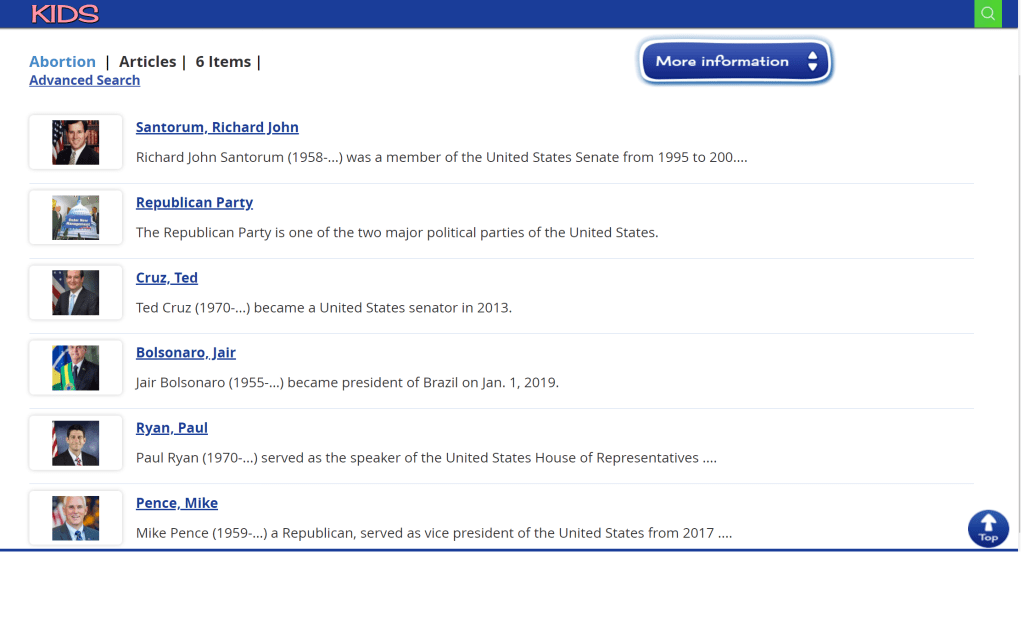
Interestingly, searching for abortion in World Book Online Kids does pull up results, but only to politicians and political parties that strongly oppose it. Also, EB School has an entry for World Book, but the reverse is not true (Encyclopedia Britannica School, 2016).
Results of a search on ‘abortion’ in World Book Online Kids
Scope
A non-existent article on human rights in the Kids level of the World Book Online is a concerning missing concept
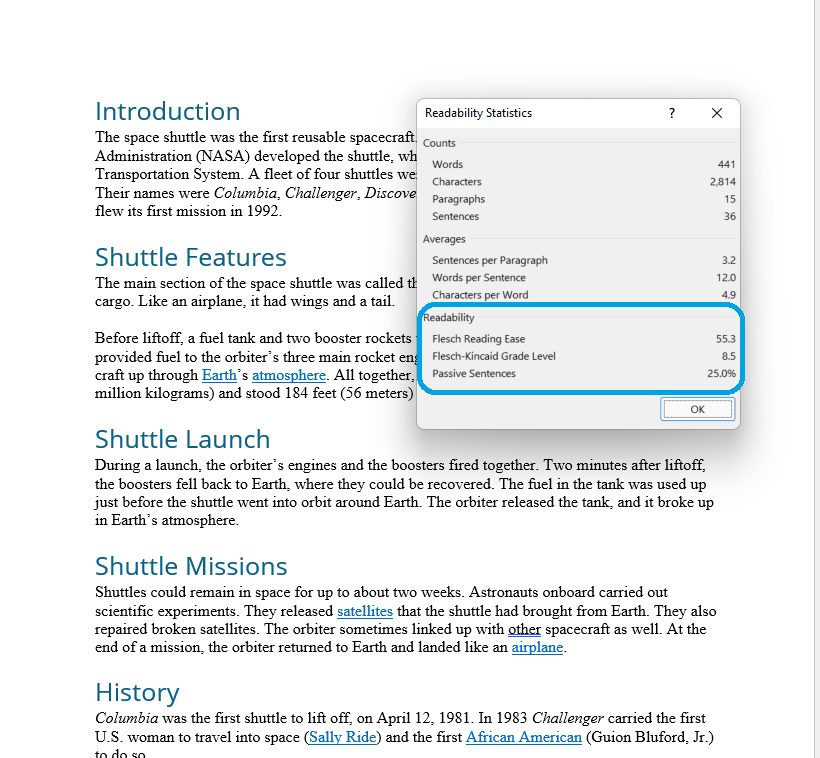
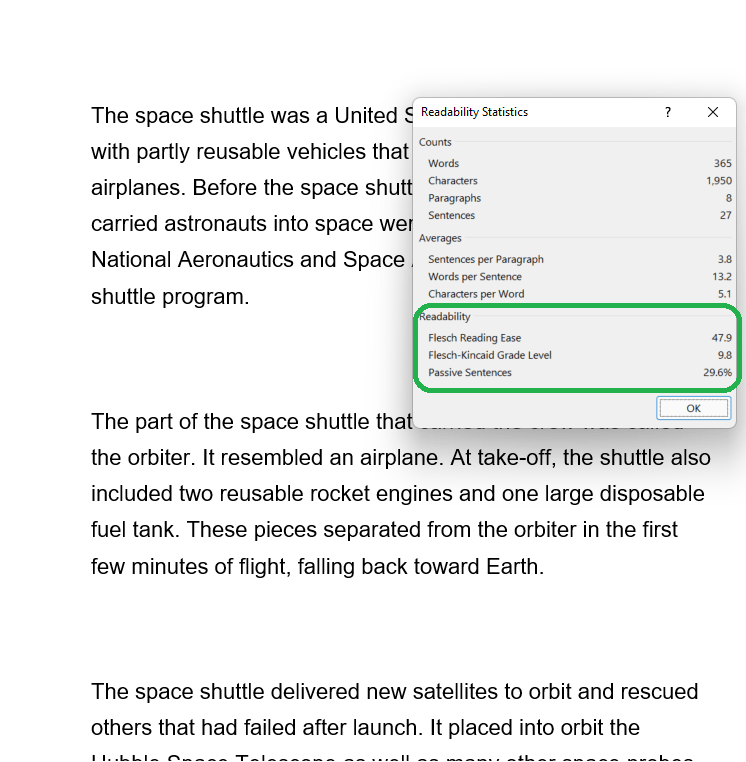
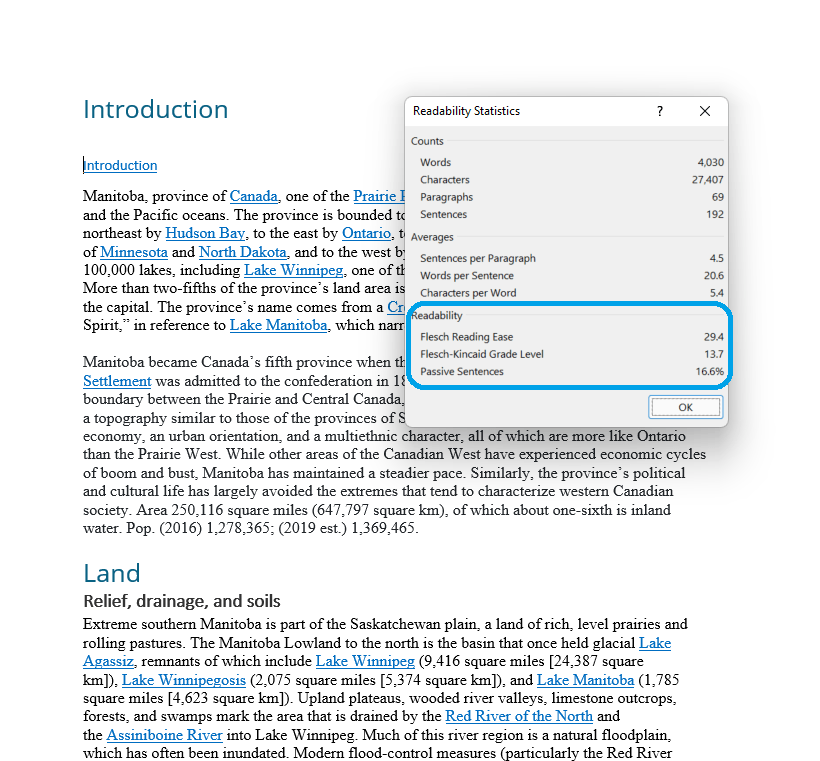
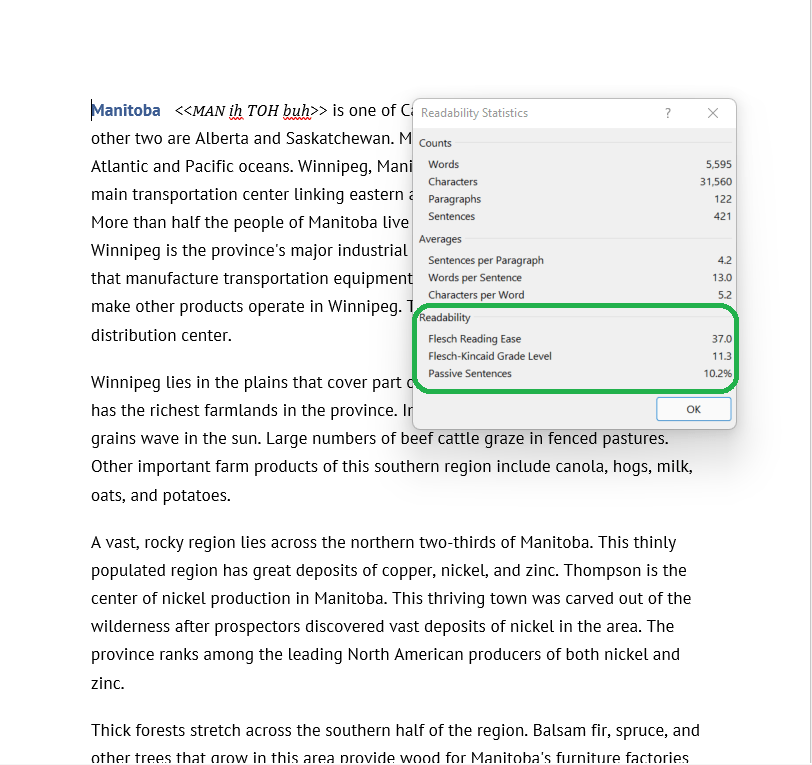
The biggest downside to both encyclopedias is that for a Grade 5-9 school, many of the articles contained within both are written at a level far outside of the independent range of younger learners. To test this, I copied and pasted encyclopedia articles out of both, and obtained readability statistics from Microsoft Word. Most materials, even from Elementary (EB) and Kids (WBO) levels were written at a Grade 8 or higher level.
Limited materials can be found on topics like Minecraft, Roblox, or k-pop artists BTS. This is not unusual for academic resources, but it is an area that could be expanded on to improve student engagement.
Features
In terms of features, World Book takes a slight edge, although it should be noted that some of them look at bit dated (like its world atlas). Teacher training is also a strength, with a much more utilitarian and useful support page – that includes videos and sign-ups for online seminars. Both offer translation features, but WB stands out as having more translations that are not reliant on computer translation programs, and the ability to have articles read aloud in languages other than English, Spanish, and French. The citation builder available in World Book is another feature that EB does not have (it only provides citations for the articles and materials found within it), but it isn’t especially user friendly or utilitarian, especially when compared to free online options like mybib.
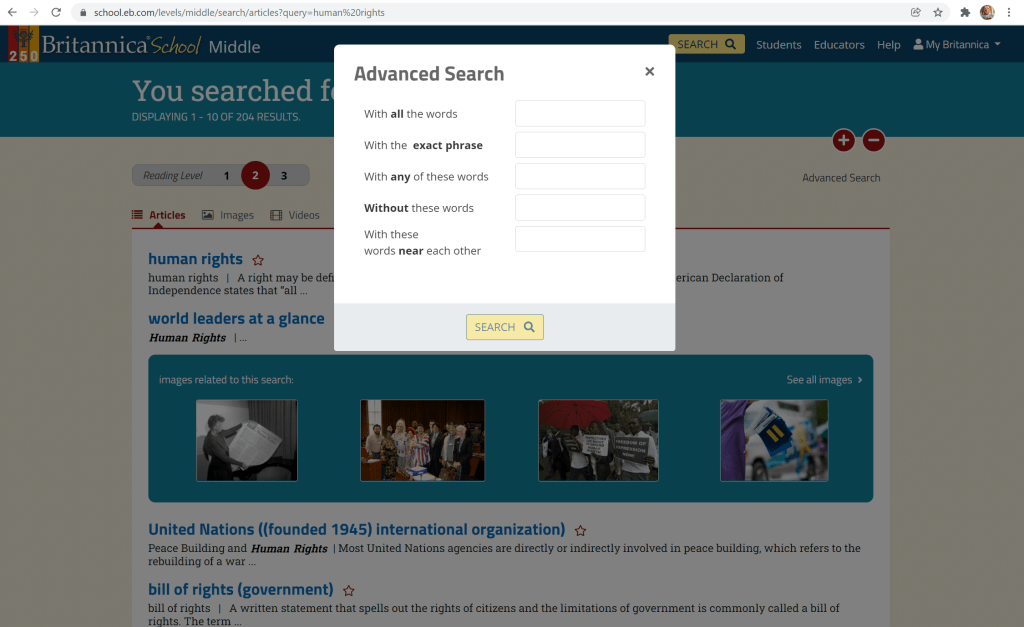
No sound for the first 10 seconds or so, it’s not your speakers! Video at https://youtu.be/FuD05S6alRsWorld Book also gives more advanced Advanced Search options, a definite benefit especially in the upper middle and senior years.
Reflection
Both of these sources are highly reputable and well respected sources of encyclopedic information. I am thankful that our students have access to both, as between the two we have significant coverage of both curricular and student interest topics, although there is room for improvement in both. EB’s ease of use and the simplicity of jumping between entry complexities, and World Book’s Translations and Voice features and advanced search functions are strengths of both that are all helpful for student differentiation and lacking in the other. While the articles themselves are quite balanced and bias free, I do worry about the search bias, and bias of omission that is shown in World Book results. Ultimately, it seems to me that Encyclopedia Britannica School comes out as a significantly better value for money, especially in a elementary or middle school where some of the pricey features that differentiate between the two are less useful.
References
Carlos, M. (2022, February 7). Question for assignment! [Email to Morgan Arksey].
The following blog post will go over my main takeaways and thoughts from the first theme of LIBE 467, which has focused on an introduction to reference services, the reference process, formats of reference materials, and their evaluation.
School Libraries build many things. This gif courtesy of gify
I’m fairly certain that if you scroll back long enough on this very blog that you will find I’ve used a version of this title before, along with another image from the 1989 film Field of Dreams; a reference that will be lost on even some students in LIBE 467 and definitely on the students that I teach daily. Regardless, all you need to know for the purposes of this blog post is its famous quote “if you build it, he will come.”
For the purposes of this metaphor, he is a strong library program.
But when it comes to libraries, what is it? I’d argue the following:
Community
Love of reading and learning
Information literacy
Digital literacy
Media literacy
Collections of multimodal resources in both physical and digital forms
Safe spaces and refuges
Access points for technology
Places to make and create
The foundations for academic rigor and integrity
Many of these require access to a reference collection, while others are necessary for the successful use of one. These things don’t just magically manifest, they must be nurtured and curated mindfully and purposefully. And sometimes, they need to be rebuilt. Or at least renovated.
The digital age has especially necessitated that for our reference collections, and this course has been a welcome reminder of the work that needs to be done to support the information literacy and research needs of students.
Something to rebuild – Achieving Information Literacy
A lot has changed in the world of reference since Achieving Information Literacy was reprinted in the year 2006. I think that it is time that this document was re-imagined for what is in many ways an entirely different world. (For reference, the original version of this document sits on a timeline closer to Field of Dreams than it does to today). Advocating for budgets and funds can be an extremely challenging process, and pointing to criteria and figures from 16-19 years ago does little to support our requests. Some things that used to be the domain of the school librarian have often become the purview of dedicated divisional departments, like what computer software is installed on library computers; especially with the rise of web-based subscription applications. It would be useful to have new guideposts to inform our planning.
Something to renovate – our library’s reference collection
The reference collection in our library doesn’t need to start again from square one, but it could use some renovation. Whether I aim to meet the standards set out in Achieving Information Literacy (AIL)or not, our non-fiction print curricular materials are not being pulled by Teachers like they were even 5 years ago, and a lot of our print reference collection has been weeded. We have some digital materials, but not enough to meet AIL criteria. But what does it mean to have a well built reference collection?
“libraries build collections based on what they think faculty and students need”
(Riedling & Houston, 2019, p. 4)
I wish I could reword this quote to say that we build collections based on what we know they need, because we have given them a voice in our space, and we are aware of what topics students are inquiring on and how they are gathering that information. It is not that we are experts that know best, but rather an active and reflective part of our school community. This ties in with Riedling & Houston’s outline of what reference services includes
defining the information needs of clientele
creating collaborative culture
student education on access
assessing resources
(2019, p. 2). Indeed, it seems like a reference collection is as much about knowing your clientele, how to access, and how to interpret and build knowledge from the resources as it is about the resources themselves. Without considering these factors, you could have an excellent reference collection, that holds little value.
Ultimately, the following definition of reference materials is all encompassing:
“a good reference source is one that serves to answer a question”
(Riedling & Houston, 2019, p. 16)
.. but I’m still left with the feeling that it needs to be combined with the ideas of a good reference service to truly meet the needs of a library.
I am thankful for the opportunities this course will allow to evaluate sources and more closely work with peers to make our reference collection more relevant to both our curriculum and our student body.
Rebuilding for all
Finally, I’ll be heavily relying on Riedling & Houston’s identified Evaluation Process for Assignment 1, which includes the following:
Content Scope
Accuracy, Authority, and Bias
Arrangement and Presentation
Relation to similar works
Timeliness and Permanence
Accessibility/Diversity
Cost (2019, pp. 23-25)
My gut instinct is that in working with a teacher for Assignment 2 that Accessibility/Diversity will be especially important. I wonder if this will be challenging. Between our physical collection, ILL availability, and our digital materials access is not so much an issue, but rather the accessibility of that information to the ones that need it the most. What is the place of manipulatives and other multimodal representations in the reference collection? Can a podcast be reference? Are their databases that are truly embracing video and audio formats, or significantly reduced readability materials for ELL students with limited prior schooling?
I look forward to investigating this further, and rebuilding a reference collection that reflects the needs of my community.
Bonus video (from a YouTube hole I fell down while reading/viewing more about accessibility)
Allister Chang from Libraries Without Borders talks about Access and Accessibility to information issues in terms of public libraries.
References
Canadian Association for School Libraries. (2006). Achieving information literacy: Standards for school library programs in Canada (M. Asselin, J. L. Branch, & D. Oberg, Eds.). http://accessola2.com/SLIC-Site/slic/ail110217.pdf
Riedling, A. M., & Houston, C. (2019). Reference skills for the school librarian : tools and tips. Libraries Unlimited.
It’s been awhile since I last posted. I am unaware if anyone even lurks here. I completed this as my final assignment for the Introduction to Children’s Literature Course I took last fall, and it might as well see other eyes than my own. I built it using Adobe Spark, which was new for me and it contains my favourite reads from last fall. All would be appropriate for a Middle School/Junior High library.
My Final Vision project is a guide to digital storytelling, which stayed true to my brainstormed outline, which you can read in my last post here. Most of it is a curated list of apps and resources, but the most significant portion of the project ended up being an approximately 5 minute video that I storyboarded, filmed, found sound effects/music, and recorded voice-overs for.
There were two major changes from my initial vision for the project. The first was that I had initially wanted to use Adobe Spark Page to compile the guide, as I hadn’t worked with it before and I thought it would be suitable. The more I worked with it, though, the more I realized that it wasn’t ideal for a project of this size; it provided no way to jump between sections of the page. I was worried that this would decrease the accessibility and ease of use, so I made a mid-project move to Microsoft Sway. Sway has a feature that allows you to jump from heading to heading in the document that works well on both computers and devices with touch and non-touch screens, and when I sent examples of both to friends, the Sway version always won.
Secondly, I had said that I was going to use the simpler Adobe Spark Video editor to compile my how-to video. While I think that the production value might have been nicer if I had stuck to that model, there were many features that I could not get access to (like having the capability for 2-3 audio files at a time and autokey for green screen , for example). And thus, I decided to bring out Adobe Premiere Pro – which I had never used before last week. Fortunately, there are officially YouTube tutorials for E V E R Y T H I N G and although I could hardly upload a clip into a sequence at first and spent 20 minutes trying to unlink video and audio files from one another, by the end I felt… moderately successful. I learned some important lessons about ensuring consistent screen size between video clips that will come in handy the next time I do this. It was a big project – but I wasn’t going anywhere last week (spring break here in Manitoba, on top of school being suspended) so what else was I going to do?
I am thankful for the opportunity to be able to play with and try out some technology and tech skills I had never personally used before. This included time-lapse video, trying out the new Samson Meteor Mics that I got for a podcasting station at school, and green screens. It was overwhelming to look through all the apps and programs that are out there that could be used for digital storytelling. Ultimately, I tried to keep my recommendations limited to an entry level + a slightly more complex option for most types of apps. There are still so many things that I could have/maybe should have listed. However, I tell myself that this project can be updated as I find new and wonderful things to try. If you have any suggestions, I’m all ears!
Below you will find a video that shows you how you can navigate through my project from section to section. I think that it’s best viewed from start to finish, but if you are returning to refer to a specific resource – the navigation is handy.
If you don’t want to read my entire project and just want to skip to the good stuff, this vid’s for you!
The cornerstone of the project is definitely my how-to video, but there are other videos to check out. The ones in the app section are simply to give a bit more background into some of the apps. I do recommend watching the example projects at the end. I’m pretty fond of those. So… without further ado here’s my project:
If you know someone who could use it – send it their way 🙂
If you’d rather just watch the digital story about digital storytelling that I made, you can just watch the video below.
I learned that video editing is hard.
It’s been a pleasure getting to know and work with you all over the last several months. Although I probably won’t see you at any PD (unless you’re making a trip to Manitoba), I look forward to keeping an eye on your blogs and Twitter feeds. Until then. To those of you who are done your course work – congrats!
All the best, keep your distance and wash your hands,











 themarksey blog
