What are common threads of humanity, and how do we keep them in education?
Growing up in small-town Manitoba, my K-5 education was not really so far removed from what my parents received. Sure, I didn’t start my schooling in a one room schoolhouse, as my parents did, but the teacher who taught my dad Grade Three was still around to teach me Grade Three-Four-and-Five in a seven-room schoolhouse. The main differences between my schooling and that of my parents were that:
- The teachers had access to a photocopier.
- The school had a TV on a cart, and you knew it was going to be a good day when they rolled that beauty into your room to watch Telefrancais and that weird pineapple told us he was a pineapple.
- There were only three grades in a classroom instead of eight.
Otherwise, most of how we were taught was pretty much the same – right down to Mrs. Johnson, the teacher. Spelling tests, World Book Encyclopedias, the rote memorization of facts, and learning that (for the most part) never left the four walls of our classroom.
The world has changed a lot since then, probably triggered by the fact that Mrs. Johnson retired.
I jest.
But more seriously, these changes are often the topics and areas that I am drawn to in terms of education. They are also topics that I imagine becoming focus points in education in the coming years. And many of them couldn’t even have been imagined 25 years ago. Some of them probably can’t even be imagined now.
My interests
Unlike the classroom of my childhood, where the computers in the school were the only computers anyone really had access to, today not everyone has the same access to resources. I see a growing divide in classrooms between those who have access to their own top-of-the-line devices, and those who are limited to the often lagging or broken laptops and other technological tools provided by the school. Significant access issues also exist between urban, rural and northern communities – leaving 10% of Canada’s population without high speed internet access according to a 2018 Auditor General’s report.
I see educator’s struggling to bridge the divide between older curriculums and expectations that are very fact heavy and outcome-based, the need to quantify student learning with a mark, and providing students with the opportunity for deep-learning which is so very difficult to boil down to a number. And frankly, that number or mark-based assessment ends up missing the point and not accurately representing the learning and growth made by students. When curriculums are shifting and changing with the times (like the New Grade k-8 ela curriculum in manitoba, which focuses heavily on digital literacies).
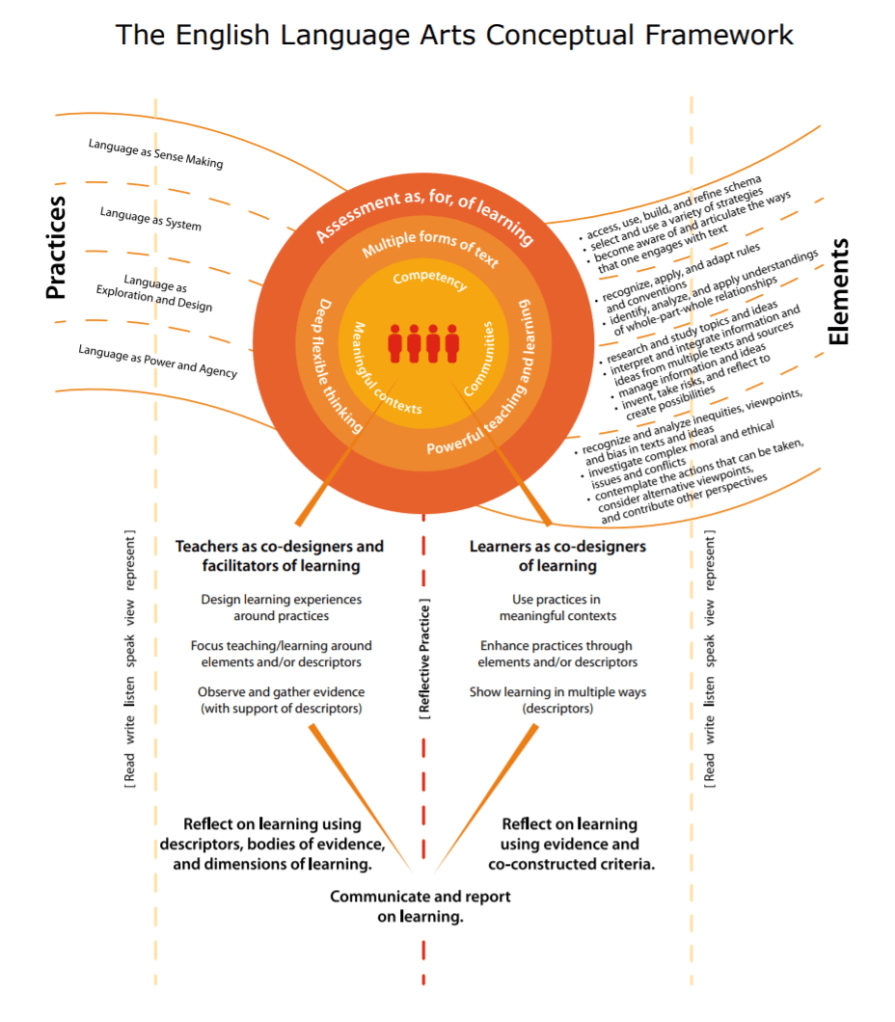
Manitoba Education. (2019, October). English Language Arts Curriculum Framework: A Living Document. Retrieved January 7, 2020, from https://www.edu.gov.mb.ca/k12/cur/ela/framework/foundations.pdf
I see teachers struggling to make the shift between teaching outcomes in isolation and a more holistic view of learning. I would argue that there is significant room for improvement in how we teach students skills and strategies to help with Cognitive load management as they juggle between countless tabs and windows while bombarded by advertisements and the pull towards other tasks that release way more dopamine into their developing brains.
I see plenty of opportunity to connect with students around the world and to provide students with an audience well beyond the snowy city of Winnipeg, and opportunities to develop cross-cultural competency. The growth and development of empathy and understanding among people of different life experiences can hopefully come from these opportunities.
I am interested in multi-modalities and the multitude of ways we now have available to teach and share concepts with teachers and students. Digital storytelling and apps are an interest that ties in with this concept. I have a pet student ‘writing’ project in the library called The Write Company, and I’m really interested in growing its audience beyond staff and parents. I’ve been using Sway in Office365 for its production but am interested in all of the different Adobe Spark products, which I have not used yet; although we have access to themthrough a division subscription. I’m interested in expanding The Write Company to include different forms of writing, like digital multimedia and student projects. Check out our first issue this school here!
And although sometimes I worry that we have moved too far past the point of no return on this topic, I’m interested in open source technologies, especially ones that aren’t limited to top of the line devices that need to be replaced every three years or the operating system is no longer updated/supported. Applications or programs that run across various operating systems would also be an interest.
I’m also interested in learning about how data from schools is used by major corporations such as Google and Microsoft.
School, divisional and provincial considerations
I teach in a Middle School/Junior High setting, so my interest would mainly be skewed to that age category – although I am always interested in seeing what elementary schools are up to because then we can scaffold and build on skills and strategies.
The division I teach in has a Standards for Success in Literacy document that has been a focus for professional development over the past several years. This tied in with a trial project at the Grade Four and Seven levels that has seen small sets of Microsoft tablets put in these grade level classrooms.
The division is also currently in the process of phasing out computer labs in K-8 learning environments. Laptop carts are also being slowly removed, and each homeroom is receiving six laptops. I hope that my exploration can some way assist teachers pedagogically as they move to a more Project Based and Inquiry learning model. This also needs to be kept in mind, because I am predicting that students will rely on their own personal devices more frequently under the new model, so using apps and programs that work across various Operating Systems is important. The 5-6 classrooms also have small banks of iPads, and there is a larger set that can be booked out of the library for all classes.
I am fortunate to have a flexible schedule, which is great because the things that I explore with can be brought back into classrooms in project blocks with individual classrooms. What I choose to research should fit within this model.
Potential Topics
Ultimately, because of school and division priority, my own personal interests, and the weighing of tech accessibility in classrooms, I am leaning towards a focus on digital storytelling. This topic lends itself to collaborative group projects, as a multitude of skills are necessary to complete a final project. I think that this fits very nicely with the new ELA curriculum in Manitoba, will give me the opportunity to support teachers in using new apps and can be tied together with Project Based and Inquiry Learning, and allows for the integration of multi-modalities. Because projects are digital in nature, I would like to learn about using Twitter as a tool to connect with others. I would also like this to tie in with skills regarding cognitive-load management that I could teach to students and teachers while working on projects.
Search Terms
- Benefits of digital storytelling
- Multimodal digital storytelling
- Empathy and storytelling
- Empathy development and technology
- Storytelling apps
- Digital storytelling tools
- Cognitive Load Management theory and skills
- Open source educational software
Upon reflecting on this process, I think it is interesting that I have narrowed my focus down to some topics that are definitely very far removed from the classroom of my childhood. But yet, the common thread that holds these things together is something that has followed humanity since the beginning of language – stories. I think that finding a way to connect these new skills and technologies to something so integral and ingrained in our history is a way for us to use these technologies and skills in meaningful and important ways.
Sources Referenced
Government of Canada, Office of the Auditor General of Canada. (2018). Report 1-Connectivity in Rural and Remote Areas. Retrieved January 15, 2020, from https://www.oag-bvg.gc.ca/internet/English/parl_oag_201811_01_e_43199.html
Manitoba Education. (2019, October). English Language Arts Curriculum Framework: A Living Document. Retrieved January 7, 2020, from https://www.edu.gov.mb.ca/k12/cur/ela/framework/foundations.pdf
Pembina Trails School Division. (n.d.). Standards for Success in Literacy. Retrieved January 15, 2020, from https://www.pembinatrails.ca/Documents/Literacy Standards Brochure.pdf
Cover Image Source
Schoolhouse in Nebraska. [Photograph]. Retrieved from Encyclopædia Britannica ImageQuest.
https://quest.eb.com/search/139_1904308/1/139_1904308/cite
 themarksey blog
This is a thoughtful and well-articulated post. It is evident that you are passionate about the themes you have identified and this will help you create a strong Final Vision of the Future Digital Artifact. The narrative structure of your post engages your reader and your multimedia elements (videos, images, links) further enhanced your discussion.
LikeLike