
And every resource, its learner
Lesson 5, which focused on the reference interview, really stood out for me in Theme 2 and left me with lots to ponder. A reference interview is a conversation between a student and a librarian that helps determine what a student’s information needs are, and how to help students find resources that will meet their needs (Riedling & Harlow, 2019, p. 88).
Despite the fact that I do reference interviews every day with students, I hadn’t really ever sat down and thought about the process that I go through when completing them. If I had had to put together a list of my steps for helping students find information, I would have said the following:
01
The Warm Up
Ask students how I can help them, and what it is they are looking for. Look over any documentation that they have for an assignment together.
02
Background Knowledge
Determine what the student already knows about the topic, and what basic understanding is necessary for them to know what they are searching for.
03
Material Format
Inquire about a preference for format (book or digital) and guide them towards the one that will meet their needs the best; I find students often come in looking for a print resource when a digital one would be better suited for their needs.
04
Getting There
Assist student to navigate to the required resource, if available.
I see my role as scaffolding towards having students find the correct information for their purposes, so that in the future they can move towards independence. I found that the example steps provided in the Riedling & Harlow text seemed more like how to find the right information for the students, whereas my approach has generally been to teach students how to find that information; more teacher-librarian, than teacher-librarian, if that makes any sense.
One of the parts that I was glad to see mentioned, but that I didn’t put on my list specifically, was reading verbal (encouragements, rephrasing, open questions, etc.) and nonverbal (gestures, tones, posture etc.) cues to guide the reference interview (Riedling & Harlow, 2019, p. 92). It was a good reminder to be more patient in my responses to students and to make sure that I am focusing on what students need, rather than what I think they need. Being a clear and empathetic communicator is key.
As an aside, I think it’s important for us to be aware of the fact that non-verbal communication can vary in between cultures. While eye contact might be read as a sign that a student is comfortable and engaged in a conversation and is something that we would want to reflect back to the student, in others this is not the case, and it could make a student uncomfortable. For example, in many Indigenous cultures sustained eye contact is not seen as an expected part of communication; often residential school survivors were punished for not maintaining it (Indigenous Corporate Training Inc., 2012).
Lesson 5 also contained this standout quote from the readings which is worth repeating and recording for posterity:
“When not guided in the use of a process, students tend to approach research as if there is only one answer and fail to use information to construct their own meaning.”
(Kuhlthau in Russell, 2001)
We must help students realize that research is a process and not simply a checklist of answers to be found. The TL’s role in creating Information, Digital, and Media Literate Critical Thinkers cannot be underestimated.
While I’ve spent most of my time discussing the first of the three lessons of this Theme, I will briefly touch on Managing and Evaluation. I feel like I am more aware of these topics because they have been covered in other courses that I have taken towards my diploma. Managing and Developing the Reference collection is done with a process that is parallel to the regular collection development process, although in my case I might be able to piggyback on different budgetary funds, and I would use the collection development stages set forth by Doiron (2002) to grow our collection (as cited in University of British Columbia, 2022).
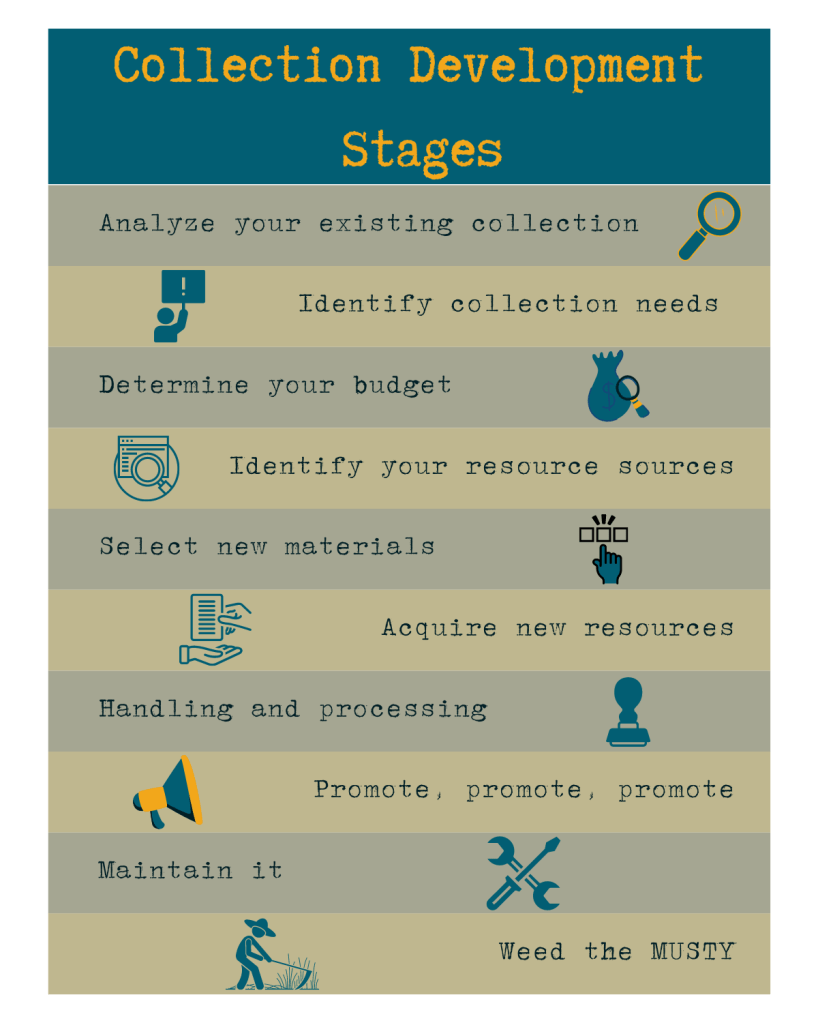
In terms of Evaluation, I was struck by this quote from the BC ERAC document, that we
“must ensure that resources are easily accessible by staff and students. The format, cost, and number of learning resources, as well as the personnel and facilities available, will be factors in these decisions.”
(2008, p. 87)
Inspired by this, I will endeavor to survey staff and students on use of our existing digital collection, what materials they would like readily available for students in the library, and frequent topics of research. I think that this information will serve me well in planning for the development of our collection and ensuring that when students come to the library for resources I can point them towards the correct resources more regularly during the reference interview process.
A bonus discussion question
How do we balance the need for efficiencies and financial savings with the importance of supporting local businesses and the local economy?
References
BC Educational Resources Acquisition Consortium. (2008). Evaluating, selecting and acquiring learning resources: A guide. https://bctla.ca/wp-content/uploads/2018/02/erac_wb.pdf
Indigenous Corporate Training Inc. (2012). Eye contact and Aboriginal Peoples. Ictinc.ca. https://www.ictinc.ca/blog/eye-contact-and-aboriginal-peoples
Riedling, A. M., & Houston, C. (2019). Reference skills for the school librarian : tools and tips. Libraries Unlimited.
University of British Columbia. (2022) “Lesson 6: Managing the Reference Collection”. UBC Canvas.
 themarksey blog