; the cell phone as printing press
When I first sat and pondered this week’s blog topic, I was reminded of the ‘charitable’ practice of donating used clothing. According to this 2018 CBC News article, 80–90 percent of clothing donated in Canada isn’t being resold here. Some is cut into rags, others ground down into upholstery filler, but the majority is packaged up to the developing world where it is sold. The issue with this is that this is the end of the line of the re-use cycle, as once they end up in these countries the clothing will inevitably end up in a landfill. Another issue is that these donations and second-hand goods end up suppressing the textile industries in these countries – industries that would offer citizens good paying jobs and the promise of economic development (Jay, 2018). Thus, these donations end up empowering the developed world (the United States economy is benefitted over $680 million each year from used clothing exports) while the economies of importers get access to cheap clothing, but at a developmental impact. Several decades ago, almost half a million Kenyans worked in the garment industry – in 2017, only approximately 20,000 of those jobs remained (Harden, 2019).
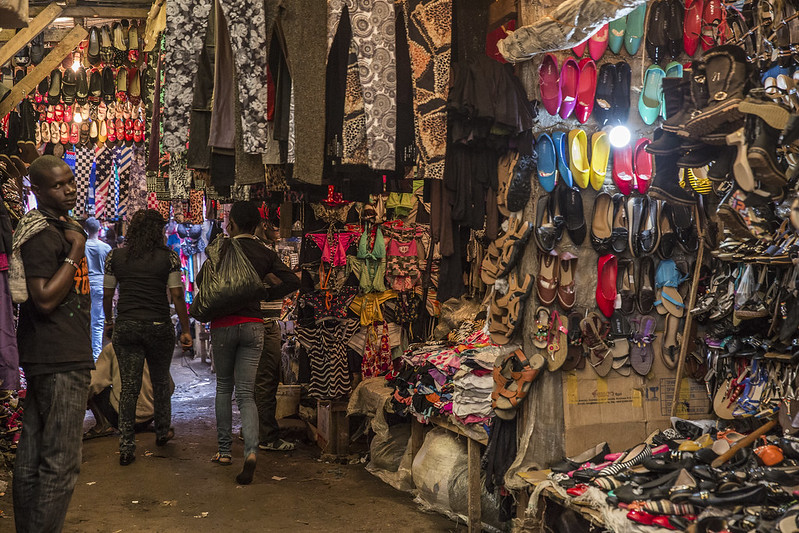
Weeded donations – good deed, or pushing garbage onto others?
Are book donations from the developed world similar? Are they just another way for those of us here to feel good about ourselves and get rid of items that we don’t want any more anyway? Are we just assuaging our privileged guilt?
I think the answer might be yes, at least a little bit. In a world before internet access and mobile devices, an old book very well might have been better than no book at all. And when the option is between nothing and something – yeah, I’d generally take something. However, my research on this week’s topic tells me that librarians in the developing world don’t see donated books as being key to their development and growth. Mose and Kaschula researched the impact of donated books from Book Aid International on primary school literacy levels in Kenya. It should be noted that these donated books were not weeded copies from libraries, but rather from using fundraised monies to purchase new books from publishing companies. Their report showed that students showed a definite improvement in literacy levels, and an increased level of enthusiasm for reading. (Hooray!) However, the authors noted that the donated books were often not relevant culturally to the readers, and went on to explain:
Rudman (1988) states that ethnic groups need to see themselves reflected in literature and that their portrayal should be well developed and offer a multi-faceted view of their heritage; this is not the case in a majority of the books donated by BAI and supplied to schools by KNLS. Rudman further indicates that individuals who develop an appreciation for their own diversity are more likely to value others.
(Mose & Kaschula, 2019, p. 396)
Perhaps our support would be better used to assist developed nations to create, write and publish culturally relevant materials of their own. Mobile and internet technology is key to this transformation. This assistance would provide untold economic development to the nations where it occurs.
It should also be noted that it is significantly more likely that a discarded book will be recycled in the developed world. By sending our unwanted books to other countries, we are also increasing the likelihood that they will end up in a landfill.
What’s being done
Access to digital resources and community building were themes frequently revisited in my research this week. Tilahun Shiferaw, a librarian at the Haramaya University Library in Ethiopia referred to his library as a space to enable innovation, have cultural meetings and create community hubs (Ray, 2019, p.14). While half a world away, these words sound like they could be coming out of the mouths of any of us in this program. Shiferaw’s own research focuses heavily on digital methods – database management, digital knowledge base systems, digitization and system administration, as well as community service and research (Ray, 2019, p.14).
Several thousand miles away from Ethiopia, in the West African nation of Ghana, Dinah Baidoo says that the greatest prohibitive factor in her university library is the extreme cost of subscribing to electronic resources (Baidoo, 2017). This sounds like something I would say. If donations are needed from the developed world, maybe access to these electronic resources would be a better option? Some academic publishers are already offering free or reduced-price access to institutions in the developing world, like Sage Publishing’s Public Private Partnerships.
Barriers for school libraries
In “A Consolidation of Challenges Faced by School Libraries in Developing Countries” Liah Shonhe from the University of Botswana completed a literature review on issues facing school libraries specifically (2019). Educational policy, staffing, funds, and inadequate facilities for maintaining physical connections were commonly reported issues across nations in Africa and South-East Asia. The review contains a long list of policy changes and recommendations, including the importance of collaboration between school and public libraries, but I was particularly struck by the following:
Developing countries should consider embracing technology and fast track-rural network connection. This will ensure that school libraries provide access to the internet and up-to date information to students.
(Shonhe, 2019, p. 9)
The role of mobile devices
In a 2014 article by United Nations University, United Nations data indicates that 6 billion of the world’s population now has access to a working mobile phone (only 4.5 billion have access to a toilet, for perspective).
While these may not be complex smart phones, they feature rudimentary screens that allow people to read text, and even books. Studying the use of these devices in seven developing countries (Ethiopia, Ghana, India, Nigeria, Pakistan, Uganda and Zimbabwe) approximately one in three stated that they used their mobile phones to read to their children. Mobile readers are heavily skewed female, with women reporting 277 minutes per month, while men average 33 minutes. This bodes well for development of female literacy, given that a disproportionate amount of the world’s population that is considered illiterate is female (64%). Mobile reading is inexpensive and allows reading to take place despite social stigma around female education. (Smith, 2014).
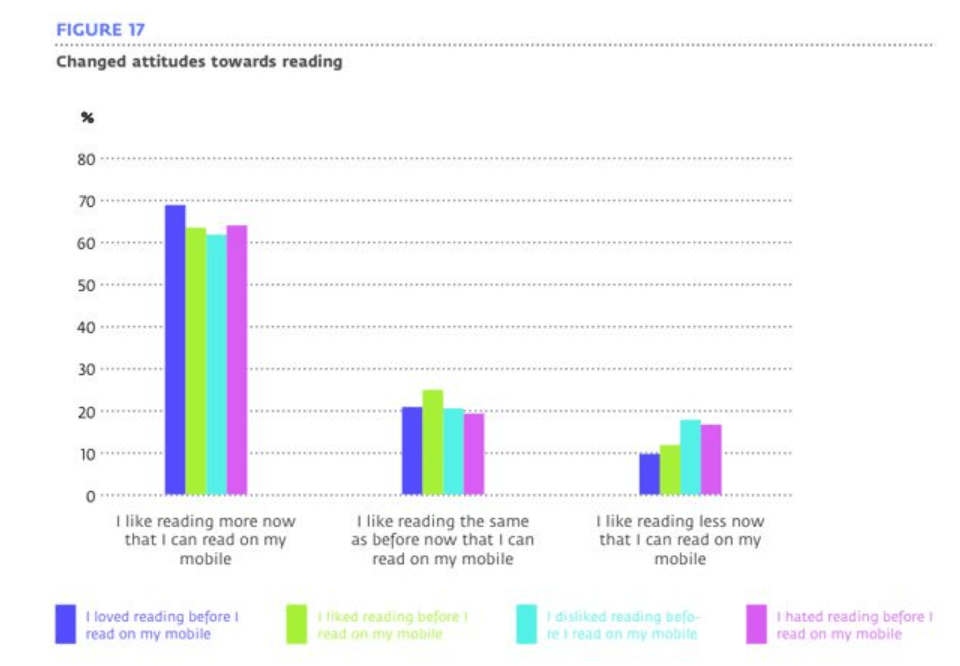
Mobile devices allow for access to multiple modalities of text, including e-books, audiobooks, and built in translation and dictionary tools. They can be accessed at any time, from remote locations, they are incredibly mobile and they make text accessible for many. For an increasing subsection of the global population, mobile devices are what makes literacy possible.
Access across a range of mobile devices
As mobile devices continue to evolve, one thing that will need to be kept in mind (globally, not just in the developing world) is accessibility. In a 2017 article entitled “We went mobile! (Or did we?)”, Laura Turner and Alejandra Nann discuss what makes mobile based web experiences optimal. For their research, they used the following 4 criteria:
1. It uses mobile friendly software.
2. It does not require the viewer to zoom and can be read from the page’s initial loading.
3. The viewer does not have to scroll horizontally.
4. Links are easily clicked on. (Turner & Nann, 2016, p. 216)
Barriers to accessibility included having to download an app, download PDF files, or use Flash. Web browser-based solutions were deemed most accessible. This takes me to my final point.
Innovative ideas from the global community
So… we want materials to be culturally relevant and in their mother tongues, up to date, and easily accessible. What is being done in edtech in these areas?
My research led me to Worldreader, a global non-profit charity that only works in digital publications. Through web-browser based e-reader technology, which can be accessed at read.worldreader.org, students have access to free e-books. All these books can be downloaded on to your device to read offline (a great feature for places in the world with spotty access to mobile data or internet). The browser-based app includes awards and motivators for reading, allows readers to set goals, read in multiple languages and increase font size.
In partnership with the Bill and Melinda Gates Foundation, Worldreader studied the impact of the e-readers in libraries in Kenya. More than 80% of participants reported reading more, 254 community events were held, 20000 people were trained to use the e-readers, and library visits at pilot sites tripled. You can read more about the effects of Project LEAP here.
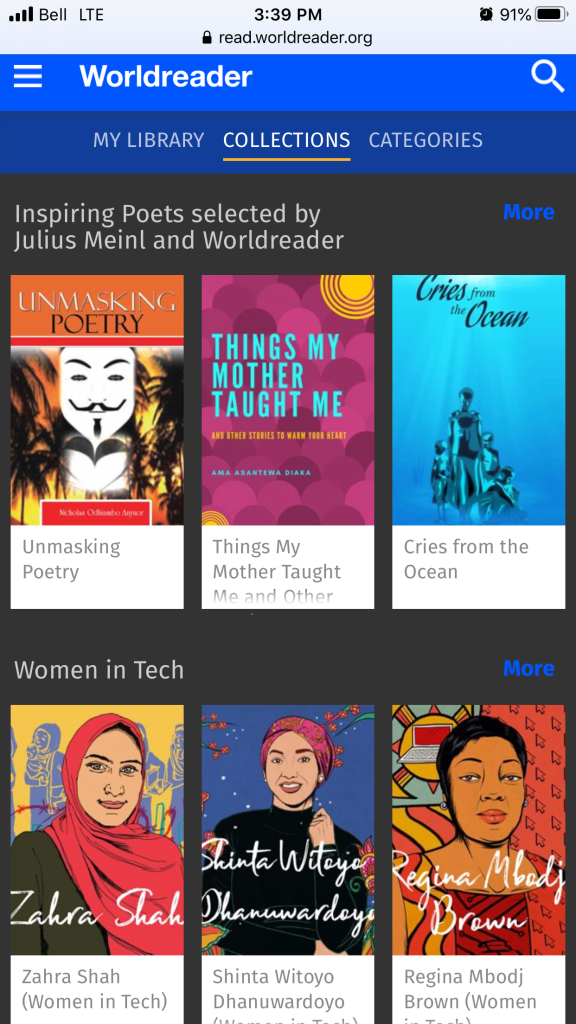
This screenshot shows a view of English book options in the Worldreader catalog
I appreciate that their financials are available for all to check out on their website – something I find very important. Also, using the four criterial from the Turner and Nann study on mobile-friendly technology, Worldreader provides an optimal web-based experience. Finally, upon browsing titles I was struck by the diversity of characters, settings and topics. Non-fiction texts about women and technology, and crime thrillers and other fiction set from Ghana to Cambodia can be found on the site. To see oneself reflected in what you read, see and hear is so very important.
When children cannot find themselves reflected in the books they read, or when the images they see are distorted, negative, or laughable, they learn a powerful lesson about how they are devalued in the society of which they are apart.
(Bishop, 1990)
This is only one innovative idea that I found. https://libraryforall.org/ is another non-profit that seems to be working along the same principles. It operates via its own app, rather than an in-browser option, which makes it slightly less accessible.
I’m excited to see the other gamechangers that exist in the world of mobile technology that my classmates will suggest!
Sources
Baidoo, D. (2017, April 13). Digital resources in developing world libraries: supporting research needs and increasing usage. Retrieved from https://connection.sagepub.com/blog/opinions/2017/04/13/digital-resources-in-developing-world-libraries-supporting-research-needs-and-increasing-usage/
Bishop, R. S. (1990). Mirrors, Window, and Sliding Glass Doors. Perspectives: Choosing and Using Books for the Classroom, 6(3), https://scenicregional.org/wp-content/uploads/2017/08/Mirrors-Windows-and-Sliding-Glass-Doors.pdf
Developing World Initiatives. (2019, December 16). Retrieved from https://us.sagepub.com/en-us/nam/developing-world-initiatives
Harden, M. (2019, May 1). The International Impact of Donated Clothing. Retrieved from https://borgenproject.org/the-international-impact-of-donated-clothing/
Jay, P. (2018, May 29). Here’s where your donated clothing really ends up. Retrieved from https://www.cbc.ca/news/canada/ottawa/donated-clothing-where-it-ends-up-1.4662023
Mose, P. and Kaschula, R. (2019), “International book donors and public libraries as partners in primary school literacy development in Kenya: Literacy prospects and obstacles”, Library Management, Vol. 40 No. 6/7, pp. 392-401. https://doi-org.ezproxy.library.ubc.ca/10.1108/LM-05-2018-0046
Our Library. (n.d.). Retrieved from https://www.worldreader.org/our-solution/library/
Ray. (2019). A check in with Librarians from around the world. International Leads, 33(1), 14.
Shonhe, L. (2019). A Consolidation of Challenges Faced by School Libraries in Developing Countries. Library Philosophy and Practice, 1–12. Retrieved from https://digitalcommons.unl.edu/cgi/viewcontent.cgi?article=5867&context=libphilprac
Smith, C. (2014, May 9). Mobile Phones to Prompt Reading Revolution in Developing World. Retrieved from https://ourworld.unu.edu/en/mobile-phones-to-prompt-reading-revolution-in-developing-world
Turner, L. S., & Nann, A. (2017). We went mobile! (or did we?) reviewing and promoting third-party device neutral library resources. The Serials Librarian, 72(1-4), 214-222. doi:10.1080/0361526X.2017.1297594
UNESCO. [UNESCO]. (2014, April 22). Reading in the Mobile Era [Video file]. Retrieved from https://youtu.be/4gOtpCIl-Ng
Worldreader. [Worldreader]. (2016, September 21). Readtokids.com [Video file]. Retrieved from https://youtu.be/CUicPi3QQOY
Worldreader. [Worldreader]. (2018, November 19). Worldreader Kids – English [Video file]. Retrieved from https://youtu.be/JmwnhFF-kCY
Cover Image Source
Mobile phone use. [Photography]. Retrieved from Encyclopædia Britannica ImageQuest.
https://quest.eb.com/search/132_1307294/1/132_1307294/cite
 themarksey blog
You’ve done so much fantastic research, Morgan. I like the comparison of donated books to donated clothes; I agree that mostly this practice assuages the guilt of the 1% (ie. us). Your many academic sources combined with the video clips make for a sound argument and well-rounded perspective. Worldreader seems like a brilliant means to bring relevant literacy to more people. Do you think it could be effective for Canada’s indigenous people too, in the effort to reclaim language and culture?
LikeLiked by 1 person
Thanks Bronwen, I had fun connecting dots and researching this week.
As for your last question, I think the answer is yes. Are you familiar with https://www.globalstorybooks.net/ ? They have a section just on indigenous stories, in indigenous languages and also English. It has a lot of promise as well.
LikeLiked by 2 people
A well-researched and thoughtful post. Excellent ideas shared here. I too think we need to question the merit of donating our second-hand items to developing countries. As you suggest there are many ramifications for doing so. I like your suggestion to instead donate to allow for others to create, write and publish works that are culturally relevant. I hadn’t made the connection before between mobile technology and women’s literacy. Thanks for that bit of research.
LikeLiked by 1 person
Thank you for your post Morgan. I agree with you about donated books perhaps not being the best solution to supporting literacy in developing countries. You’re correct in your statement that often the donated books are not a representation of the reader and thus they cannot connect to what they are reading. Your idea of helping developing countries write and publish their own material is a good one. Also, the WorldReader resource looks wonderful. I look forward to looking into it more.
LikeLiked by 1 person
I, too, love the questions you raise about donated books as having books that appropriately represent one’s culture and in one’s first language is also an interest of mine. You make many valid points — right at the time one of our district colleague is in the Philippines delivering new and used library books to elementary schools. Despite the books being in English, the schools are thrilled (as per the pictures she sent and her perspective). However, you are right — the schools are still lacking in first language materials. Thus, I love your advocacy for supporting publishing in the developing countries themselves. Have you done any research on that to see if this is an idea that has taken off?
In regards to mobile use, I came across World Reader, too, but didn’t touch it after your wonderful research! You document what they do quite well, and pair it with UNESCO’s research. The importance of the gender gap is so important, too. Really, this blog hits so many major considerations!
LikeLiked by 1 person