– or, we can lead horses to water, but how do we encourage them to drink?
Alternate title – if we build it, they will come?
I just finished reading Todd Rose’s The End of Average this week. Rose, a professor at Harvard and a student who barely made it through high school, discusses how the concept of average people and standards came to be. Ultimately, he argues that although this view has played a crucial role in creating the world that we live in, it is time for us to look for other ways to reach, educate, and employ the world around us. He describes how many of the ‘benchmarks’ of development that we have been taught to look for don’t so much tell us about normal development, but rather provides information about the environment someone was raised in (Rose, 2016, pp. 127-128), and that there are many ways to go from point A to point B. It wasn’t surprising when he went on to explain that even a concept like honesty is something that is context dependent.

When I was but a young T-L to be, I remember sitting in on an IEP meeting at which the student’s profile was referred to as a deficit based ‘Sawtooth’ profile. Some years later it’s clear to me that we are all, each and everyone of us, a sawtooth profile. We have strengths and gaps, just like very person does. Teaching students (and ourselves) how to leverage these strengths to develop others is one of the necessities of modern education.
Now, you might be wondering what on Creator’s great earth is Morgan getting at here – but I promise that I have a point. There is no one-sized fits all approach to professional development, just as there is no one size-fits all approach to education in general. In assuming there is, we limit the achievement potential of those around us.
So, how do we reach all people without burning ourselves out?
Get to know people and what will engage them
Observe, observe, observe. In the first class I took as part of my journey to become a trained Teacher-Librarian, we read New on the Job and I was struck by the chapter on ‘Clientele’. While the chapter was focused on collaboration, I think that it has tendrils that hook into professional development. The discussion of Gregorc’s Mind Styles Model strikes me as important to this discussion. Gregorc sorted people into four combinations of perceptual and ordering ability. (It is important to note that he did not think that anyone was a “pure” version of each style, but rather that we exist on a continuum of these traits). Concrete Sequential teachers are highly focused and often do best with brief projects. Abstract Sequential teachers are big picture thinkers who would do well with PD based on large topics. Concrete Random teachers are those who are most likely to try something completely new and out of left field. Finally, Abstract Random teachers work well in groups and with broad topics that they will be able to narrow down to fit their own styles (Toor & Weisburg, 2015, pp. 101-102). Personally, I know I am a very abstract thinker, although I can sway between sequential and random. I try to be mindful of this when I am planning for others. Knowing who you and your coworkers are will help you design tasks that work for everyone.
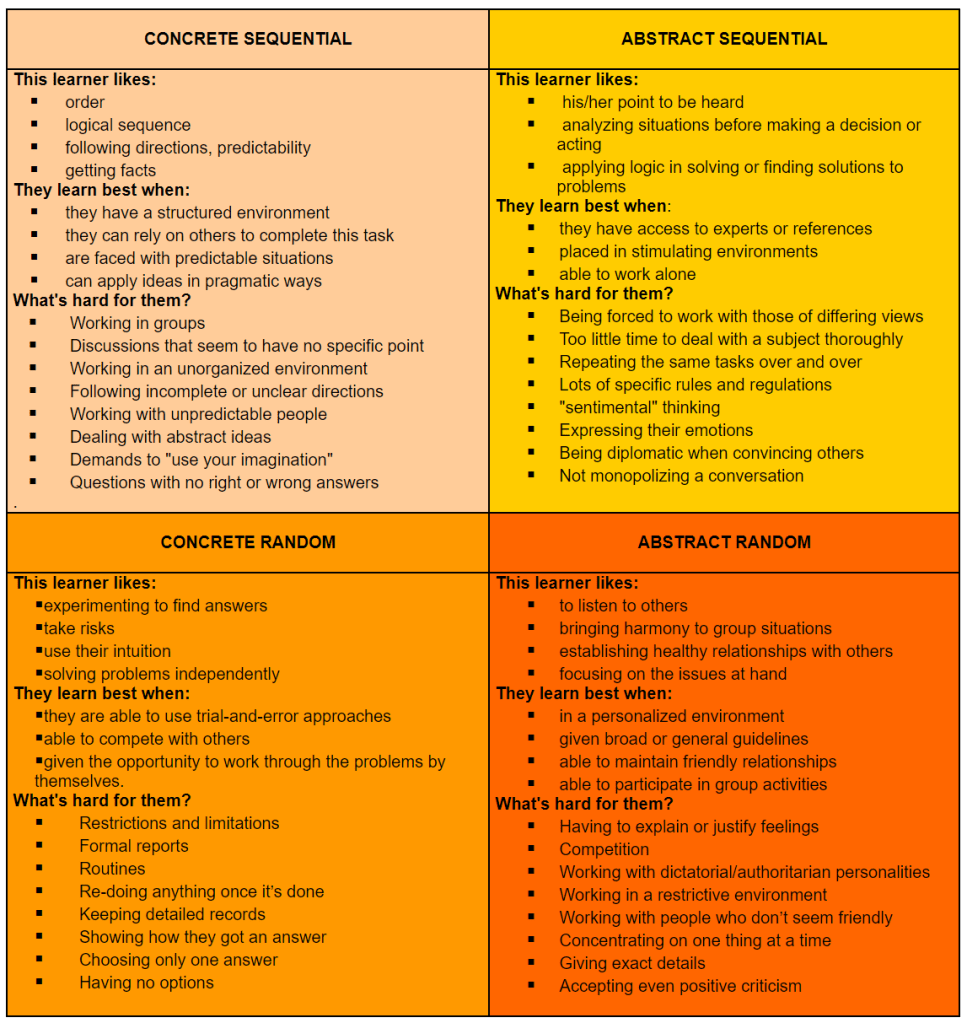
Pay attention to what people are teaching and send ideas and opportunities their way that will meld with their own teaching style. What are people interested in and passionate about? Connecting PD in technologies to these areas will enhance your likelihood for success.
Many things will influence whether teachers are likely to engage in PD. Time is one of them. Get to know the teachers in your building: some of the staff in your building will never, ever come to a lunch and learn session, or invite you in for a prep. Some will be more eager to get together outside of school hours. Are before and after school options for some? And what are your own personal availabilities? Remember to not get too set in your view of your coworkers and limit them before giving them choices, though.
Where is everyone at in terms of their own skill levels with technology? When it comes to whole group professional development, it might be a good idea to plan activities on a spectrum so that some are not left wondering what is going on, while others are bored. To borrow from math guru Jo Boaler, consider Low Threshold High Ceiling tasks that are accomplishable by all, but where increasing complexity is possible. Keep in mind that many educators have always felt successful at school, and new things, or tasks involving technology may leave them feeling less than successful, which can inhibit their participation. Do your best to plan so that you will not alienate those that need it the most. Everyone deserves to feel success!
Put options out there in advance
In the past, I have used an online survey to gather interest in small PD opportunities that I could provide for school staff. In the images below, you will see the questions that I asked of staff, which were based on technological availability as well as my own personal observations about the range of staff tech skills.
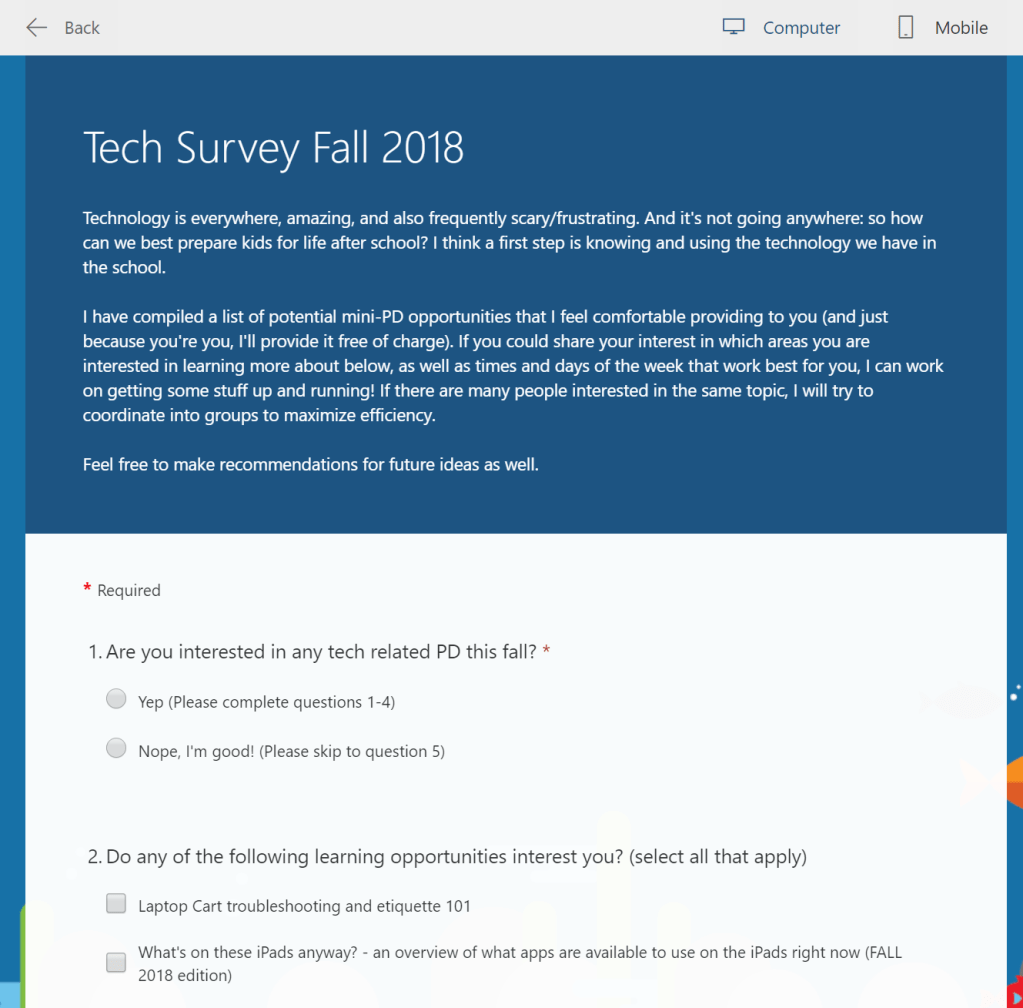
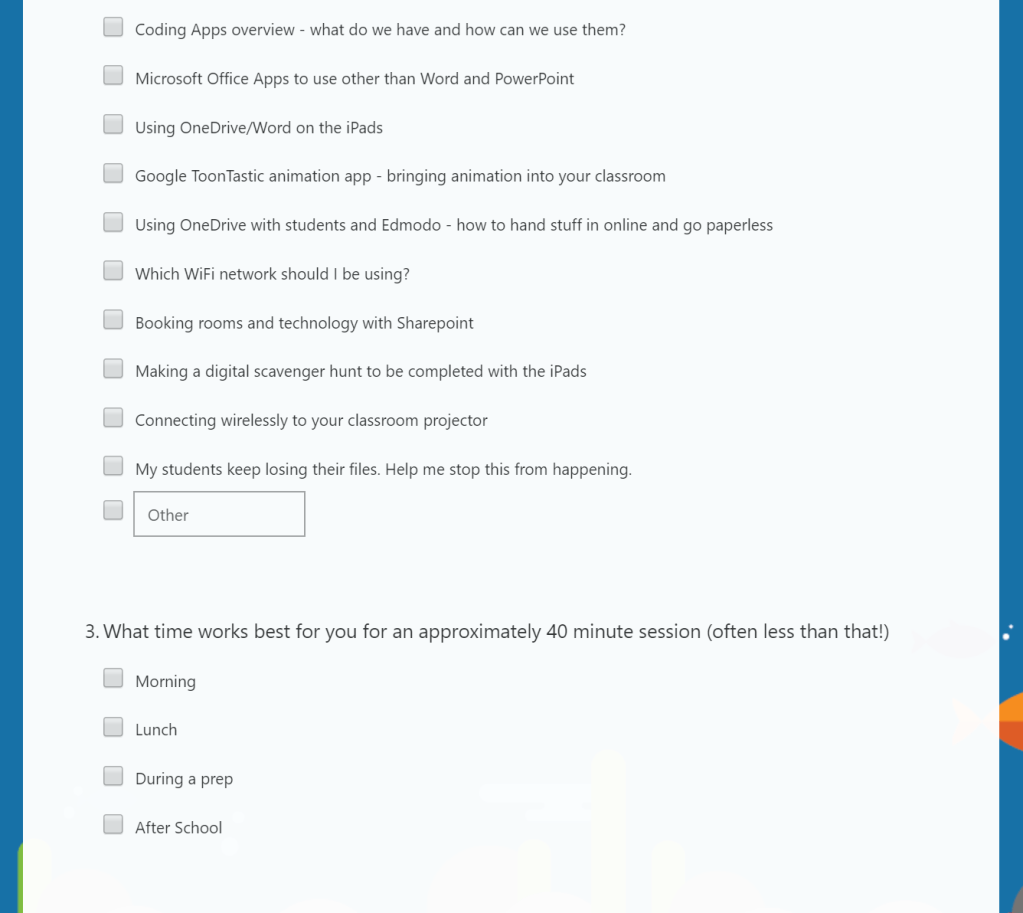
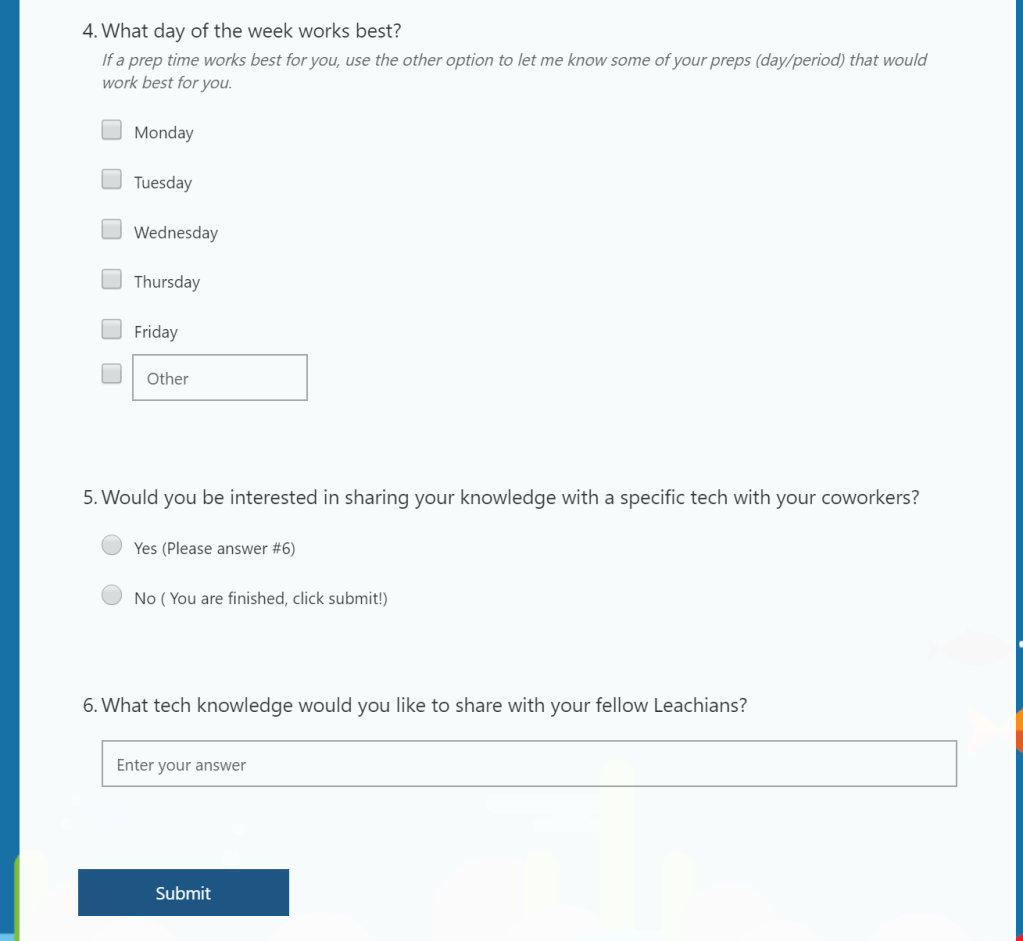
I’d say that this model was semi-effective, as I had a 45% teacher response rate. It did allow me to set up some small-scale exploration groups and teach some basic skills to teachers. I was left feeling like it didn’t have quite the effect on teacher pedagogy that I had hoped. The responses did let me know that there was a vocal minority who were uncomfortable with PD happening outside of divisionally mandated PD days. So, while it did not necessarily impact teacher skills and pedagogy, the rich information it provided did help me understand my co-workers.
When I redo the survey again, I think I will start with an anonymous survey in which staff rate their interest in various areas of tech related PD. We have a school Leadership committee that could provide some feedback on choices and options. I have created a draft version of the survey that you can check out here. If you want to see it, click here!
Try a range of different models
– Book clubs are a great suggestion for professional learning, and could be incorporated into many of the models listed below, whether Lunch and Learns or more formal PLNs.
– Lunch and Learns are a great option for those staff who are okay with giving up some of their mandated non-contact time. Bring in snacks, or see if your school budget has the ability to provide a light lunch (Weinstein and Toor are also big fans of food as a facilitator). If they are one offs, these are great opportunities to introduce and do a brief introduction to a new app or program. If this is over a period of time, you can make it a mini-inquiry.
– Kick off the staff meeting with a 5-minute highlight on a handy new tool or with a quick tip to make teachers’ lives just a little easier. Tangible take-aways often go over well in the education crowd; teachers love something that they can apply to their practice right away.
– Send out quick email updates on new technology tools and apps – I’m blessed to have a (mostly) flexible schedule that allows me to book banks of time with classes as they work on projects. This also means that if I find something new that I want to try out, I can just send out an email to staff and find some collaborators. Me taking the lead and organizing the event/activity takes a lot of stress out of trying something new, and means that I am more likely to get buy in. This allows me to work out some of the kinks and share problem solving hacks with those teachers who have heard about it through the grapevine and are now interested.
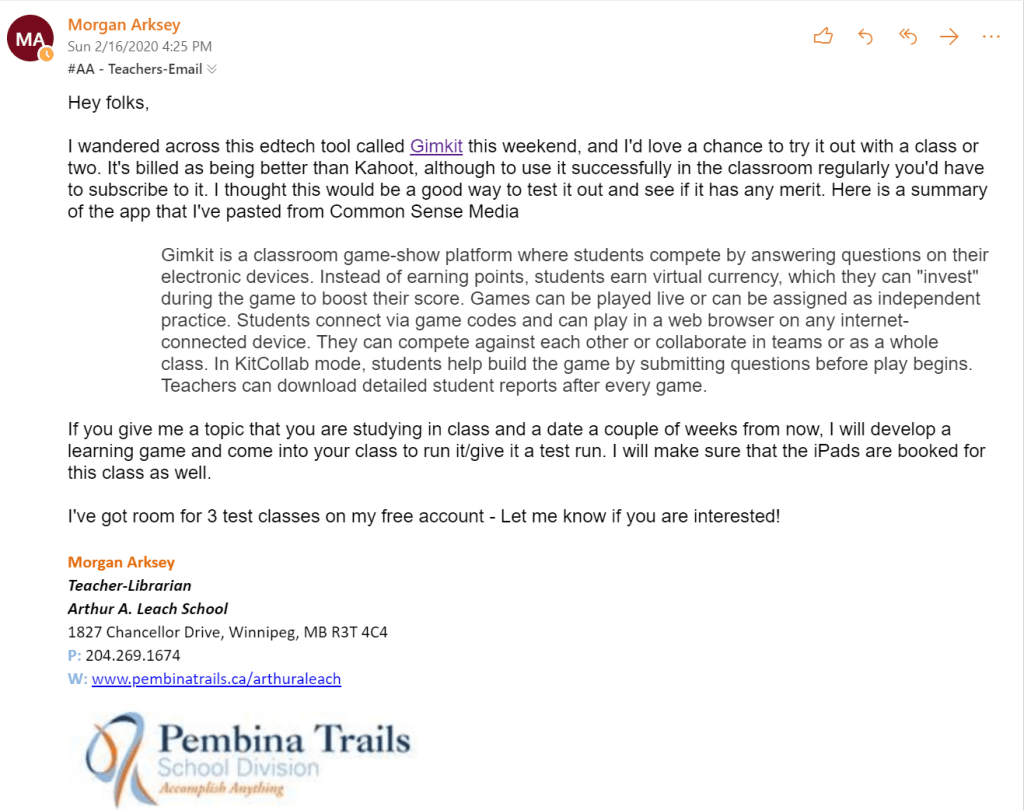
According to research from the International Literacy Association, barriers to including new technology in classrooms involve the time to explore and prepare, the teacher’s own knowledge, and the perceived skill levels of students, amongst others. By doing some of the initial work, we have the ability to help teachers overcome some of those barriers (Thoma et al., 2017).
– Setting up collaboration time in our schedules to work with new and interested teachers is another great strategy to create individualized professional development that matches the styles and interests of that teacher.
– Give staff time to learn from one another – some of my favourite in-school PD opportunities have been done via an EdCamp model. For those unfamiliar with the model, this wikipedia article does a great job of summarizing it. I love seeing the tips, tricks and game-changers that the people that we work with are already using and having the opportunity to share things that I love. I think it gives power and choice back to individuals that often people groan about losing in a one-size fits all PD environment. Breakout sessions are another way to add choice and have staff play to their strengths.
– Become a part of, or help set up, school based Professional Learning Communities/Networks. If you can, set these up with the assistance of your divisions Joint Professional Development funds. This might mean creating a proposal and submitting it for approval – but it also means that you are more likely to hook teachers who are less likely to give up “their own time”, as substitute coverage will be provided.
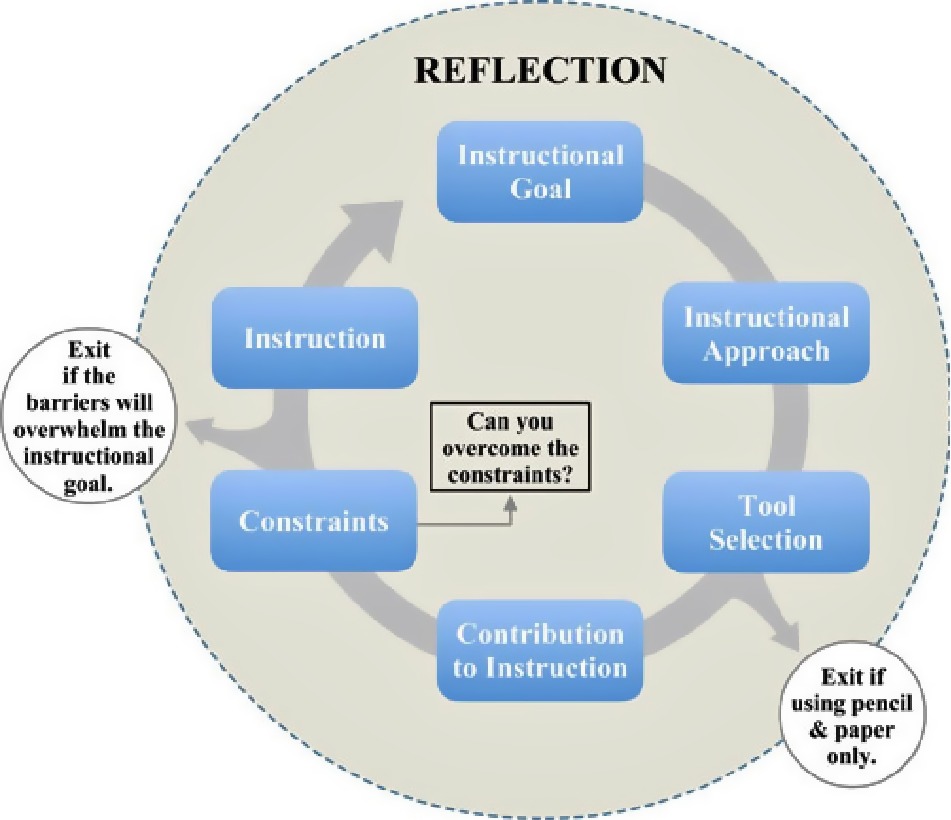
– Consider framing any larger planning and development using the Technology Integration Planning Cycle to make sure that technology is used in meaningful and realistic ways.
– Be open to trying new things! Here’s a fun thread I found on Twitter about the neat PD opportunities other schools are trying out
https://platform.twitter.com/widgets.jsI’m putting together a post on alternative structures for PD. If your district is doing something besides sit-and-get, everyone in the same room, whole-school traditional PD, tell me about it! #edchat #satchat #mschat #leadupchat
— Jennifer Gonzalez (@cultofpedagogy) February 28, 2018
This is just a brief list of ideas. Strong relationships and getting to know your co-workers will go a long way. If you build it, they will come.
Sources
Anderson, M. (n.d.). Mind Styles – Anthony Gregorc. Retrieved from https://web.cortland.edu/andersmd/learning/gregorc.htm
EdCamp. (2019, October 18). Retrieved from https://en.wikipedia.org/wiki/EdCamp
Gonzalez, J. [@cultofpedagogy]. (2018, February 28). I’m putting together a post on alternative structures for PD. If your district is doing something besides sit-and-get, everyone in the same room, whole-school traditional PD, tell me about it! #edchat #satchat #mschat #leadupchat. [ Tweet]. Retrieved from https://twitter.com/cultofpedagogy/status/968875153747795969
Moreno, J. (2019, December 6). Everything You Need to Know for Killer Conference Breakout Sessions. Retrieved from https://helloendless.com/conference-breakout-sessions/
NRICH. (2013, September). Low Threshold High Ceiling – an Introduction. Retrieved from https://nrich.maths.org/10345
Rose, T. (2015). The end of average: How we succeed in a world that values sameness. HarperOne/HarperCollins.
Thoma, J., Hutchison, A., Johnson, D., Johnson, K., & Stromer, E. (2017). Planning for Technology Integration in a Professional Learning Community, 71(2), 167–175. Retrieved from https://doi.org/10.1002/trtr.1604
Toor, R., & Weisburg, H. K. (2015). New on the job: a school librarians guide to success. Chicago: ALA Editions, an imprint of the American Library Association.
Cover Image Sources
FIELD OF DREAMS (1989). [Photography]. Retrieved from Encyclopædia Britannica ImageQuest.
https://quest.eb.com/search/144_1531520/1/144_1531520/cite
Horses drinking in river, Regional Nature Park of the Camargue (Parc naturel regional de Camargue), Provence-Alpes-Cote d’Azur, France. [Photograph]. Retrieved from Encyclopædia Britannica ImageQuest.
https://quest.eb.com/search/126_505599/1/126_505599/cite
 themarksey blog
Oh, you and I think alike! We just use different diction — ha, ha! I totally agree that getting to know your colleagues is essential before any professional development is attempted. However, I particularly like how you point out that one needs to know themselves as well — a VERY valid point! I love the specific example you provide of the email sent to staff about Gimkit — telling them you’ll take the lead if interested — that’s brilliant! I also particularly enjoyed hearing about Rose’s book and how it tied into this week’s post. I’d never heard the profile “sawtooth” before, but how you paired it with “average normal” makes a lot of sense. I enjoy following your train of thought!
LikeLiked by 1 person
You raise one of the most important questions a TL can ask themselves –
“How do we reach all people without burning ourselves out?” Often, we have a lot of autonomy in what our role can look like. Because of this, we can stretch ourselves thin supporting others and forgetting to take care of ourselves.
The sample survey and email example are excellent resources for your reader.
LikeLiked by 1 person