; keeping in front of edtech
The internet is overwhelming. According to this Forbes article from May 2018, 2.5 quintillion bytes of data are produced every day. To use terms that you’re probably a bit more familiar with, that’s around two and a half million terrabytes of data. That’s 1 736 111 100 000 (one trillion seven hundred thirty-six billion one hundred and eleven million one hundred thousand) three and a half inch floppy-disks for those of you who remember what the save icon stands for.
In 2018, over 456 000 Tweets were sent out each minute, along with 510 000 Facebook comments made on top of 239 000 status updates. How on this green earth are we to find ANYTHING amongst all that?
The good news is that most of this information isn’t relevant or useful for you. But it is the chaff through which you will need to search for the wheat that is useful pedagogy, skills and tech tools. The good news is that I think there are lots of ways to find those gems, and not all of them involve being technologically savvy. Here’s my list of ways to keep my fingers on the pulse of edtech.
ISTE
Joining Professional Learning Networks through the International Society for Technology in Education (ISTE) or becoming friends with someone who is a member so that you can hear about cool opportunities, learning and professional development through them is my current top tip. ISTE itself is
home to a passionate community of global educators who believe in the power of technology to transform teaching and learning, accelerate innovation and solve tough problems in education.
ISTE inspires the creation of solutions and connections that improve opportunities for all learners be delivering: practica; guidance, evidence-based professional learning, virtual networks, thought provoking events and the ISTE Standards.
ISTE. (n.d.). About ISTE. Retrieved February 13, 2020, from https://iste.org/about/about-iste
This document describes the differences between the levels of membership to ISTE that are required to gain access to these PLNs. I think a basic membership, with it’s access to the PLNs and more for only $105 USD is a fantastic option.
I will admit that I have not yet personally joined – but I am interested in several Professional Learning Networks that they offer. These networks allow us to connect with other members in such focus areas as Digital Citizenship, Early Learning, Global Collaboration, Games and Literacy; they even have a PLN for Librarians! They provide us the ability to connect and collaborate with other educators across the world, allowing us to “network resources to help students collaborate”; one of the teacher skills required in the area of knowledge deepening in the ICT competency standards for teachers set out by UNESCO in 2008 (p. 12).
According to ISTE members these online groups are rated as the most popular membership perk. Other benefits include things like online streaming of conferences, webinars, and general global networking. Membership also allows you to sign up and attend the annual ISTE conference! When I have access to PD grants again after completing my diploma, I hope to attend it. The timing is not ideal, the last week in June every year, but I have only heard amazing things about it.
I am mindful that ISTE is heavily supported by Microsoft, and I try to be aware of the impact of corporate sponsorship.
Virtual Connections
I think that Twitter may have become an established routine of mine now. I don’t spend much time, just a minute or two (okay 5) at the end of the day before I curl up with my book, but I do a quick scan through those I follow. If something interesting jumps out at me, I share the link via email to myself to read/share at another time. If I feel like I have a few more minutes of time to spend, I do a search for #edtech. Inspiration can strike from anywhere. Twitter is also a great way to reach out and connect with experts around the world – last year while reading the novel Exo by Fonda Lee, it was a tweet that connected her to my class, and then she was able to skype in to answer some of our questions about the novel.
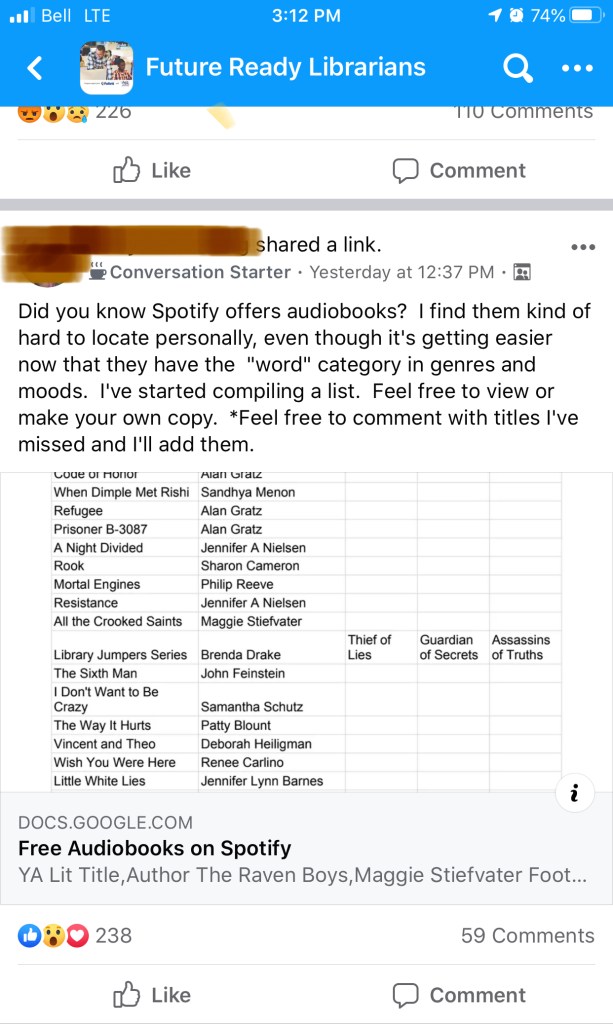
As mentioned in my earlier post about the Library’s role in a school’s culture of reading, one of my current favourite sources of couch PD is the “Future Ready Librarians” group on Facebook. Here Librarians from around the world post asking for ideas, connections, or sharing cool things that they have going on in their Libraries. There are even free webinars from admins on the page. Some things relate to more traditional library life, but a significant portion involves making and new apps and learning tools. It should be noted that this group is supported by Follett.

Local Networking
I am fortunate that the division I teach in has a consultant at our head in with to check in with, and who plans multiple professional development opportunities for us throughout the year. I attend these sessions, despite the dreaded sub planning, because they provide me the opportunity to meet with my peers, see and hear what they are doing in their schools, and we are often provided information or brief introductions to new tools that are available. They also advocate heavily on our behalf to be provided coverage to attend other PD initiatives related to technology.
At a provincial level there are numerous organizations to join or attend PD with. The Manitoba School Library Association offers a full-day professional development session in November and other member benefits throughout the year, and these events and their journals allow exposure to new ideas and networking opportunities. In Manitoba, another group to consider joining would be the Manitoba Association of Computing Educators, or ManACE. Like MSLA, they provide a November PD, as well as occasional evening events throughout the year,and bi-monthly journals. ManACE is very connected to the maker movement in Manitoba, and a great way to make connections. Your province or state has these organisations too. Reach out, join, and contribute!
My friend, Google
One of my favourite things about the end of the calendar year is looking for ‘best of the year’ lists. Lots of these things are for my personal enjoyment, but many are also connected to the LLC. As I read through lists of the best music and books of the year, I also make sure to check out lists of the best educational technology. My usual search terms are “best + edtech + tools + YEAR”
Larry Ferlazzo’s list of apps has been one that I have been checking out for years now. His background is in English Language Learning, but the apps that he selects are all free and easily accessible to non-tech savvy users and ELL students. Here’s his list of ‘The Best Web 2.0 Applications for Education in 2019 – part one”.
Another of my favourites is Jennifer Gonzalez’s blog cultofpedagogy.com; she posts at least yearly about the newest apps for teachers to test out in their classroom. My only complaint about her recommendations is that they often require purchasing – but if the tools are transformative enough, I’ll consider it. Here’s her post about ‘6 Ed Tech Tools to try in 2020’. If podcasts are more your style or meld with your hectic schedules, hers is also well worth a listen. Every year she posts a Teachers Guide to Tech for sale on Teacher’s Pay Teachers; which this year is a 282 page hyperlinked PDF file with all kinds of tools, exemplars, screenshots and links to YouTube videos.
It’s also usually worthwhile to do a search right after the ISTE conference – here’s one from weareteachers.com about their favourites from last year’s conference, which was the first time I had heard about the Bulb App for digital portfolios.
I hope this list has been a supportive list of suggestions for tools to keep you up to date with an ever-changing topic. It may feel like you’re being chased by a Great White, but with a little help from our friends (and global collaborators) we’ll make it through okay.
Sources
Gonzalez, J. [Cult of Pedagogy]. (2020, January 6]. How to Use the 2020 Teacher’s Guide to Tech [Video file]. Retrieved from https://www.youtube.com/watch?v=P8HBmrcw9ig&feature=youtu.be
Ferlazzo, L. (2019, April 15). The Best Web 2.0 Applications For Education In 2019 – Part One. Retrieved from https://larryferlazzo.edublogs.org/2019/04/15/the-best-web-2-0-applications-for-education-in-2019-part-one/
Gonzalez, J. (2020, January 8). 6 Ed Tech Tools to Try in 2020. Retrieved from https://www.cultofpedagogy.com/6-ed-tech-tools-to-try-in-2020/
ISTE. (2019, June 27). Experience the bold learning at ISTE19! [Video file]. Retrieved from https://www.youtube.com/watch?v=sJCCLMEprQk
ISTE. (n.d.). About ISTE. Retrieved February 13, 2020, from https://iste.org/about/about-iste
Moran, K. (2019, June 25). 5 of the Coolest Ed Tech Tools We Found at ISTE 2019. Retrieved from https://www.weareteachers.com/ed-tech-tools-iste-2019/
UNESCO. (2008). ICT competency standards for teachers: competency standards modules. Retrieved from https://unesdoc.unesco.org/ark:/48223/pf0000156207
Cover Image Source
FINDING NEMO (2003). [Photography]. Retrieved from Encyclopædia Britannica ImageQuest.
https://quest.eb.com/search/144_1541717/1/144_1541717/cite
 themarksey blog
I love your blogs! The graphics/images you choose are engaging and SO appropriate, and I love how you focus on key elements (i.e. ISTE) yet still say so much! Particularly, I enjoy your personal sharing — how you use Twitter, what you are doing now, etc. It is useful to see how others handle social media and networking. Out of curiosity, do you keep a personal/professional and a classroom Twitter account, or do you use one and the same? I’m in the midst of exploring what to do on with that.
I found myself taking a few notes from your blog, like on Jennifer Gonzalez’s book and checking out what others have said after the ISTE conference. Great tips! Thanks!
LikeLiked by 1 person
Hi Sarah! I’m glad I can share some helpful tips and tricks.
I am currently not using Twitter for our LLC, and just have my professional personal account. My school account is on Instagram, because I find that I am more likely to interact with students on that medium, and that has been my main focus over the past year or so. That being said, I know that advocacy is important, so I should be reaching out beyond my clientele. It’s on my to do list (it’s a long list).
The graphics are a good outlet for a weird sense of humour 😉
LikeLiked by 1 person
Ha, ha — I love your humour! I have been considering using Instagram for the same reasons you mention — to interact with students and advocate for use of our space/books, etc.
Do teacher-librarians ever have short to-do lists???
LikeLiked by 1 person
Another engaging, thoughtful, reflective and well-developed post! You have outlined excellent strategies for continuing to build your ICT skills and have linked excellent resources that enhance your discussion and support your reader.
LikeLiked by 1 person
Thanks Darcy, I was worried that I didn’t get deep enough into all of the ways of professional learning – but I thought that a 30,000 word blog post might end up losing readers’ interest fast. Haha.
LikeLiked by 1 person
Morgan, another great post! It truly is overwhelming thinking about how much data is produced online everyday! I appreciate the strategies and resources you’ve outlined on how to manage your ICT skill development. The three big takeaways that I want to explore further are the ICTE personal learning network, the “future ready librarians” facebook group, and the spotify audiobooks. Some great learning for me too 🙂
LikeLiked by 1 person
I fully support joining and lurking on the Facebook group; I just love PD that is connected to something that I already do. We have so much on our plates and I think it’s important that we find ways to learn and explore that don’t end up taking away from our already limited time.
LikeLiked by 1 person