Condensing text has always struck me as one of gen-AI’s genuine strengths—especially with passages only a page or two long. Because colleagues and I constantly wrestle with teaching complex ideas to readers at wildly different levels, I decided to run a little experiment.
I grabbed a section from an open Canadian-history textbook on Winnipeg’s water supply and its century-long impact on Shoal Lake First Nation. (Copyright dodged!) Then I sent the same passage through two “grade-five level” text-levelling tools. After the fun I had last week coding responses (sadly I am not being sarcastic) I did a bit of the same here. The results were fascinating. My hunch is that these tools perform better in tightly structured subjects like science or math, but I wanted to see how they’d handle a topic that matters deeply in Winnipeg and which structures of power and colonial legacy have significant impact.
In a perfect world you’d use an AI system that lets you spell out the key concepts that must survive the rewrite, but that raises the stakes for prompt quality. For this assignment I stuck with true paste-and-go tools—the kind that lure in brand-new or still-skeptical AI users.
I’ve bundled my heuristic, the side-by-side outputs, and a brief analysis in a Genially presentation (link below). Make sure to use the show interactive elements button in the top right corner, so that you don’t miss any interactive content. I’d love to hear your thoughts.
And what can I figure out from what it doesn’t say?
I went a bit overboard.
I started looking at two LLMs and then I just kept on adding one more to the list and then I ended up with a 20+ minute video and hours worth of unused footage and a look at how Meta AI, ChatGPT (v. o3), Deepseek, and Copilot handle the same question.
Fun Fact: I used the AI features in CapCut for the emoji captions!
Regardless of my overkill, it was fun. I’ve attached a couple of extra things aside from the video itself.
An interactive couple of graphs that I made in Canva so that you can see some of the data I pulled from my analysis. The charts are interactive, so click around a bit -the labels in the white menu bar under the titles allow you to see one set of information at a time.
I have to say, I’m tempted to strip the model names from the responses and my excel sheet with the records and upload it into Chat and Deepseek to see what they notice. Should I do it?
References
Coleman, B. (2021). Technology of The Surround. Catalyst: Feminism, Theory, Technoscience, 7(2), 1–21.
Crawford, K. (2021). Atlas of AI: Power, Politics and the Planetary Costs of Artificial Intelligence. Yale University Press.
The Learning Environment evaluation rubric was an interesting assignment for me, as I joined a group focused on post-secondary education, despite all of my teaching experience being at the middle and high school levels. Specifically choosing Canadian Memorial Chiropractic College (CMCC) as our organization provided an excellent opportunity to explore how technology could be leveraged in a program that relies heavily on in-person and hands-on practicum. As I joked in one of our meetings this week—I don’t think I would be willing to go to a chiropractor who was trained only virtually! As such, it became clear that the platform we recommended needed to complement, not replace, face-to-face and practical training.
I had a lot of fun collaborating to develop the rubric for this assignment and weaving together elements from both the SECTIONS and CITE models to create a more holistic overview – what we have entitled the LEARNERS Institutional Needs Assessment Scale and the LEARNERS Learning Tool Assessment Calculator. While the SECTIONS model offers a clear lens for classroom integration, the CITE framework (aimed at global development) brings in valuable perspectives around equity and community benefit—something I believe should be considered in a Canadian context as well. That said, the CITE model can be difficult to navigate, which led us to focus on identifying overlaps and building something new that worked for our scenario. You can see the Needs Assessment Scale here, and the Assessment Calculator here.
One key realization for me during this process was the difference between equity and accessibility in evaluating a technology’s appropriateness. Coming from a public school background, I often prioritize equitable access across diverse devices and connectivity levels. However, in the context of CMCC, with a smaller and more homogenous student body, these concerns were not as high on the institutional priority list. This highlighted how institutional context truly shapes which values are seen as essential—and which are optional.
This project also gave me the opportunity to explore two LMS platforms I hadn’t previously encountered: Docebo and Google Classroom. Docebo, which is used largely in corporate settings, did not sit well with me. Its marketing—“There is no reason we can’t quadruple revenue in the next two years… Docebo has allowed us to create an education engine that’s very plug-and-play and very scalable” (Docebo, 2025)—left me wondering whether education was being reduced to a one-size-fits-all revenue model. That’s obviously beyond the scope of our rubric, but it left a lasting impression (and not a good one). That being said, it offered almost all of the bells and whistles you could be looking for 🙂
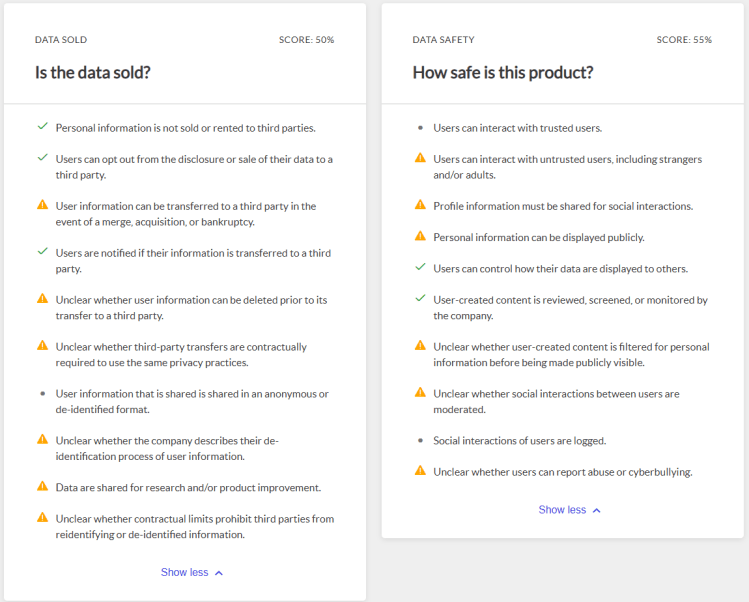
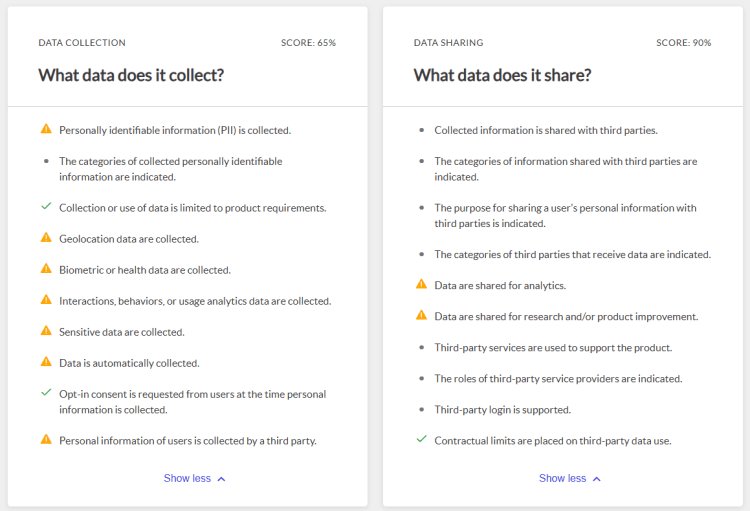
Google Classroom is a more familiar and affordable option, but I worry that its low cost is being subsidized through user data collection. The recent bankruptcy of 23andMe (Allyn, 2024), and the concerns about what might happen to user data post-collapse, made me reflect on the fragility of digital trust. While Google Classroom receives a passing grade from Common Sense Media, even their evaluation notes several red flags around data use.
The following two images (Common Sense Media, 2022) show concerns re: data in the Google Classroom ecosystem.
By the end of this assignment, I found myself increasingly skeptical that a truly ethical, learner-centered LMS exists. This exercise sharpened my ability to evaluate tools critically—but it also reinforced my concerns about the broader systems behind them.
(Or to those of you not currently obsessed with working your way through the Duolingo German course—good day my readers.)
For those of you new to my blog, willkommen! I’m Morgan, a secondary school teacher-librarian and current student in the Masters of Educational Technology program through the University of British Columbia. I’m just starting ETEC 524, Learning Technologies: Selection, Design and Application, and this seems like the perfect excuse to dust off my poor, neglected blog. If you scroll through past posts, you’ll get a sense of my background—but here’s the Coles notes version.
This is my fifteenth-year teaching in the public school system in Manitoba, mostly at the middle and high school levels. On paper, I think I was supposed to be a history teacher, but I’ve done a little bit of everything—core classrooms and upper-middle humanities. Seven years ago, I was asked to move into a teacher-librarian role, and I haven’t looked back since. As this blog shows, this is my second program at UBC; my first was the LIBE Diploma, which gave me excellent training in running a well-rounded library program. Librarianing is the best. I get to buy books, collaborate with teachers, curate across multimodalities, nag people about copyright (not gonna lie, my least favourite part), and help guide future-focused pedagogy. I considered a Masters in Library Studies but felt that this program better fit my interests, the needs of our space, and where I see the future of libraries heading.
For this course, I’m interested in bridging the gap between healthy communities and the overwhelming amount of digital content at our fingertips. How do I help students not just find information, but apply it to their own lives? Moving between in-person and virtual spaces is part of daily life, but how do we make that shift feel practical for learners? Maybe it’s the creep of middle age making me critical, but many students seem increasingly disillusioned with school. How do we build learning environments where students critically engage with tech beyond academic checkboxes? And how do I ensure I’m using technology for true redefinition (Puentedura, 2009) rather than using resource-heavy tools for tasks that could just as easily be done on paper? As a librarian, I see the aftermath of a lot of poorly planned tech investments, and I don’t want what I design to add to the mess.
Best golden grill, best fluffy texture, best unusual fillings. One could learn much, mastering the perfect pancake.
What I hope to develop is a course where students choose a demonstrable skill—something they truly want to learn—and build it over a semester. They would set goals, manage their time, reflect on their progress, tackle challenges, and share their learning with others. For example, I might choose to learn how to make the perfect pancake (a worthy pursuit, in my opinion). I’d network with cooks, test recipes, reflect on my process, and document what I learn so I could share it with others. The course would wrap up with a community celebration where students showcase their skills. It’s still just the glimmer of an idea, but I’m hopeful this class will help me turn it into something practical and worth running.
The challenge, of course, is designing something meaningful and manageable when students will pick skills I know nothing about—and that’s kind of the point. I won’t be the expert, but I can build structures to help them find reliable sources, network and connect with experts, and reflect on their learning. That’s where I hope this course will help me grow—giving me the tools to better select and apply technologies that support diverse, self-directed learning without turning the course into a chaotic free-for-all.
This course feels like the right fit to help me move that idea forward. The frameworks we’ll explore—like SAMR and SECTIONS (Bates, 2014)—can help me evaluate whether my design choices are meaningful or just adding extra steps. The focus on learning environments, interaction, and engagement will help me balance student independence with community-building. The work on assessment will push me to clarify what success looks like when every student is learning something different. Later modules on content creation, multimodal presentation, and communication will give me practical tools to support students in sharing their learning in ways that go beyond the traditional slideshow or essay. The final assignments are perfectly timed to help me produce both a structured unit and a tech integration proposal—directly aligned with my course concept.
In short, I hope this course will help me move from intention to implementation—grounding my ideas in research-backed frameworks and best practices, and giving me peer and instructor feedback on my course design. Specifically, I hope to strengthen my ability to design learning environments that foster student agency, apply digital tools purposefully, develop process-based assessment strategies, and support students in sharing their learning in meaningful ways.
To do this, I’ll need access to examples of blended learning structures, readings on assessment for self-directed learning, and opportunities to experiment with digital tools for documenting learning. I also hope to learn from my peers—many of whom bring different teaching contexts and insights that could help me refine my thinking.
By the end of our time together, I know this course will help me take a meaningful step forward in becoming a digital-age teaching professional—someone who not only navigates the evolving world of educational technology but helps students do the same, critically, creatively, and ethically.
An accurate representation of me during this 13 hours.
Check out this link to take a sneak peak at 13 hours of my life, on what I thought would be a pretty chill, unstructured day. This time, featuring a Pig in Lipstick.
This week I chose to focus my attention on Media Convergence, and you can view my MindMap on the topic here! Below, you can watch as Bovine Morgan takes you on a journey through his many thoughts about the topic.
Here’s a link to my assignment this week. I wanted to embed it directly into my blog, but some features weren’t working that way, and you deserve the full experience. You’ll find my references embedded in my presentation.
I went a bit overboard this week, something I may not be able to sustain long term – but I had a lot of fun putting this together! The animated video and clipart are courtesy of Adobe Express.
It should be known that the astronaut is just a preset character in the animate from audio function in Adobe Express, but how serendipitous. Little guy looks a lot like me!
Sutton, R. S. (2020). John McCarthy’s definition of intelligence. Journal of Artificial General Intelligence, 11(2), 66–67. https://doi.org/10.2478/jagi-2020-0003
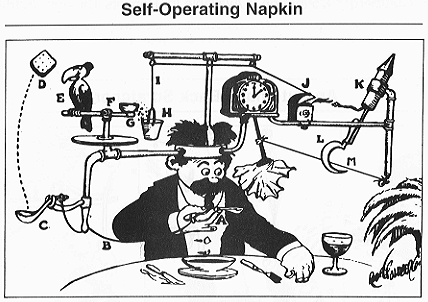
Perhaps it is simpler to view usability through the lens of a stone age technology. The wheel proliferated because it is infinitely usable. To borrow from Issa and Isaias’ usability criteria (2015, p. 33), the wheel was easily understood and adopted across various cultures (learnability). It could be adapted for use in many places (flexibility). When properly designed, it rarely failed (robustness). The wheel significantly reduced the effort required for transportation (efficiency), and its design was simple, effective, easily reproduced, and impossible to forget how to use (memorability). Small imperfections don’t usually effect its utility (error handling), and it made people’s lives better and easier (satisfaction). When we are designing tools for use, usability must be the end goal, or else we are building Rube Goldberg machines; complex machines that perform tasks in indirect and convoluted ways (Wikimedia Contributors, 2019) that are more of a puzzle and pastime for the designer than solutions to widely held problems or ways to improve quality of life.
Rube Goldberg’s comics often made fun of the American obsession with technology, even when it served no advantage.
What about educational usability?
From an educational lens several ideas are missing. Unlike the profit-driven motives of the free market, which often lead to excluding certain users in technology design, the education system prioritizes inclusivity, catering to diverse learning needs, and supporting both teaching and learning processes. When technologies have been designed for commercial usability rather than educational, educational outcomes and learning effectiveness are often sacrificed. Adding features necessary for ensuring support for different age groups, modes of learning, technological proficiency and integration with learning standards are not marketable in the same ways.
Data privacy is another concern. Individuals of legal age can consent to technology use and data terms, but schools must prioritize student data privacy, often facing higher costs for technology that adheres to these standards, unlike commercial tech subsidized through data sale (Canadian Centre for Cyber Security, 2023). Ultimately, one could define educational usability as technology that meets Issa and Isaias’ criteria on top of being ethically responsible and inclusive, which prioritizes the learning process, and recognizes the financial and security challenges that are unique to the educational field.
When usability studies go wrong
User-centred design is integral . Woolgar effectively argued that in his observed usability study, he saw the configuration of the user to the technology. This is problematic because it can lead to a notable mismatch between user needs and the technology, resulting in a product that is difficult to use, or doesn’t serve the problem it is intended to address. It also leads to potential user frustration and disengagement because they are forced to adapt to a system that doesn’t align with their natural behaviours, expectations, and motivations.
One issue that stood out for me was the very close presence of testers during the process. The testers were physically in the space and verbally guided the users along the way, telling users when they could give up, or providing positive reinforcement to encourage useful behaviours like reading a manual (Woolgar, 1990, p. 85). Would users outside of this ecosystem persist in their use of the technology, and where would users genuinely struggle? Configuring the users muddies the water.
Woolgar highlighted the insider/outsider contrast, with insiders like tech support often surprised by outsiders’ real-world use of technology, exemplified by simplified computer instructions posted in a school computer lab. (Woolgar, 1990, p. 72). The sheer depths of knowledge and experience of designers act as blinders to the everyday needs of average users, who may not share the same level of expertise or perspective. Perhaps a better process for usability testing would have helped create a device that was more intuitive.
Usability over time
Woolgar’s points on usability are particularly relevant when considering the DOS-based 286 computers he references in 1990, which, due to their novelty and hardware constraints, necessitated user adaptation and lacked key usability aspects like learnability and satisfaction set out by Issa and Isaias 25 years later. It is likely that in Woolgar’s case users legitimately needed to be configured. Now that technology is ubiquitous, and screen recording technology/keystroke-logs exist we can now take the lessons learned from Woolgar and apply them in a way that helps users configure the tech rather than vice versa. Testers no longer need to physically be in a room with those doing the testing, as we can gather helpful data virtually. In Woolgar’s case, usability studies were an end of process project to be completed shortly before heading to market, whereas Issa and Isaias frame usability evaluation as a recursive process of prototype releases; this is a significantly more proactive, user-centric approach. Ultimately, when read together these pieces highlight how important it is that our conceptions of usability do not remain static.
It is crucial to understand that marginalized populations are often constrained by the systems imposed by the dominant culture, through no fault of their own. What follows aims to offer a historical perspective on how these communities can become entangled in their own marginalization while trying to effect change from within systems that have historically excluded them or limited their access.
Original Question
What kind of information is provided in early documents about Indigenous Education in Manitoba seemingly endorsed by Indigenous groups?
Search terms
“Indian” – as I am searching for an early document around Indigenous education in the Province of Manitoba I am restricted to using the terminology of the time period
“Education”
“Manitoba”
Document Source
My initial search was completed using the Government of Canada’s Publications catalogue. Using my search terms, I was able to uncover a document entitled “Indian education in Manitoba: information for educaters [sic] & band officials”, which was published in 1972 by the Department of Indian and Northern Affairs. The document starts with a 2-page letter of introduction from the Manitoba Indian Brotherhood, the forerunner of the current Assembly of Manitoba Chiefs (Manitoba Historical Society Archives, 2022).
Initial Analysis
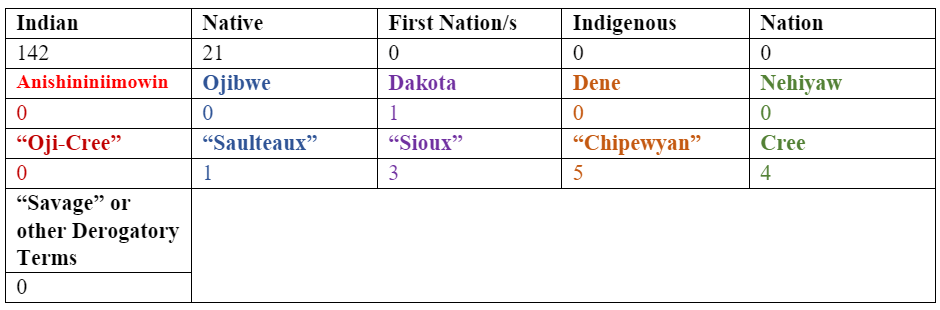
* I did not include uses of the word Indian when referring to organizations/groups like the Manitoba Indian Brotherhood or the Department of Indian Affairs, or in document titles.
* Only the main body text was analyzed, not appendices.
Added to the original search terms, I included the names of Indigenous Nations in the province of Manitoba, both as used by most groups themselves currently as well as historical terminology, which is recorded in quotation marks in the chart above. Interestingly, while terms used to represent the entirety of Manitoba’s Indigenous population were used well over 140 times, names specific to a cultural group were only mentioned a total of 14 times, and only in instances referring to language. Anishininiimowin (Oji-Cree) identity is completely unreferenced. Given the several times the document refers to the importance of cultural understanding (see paragraph 3 on page 107 for example) on the part of non-Indigenous peoples, this seems like a notable discrepancy. The prevalence of generalized terms over specific cultural group names suggests a broad-brush approach to Indigenous identity within the document, which contrasts with the expressed emphasis on cultural understanding. This raises questions about the depth and authenticity of the cultural awareness and sensitivity claimed in the document.
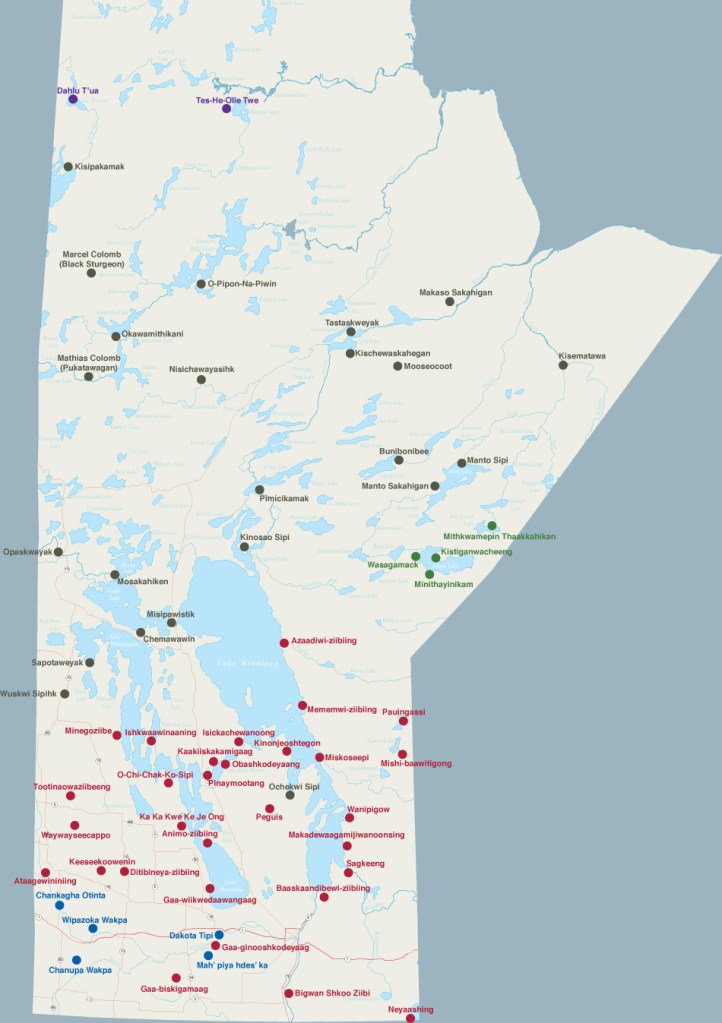
The map above shows the heterogeneous nature of the Indigenous communities within the Province of Manitoba. (MFNERC, 2015)
In my initial review of the document, several aspects stood out, particularly in light of historical context:
References to Residential Schools: The document frequently mentions residential school facilities, detailing their amenities and procedures for enrolling Indigenous students. This is particularly striking given the traumatic legacy of these institutions in forcibly assimilating Indigenous children, a practice now widely recognized as part of Canada’s colonial history.
Mentions of the Child Welfare System: There are notable references to the child welfare system, including contacts for agencies to be alerted if there were concerns about the welfare of Indigenous children. During this period, welfare agencies were actively involved in the removal of Indigenous children from their families for adoption into non-Indigenous homes, a practice later termed the Sixties Scoop (Sinclair & Dainard, 2021). The legacy of this system still has a residual hold on us; national Canadian data shows that over 50% of children in foster care today are Indigenous, in Manitoba that number is closer to 90% (Hobson, 2022)
The broad-brush approach to all Indigenous groups, and the references to residential schools and the child welfare system made me think about the ways in which marginalized populations are often positioned within dominant societal narratives, particularly in historical contexts. It highlights a systemic approach to managing Indigenous affairs that prioritizes assimilation and control over the preservation and respect of diverse cultural identities.
In terms of its impact on teacher professional development, I think that it was probably progressive for its time. Unfortunately, I still think that it would have reinforced stereotypes and encouraged stigmatizing and problematic behaviours from non-Indigenous readers. On one hand, historically used derogatory terminology is absent (with the notable exception of settler names for some Indigenous groups), but from a modern lens the frequent use of the term Indian is jarring. The document explains that intelligence tests cannot be removed from culture (p. L1) and gives some attention to the importance of cross-cultural training (p. C3). But ultimately, the information contained within reflects the values of the dominant Manitoban culture, and reinforces systems that continued to do significant harm to Indigenous people. Much of the document is about funding allocations, welfare concerns, and different residential school locations.
Updated Question
How does the 1972 ‘Indian education in Manitoba’ document, despite its endorsement by Indigenous organizations, fail to reflect the complexities and realities of Indigenous education and cultural practices of the time?
Analysis
The opening note from the MIB sets out goals of educational autonomy and Indigenous control of their own education, ultimately a push back against the system. The final line of Verna Kirkness’ letter stating that the document that follows “will… provide you with the information on ‘things you have always wanted to know about Indian education but were afraid to ask’” makes no qualifiers on the quality of the information, and its use of quotation marks strikes me as an indication of MIBs critical stance on the material included within. However, the rest of the document presents a systemically aligned perspective on Indigenous education. From the uncritical eyes of non-Indigenous readers, this could be seen as acceptance.
Ultimately, the document remains a product of its systemic context. Its portrayal of residential schools is notably softened, a stark contrast to the more troubling accounts that have emerged since. For example on page 36 of the document, it simply says that it became evident that it was “not desirable” to remove children from families, and speaks of the benefits of Day Schools, racially segregated schools that served to assimilate Indigenous students in conditions that were frequently abusive, staffed by unqualified and non-Indigenous teaching staff and the subject of a significant Class Action Lawsuit finalized in the year 2019 (Pind, 2023). Traditional spirituality, family organization, and cultural practices are conspicuously absent from the discussion; material which quite literally is information teachers and educators should know about Indigenous education. Furthermore, the document not only encourages but also provides the necessary contacts for readers to engage with existing child welfare systems. This guidance subtly positions Indigenous families under the scrutiny of non-Indigenous systems, reflecting a lack of recognition for their autonomy and cultural integrity.
Reflection
My interest in this topic stems not only from the importance of understanding historical context in the process of Reconciliation but also from my personal identity as a member of the 2SLGBTQIA+ community and my background in social history. Like Indigenous advocacy groups, early 2SLGBTQIA+ rights groups, such as the Mattachine Society, The Daughters of Bilitis, and ONE, Inc. in the United States, and the Gay Alliance Toward Equality in Canada, faced similar challenges as a historically marginalized population struggling to gain public acceptance. These groups often adopted a strategy of respectability politics, which included things like members being forced to adhere to the acceptable gender norms of the time to avoid being labeled as deviant. For instance, having a ‘friend’ was considered acceptable, but openly describing an intimate relationship with a same-sex partner was not, as noted by Case in 2020. This approach created a divide within the marginalized communities between those who conformed to these norms and those who either could not or chose not to do so.
If we apply a definition of ‘respectability politics’ as the way in which more privileged members of marginalized groups attempt to agree with and promote mainstream cultural norms to advance their group’s condition (Dazey, 2021) then it becomes clear that this strategy, while offering potential short-term gains in acceptance and rights, can also perpetuate long-standing inequities and internal divisions. It is from this lens that I have analyzed the following document. What becomes clear is that systemic change alone is not enough to effect true and lasting societal transformation. While changes in policy and practice are crucial, they must be accompanied by a deeper shift in societal attitudes and a genuine acknowledgement of the diversity and autonomy of marginalized groups. In the case of the document I analyzed, the focus on institutional structures like residential schools and the child welfare system, even when ostensibly endorsed by Indigenous groups, reflects a top-down approach that does little to empower these communities or respect their cultural uniqueness.
Ultimately, what I will take from my reading of this document is the critical need for direct and authentic engagement with specific Indigenous communities, rather than solely relying on broad systemic approaches. True progress hinges on listening to and learning from these communities themselves, ensuring their voices and specific cultural needs are at the forefront of any educational and policy development.







![A typewritten cover on orange paper.
Document is entitled "Indian Education in Manitoba; information for educaters [sic] & band officials"
The document was published by the Department of Indian Affairs and Norther Development's Manitoba Regional Office - Education Division, and was published in 1972.](https://themarksey.ca/wp-content/uploads/2024/01/screenshot-2024-01-15-172158.png?w=230)
 themarksey blog