The Learning Environment evaluation rubric was an interesting assignment for me, as I joined a group focused on post-secondary education, despite all of my teaching experience being at the middle and high school levels. Specifically choosing Canadian Memorial Chiropractic College (CMCC) as our organization provided an excellent opportunity to explore how technology could be leveraged in a program that relies heavily on in-person and hands-on practicum. As I joked in one of our meetings this week—I don’t think I would be willing to go to a chiropractor who was trained only virtually! As such, it became clear that the platform we recommended needed to complement, not replace, face-to-face and practical training.
I had a lot of fun collaborating to develop the rubric for this assignment and weaving together elements from both the SECTIONS and CITE models to create a more holistic overview – what we have entitled the LEARNERS Institutional Needs Assessment Scale and the LEARNERS Learning Tool Assessment Calculator. While the SECTIONS model offers a clear lens for classroom integration, the CITE framework (aimed at global development) brings in valuable perspectives around equity and community benefit—something I believe should be considered in a Canadian context as well. That said, the CITE model can be difficult to navigate, which led us to focus on identifying overlaps and building something new that worked for our scenario. You can see the Needs Assessment Scale here, and the Assessment Calculator here.
One key realization for me during this process was the difference between equity and accessibility in evaluating a technology’s appropriateness. Coming from a public school background, I often prioritize equitable access across diverse devices and connectivity levels. However, in the context of CMCC, with a smaller and more homogenous student body, these concerns were not as high on the institutional priority list. This highlighted how institutional context truly shapes which values are seen as essential—and which are optional.
This project also gave me the opportunity to explore two LMS platforms I hadn’t previously encountered: Docebo and Google Classroom. Docebo, which is used largely in corporate settings, did not sit well with me. Its marketing—“There is no reason we can’t quadruple revenue in the next two years… Docebo has allowed us to create an education engine that’s very plug-and-play and very scalable” (Docebo, 2025)—left me wondering whether education was being reduced to a one-size-fits-all revenue model. That’s obviously beyond the scope of our rubric, but it left a lasting impression (and not a good one). That being said, it offered almost all of the bells and whistles you could be looking for 🙂
Google Classroom is a more familiar and affordable option, but I worry that its low cost is being subsidized through user data collection. The recent bankruptcy of 23andMe (Allyn, 2024), and the concerns about what might happen to user data post-collapse, made me reflect on the fragility of digital trust. While Google Classroom receives a passing grade from Common Sense Media, even their evaluation notes several red flags around data use.
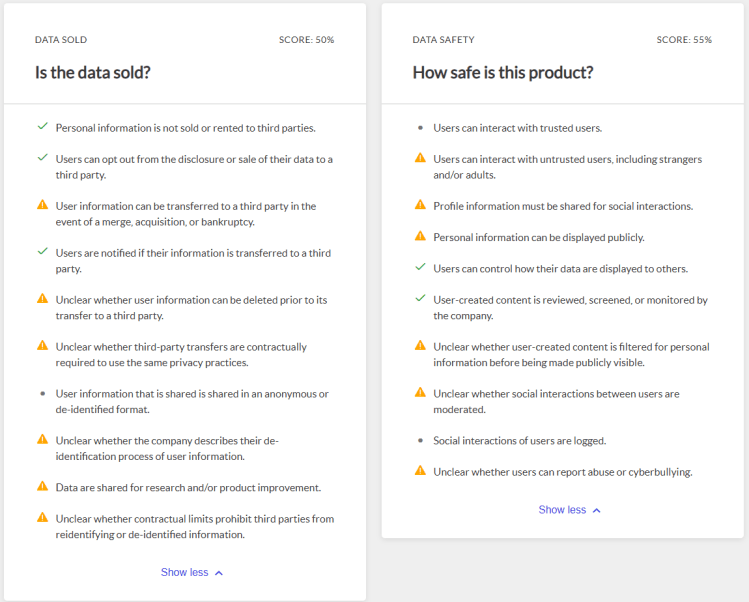
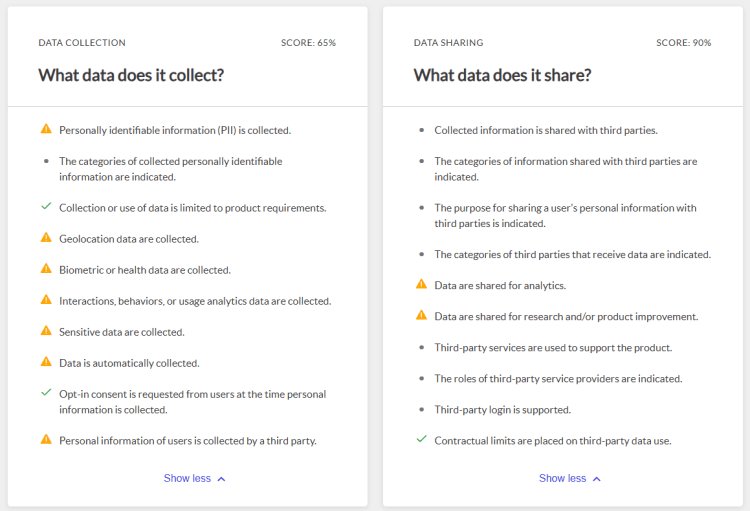
The following two images (Common Sense Media, 2022) show concerns re: data in the Google Classroom ecosystem.
By the end of this assignment, I found myself increasingly skeptical that a truly ethical, learner-centered LMS exists. This exercise sharpened my ability to evaluate tools critically—but it also reinforced my concerns about the broader systems behind them.
References
Allyn, B. (2024, October 3). 23andMe is on the brink. What happens to all its DNA data? NPR. https://www.npr.org/2024/10/03/g-s1-25795/23andme-data-genetic-dna-privacy
Bates, A. W. (2015). Teaching in a digital age. In opentextbc.ca. Tony Bates Associates Ltd. https://opentextbc.ca/teachinginadigitalage
Common Sense Media. (2022, December 19). Common Sense Privacy Evaluation for Google Classroom. Privacy.commonsense.org. https://privacy.commonsense.org/evaluation/Google-Classroom
Docebo. (2025, April 21). The LMS for education. https://www.docebo.com/solutions/education/
Osterweil, S., Shaw, P., Allen, S., Groff, J., Kodidala, S. P., & Schoenfeld, I. (2015). A framework for evaluating appropriateness of education technology use in global development programs. https://dspace.mit.edu/bitstream/handle/1721.1/115340/Summary%20Report_A%20Framework%20for%20Evaluating%20Appropriateness%20of%20Educational%20Technology%20Use%20in%20Global%20Development%20Programs.pdf
 themarksey blog