
A vision for what may come out of ETEC 524
Guten tag meine Leser!
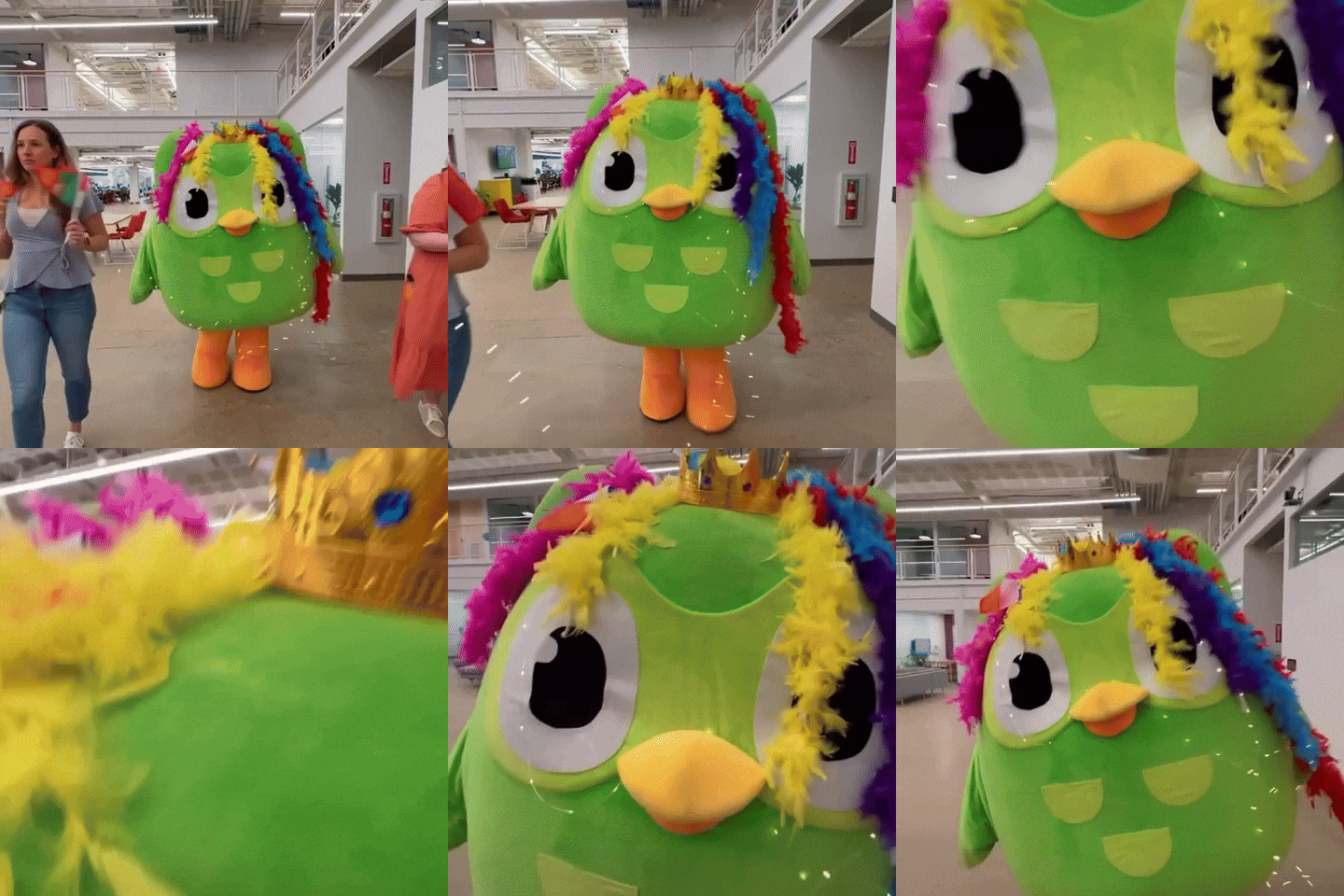
(Or to those of you not currently obsessed with working your way through the Duolingo German course—good day my readers.)
For those of you new to my blog, willkommen! I’m Morgan, a secondary school teacher-librarian and current student in the Masters of Educational Technology program through the University of British Columbia. I’m just starting ETEC 524, Learning Technologies: Selection, Design and Application, and this seems like the perfect excuse to dust off my poor, neglected blog. If you scroll through past posts, you’ll get a sense of my background—but here’s the Coles notes version.
This is my fifteenth-year teaching in the public school system in Manitoba, mostly at the middle and high school levels. On paper, I think I was supposed to be a history teacher, but I’ve done a little bit of everything—core classrooms and upper-middle humanities. Seven years ago, I was asked to move into a teacher-librarian role, and I haven’t looked back since. As this blog shows, this is my second program at UBC; my first was the LIBE Diploma, which gave me excellent training in running a well-rounded library program. Librarianing is the best. I get to buy books, collaborate with teachers, curate across multimodalities, nag people about copyright (not gonna lie, my least favourite part), and help guide future-focused pedagogy. I considered a Masters in Library Studies but felt that this program better fit my interests, the needs of our space, and where I see the future of libraries heading.
For this course, I’m interested in bridging the gap between healthy communities and the overwhelming amount of digital content at our fingertips. How do I help students not just find information, but apply it to their own lives? Moving between in-person and virtual spaces is part of daily life, but how do we make that shift feel practical for learners? Maybe it’s the creep of middle age making me critical, but many students seem increasingly disillusioned with school. How do we build learning environments where students critically engage with tech beyond academic checkboxes? And how do I ensure I’m using technology for true redefinition (Puentedura, 2009) rather than using resource-heavy tools for tasks that could just as easily be done on paper? As a librarian, I see the aftermath of a lot of poorly planned tech investments, and I don’t want what I design to add to the mess.

What I hope to develop is a course where students choose a demonstrable skill—something they truly want to learn—and build it over a semester. They would set goals, manage their time, reflect on their progress, tackle challenges, and share their learning with others. For example, I might choose to learn how to make the perfect pancake (a worthy pursuit, in my opinion). I’d network with cooks, test recipes, reflect on my process, and document what I learn so I could share it with others. The course would wrap up with a community celebration where students showcase their skills. It’s still just the glimmer of an idea, but I’m hopeful this class will help me turn it into something practical and worth running.
The challenge, of course, is designing something meaningful and manageable when students will pick skills I know nothing about—and that’s kind of the point. I won’t be the expert, but I can build structures to help them find reliable sources, network and connect with experts, and reflect on their learning. That’s where I hope this course will help me grow—giving me the tools to better select and apply technologies that support diverse, self-directed learning without turning the course into a chaotic free-for-all.
This course feels like the right fit to help me move that idea forward. The frameworks we’ll explore—like SAMR and SECTIONS (Bates, 2014)—can help me evaluate whether my design choices are meaningful or just adding extra steps. The focus on learning environments, interaction, and engagement will help me balance student independence with community-building. The work on assessment will push me to clarify what success looks like when every student is learning something different. Later modules on content creation, multimodal presentation, and communication will give me practical tools to support students in sharing their learning in ways that go beyond the traditional slideshow or essay. The final assignments are perfectly timed to help me produce both a structured unit and a tech integration proposal—directly aligned with my course concept.
In short, I hope this course will help me move from intention to implementation—grounding my ideas in research-backed frameworks and best practices, and giving me peer and instructor feedback on my course design. Specifically, I hope to strengthen my ability to design learning environments that foster student agency, apply digital tools purposefully, develop process-based assessment strategies, and support students in sharing their learning in meaningful ways.
To do this, I’ll need access to examples of blended learning structures, readings on assessment for self-directed learning, and opportunities to experiment with digital tools for documenting learning. I also hope to learn from my peers—many of whom bring different teaching contexts and insights that could help me refine my thinking.
By the end of our time together, I know this course will help me take a meaningful step forward in becoming a digital-age teaching professional—someone who not only navigates the evolving world of educational technology but helps students do the same, critically, creatively, and ethically.
References
Bates, A. W. (2015). Teaching in a digital age. In opentextbc.ca. Tony Bates Associates Ltd. https://opentextbc.ca/teachinginadigitalage
PowerSchool. (2021, April 13). SAMR Model: A Practical Guide for K-12 Classroom Technology Integration. https://www.powerschool.com/blog/samr-model-a-practical-guide-for-k-12-classroom-technology-integration
 themarksey blog