
Ponderings on Usability
What is usability?
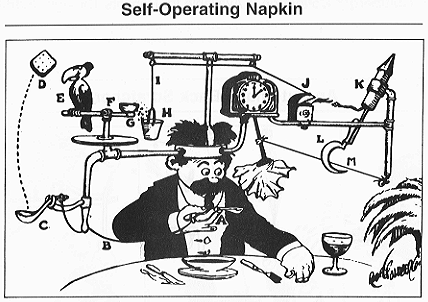
Perhaps it is simpler to view usability through the lens of a stone age technology. The wheel proliferated because it is infinitely usable. To borrow from Issa and Isaias’ usability criteria (2015, p. 33), the wheel was easily understood and adopted across various cultures (learnability). It could be adapted for use in many places (flexibility). When properly designed, it rarely failed (robustness). The wheel significantly reduced the effort required for transportation (efficiency), and its design was simple, effective, easily reproduced, and impossible to forget how to use (memorability). Small imperfections don’t usually effect its utility (error handling), and it made people’s lives better and easier (satisfaction). When we are designing tools for use, usability must be the end goal, or else we are building Rube Goldberg machines; complex machines that perform tasks in indirect and convoluted ways (Wikimedia Contributors, 2019) that are more of a puzzle and pastime for the designer than solutions to widely held problems or ways to improve quality of life.
What about educational usability?
From an educational lens several ideas are missing. Unlike the profit-driven motives of the free market, which often lead to excluding certain users in technology design, the education system prioritizes inclusivity, catering to diverse learning needs, and supporting both teaching and learning processes. When technologies have been designed for commercial usability rather than educational, educational outcomes and learning effectiveness are often sacrificed. Adding features necessary for ensuring support for different age groups, modes of learning, technological proficiency and integration with learning standards are not marketable in the same ways.
Data privacy is another concern. Individuals of legal age can consent to technology use and data terms, but schools must prioritize student data privacy, often facing higher costs for technology that adheres to these standards, unlike commercial tech subsidized through data sale (Canadian Centre for Cyber Security, 2023). Ultimately, one could define educational usability as technology that meets Issa and Isaias’ criteria on top of being ethically responsible and inclusive, which prioritizes the learning process, and recognizes the financial and security challenges that are unique to the educational field.
When usability studies go wrong
User-centred design is integral . Woolgar effectively argued that in his observed usability study, he saw the configuration of the user to the technology. This is problematic because it can lead to a notable mismatch between user needs and the technology, resulting in a product that is difficult to use, or doesn’t serve the problem it is intended to address. It also leads to potential user frustration and disengagement because they are forced to adapt to a system that doesn’t align with their natural behaviours, expectations, and motivations.
One issue that stood out for me was the very close presence of testers during the process. The testers were physically in the space and verbally guided the users along the way, telling users when they could give up, or providing positive reinforcement to encourage useful behaviours like reading a manual (Woolgar, 1990, p. 85). Would users outside of this ecosystem persist in their use of the technology, and where would users genuinely struggle? Configuring the users muddies the water.
Woolgar highlighted the insider/outsider contrast, with insiders like tech support often surprised by outsiders’ real-world use of technology, exemplified by simplified computer instructions posted in a school computer lab. (Woolgar, 1990, p. 72). The sheer depths of knowledge and experience of designers act as blinders to the everyday needs of average users, who may not share the same level of expertise or perspective. Perhaps a better process for usability testing would have helped create a device that was more intuitive.
Usability over time
Woolgar’s points on usability are particularly relevant when considering the DOS-based 286 computers he references in 1990, which, due to their novelty and hardware constraints, necessitated user adaptation and lacked key usability aspects like learnability and satisfaction set out by Issa and Isaias 25 years later. It is likely that in Woolgar’s case users legitimately needed to be configured. Now that technology is ubiquitous, and screen recording technology/keystroke-logs exist we can now take the lessons learned from Woolgar and apply them in a way that helps users configure the tech rather than vice versa. Testers no longer need to physically be in a room with those doing the testing, as we can gather helpful data virtually. In Woolgar’s case, usability studies were an end of process project to be completed shortly before heading to market, whereas Issa and Isaias frame usability evaluation as a recursive process of prototype releases; this is a significantly more proactive, user-centric approach. Ultimately, when read together these pieces highlight how important it is that our conceptions of usability do not remain static.
References
Canadian Centre for Cyber Security. (2023, August 4). Protecting your information and data when using applications- ITSAP.40.200. Canadian Centre for Cyber Security. https://www.cyber.gc.ca/en/protecting-your-information-and-data-when-using-applications-itsap40200
Goldberg, R. (1931). Self-operating napkin [Comic]. In Wikimedia Commons. https://upload.wikimedia.org/wikipedia/commons/a/a9/Rube_Goldberg%27s_%22Self-Operating_Napkin%22_%28cropped%29.gif
Issa, T., & Isaias, P. (2015). Usability and Human Computer Interaction (HCI). In Sustainable Design (pp. 19–36). https://doi.org/10.1007/978-1-4471-6753-2_2
Wikipedia Contributors. (2019, April 10). Rube Goldberg machine. Wikipedia; Wikimedia Foundation. https://en.wikipedia.org/wiki/Rube_Goldberg_machine
Woolgar, S. (1990). Configuring the user: The case of usability trials. The Sociological Review, 38(1_suppl), 58–99. https://doi.org/10.1111/j.1467-954x.1990.tb03349.x
 themarksey blog