
But what about the truth?
Our discussions of knowledge and constructivism often focus on the elusive idea of truth. And it’s not surprising, because so much of our lives depend on the truths that others have decided for us, and the truths we have made for ourselves. For example, when people experience conflict, we ask them what actually happened, and they are often judged and given consequences based on the information they provide, despite the fact that the limitations of human cognition mean that we will almost inevitably be missing, misconstruing, or misrepresenting information. The emphasis on truth also isn’t surprising, because some of our earliest philosophical musings about what constitutes knowledge defined it as “justified true belief” (Pritchard, 2014, p. 22).
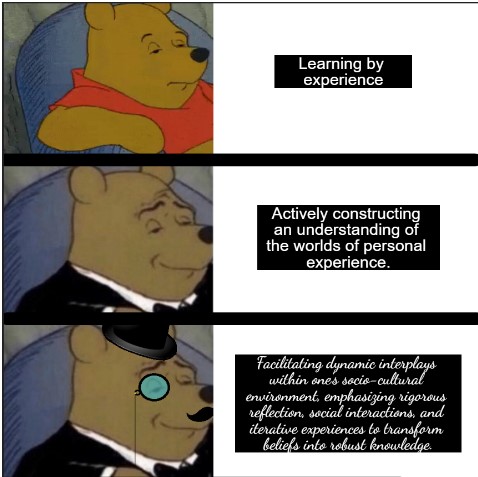
Constructivism is a framework for explaining how people learn. Cobb points out two main trends in constructivist research: one that students are actively constructing an understanding of the worlds of their personal experience; the second that focuses on the “social and cultural”-ness of everything that we do (2005, p. 87). Although these views can seem conflicting, neither directly addresses the concept of truth.
Over the millennia that humans have been questing after it, we have developed some significant methods for determining theoretical truths thanks to the use of the scientific method and other well established and rigorous patterns of logic and observation. To borrow from Dr. Taber, we can build a good picture from clues, and we can test these expectations against future experience and make revisions. And from this, we can learn a lot about the world (2020).
Perhaps part of the problem is that both knowledge and belief have instrumental value, with knowledge typically being seen as having greater value (Pritchard, 2014, pp. 12-13). This value is not just inherent; it is socially constructed and reinforced. When we hold a particular belief and find ourselves within a community that shares that belief, we derive a sense of belonging, validation, and even identity from it. Even if a belief is later found to be inaccurate, the process of altering that belief can be complex and emotionally taxing, not merely because of cognitive inertia but also due to the social ramifications it may entail. Taber (2020) hinted at this when he spoke of how we often interpret our experiences to fit our inherent cognitive biases. This is where constructivism’s emphasis on the social dimension of learning becomes crucial.
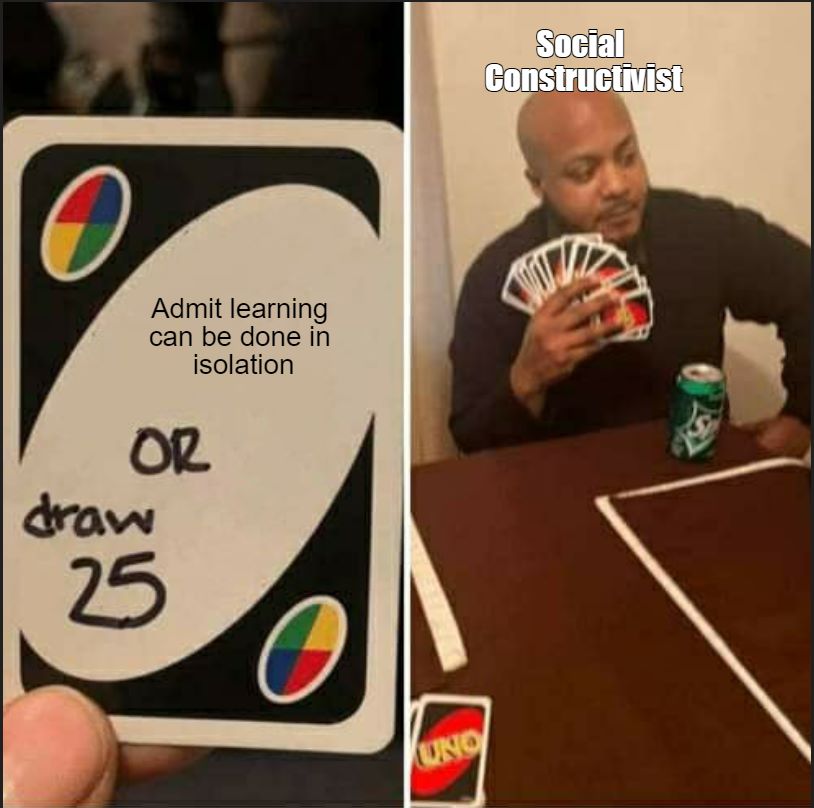
Constructivism posits that learning isn’t merely an act of individual reflection and experience; it also involves a dynamic interplay with one’s physical and social environment. In essence, our thoughts, and thereby our learning and knowledge, are influenced by our culture. However, they also challenge it, gradually altering its boundaries (Fosnot & Perry, 2005, p. 71). Some theories draw parallels between evolutionary processes and individual learning, suggesting that personal learning can be understood as a result of activity and self-organization. This, in turn, leads to the development of cognitive structures (Fosnot & Perry, 2005, p. 79). As learners engage with their community, they may initially form beliefs based on shared experiences or the prevailing views of that community. The task for educators, then, isn’t just about correcting misinformation but facilitating environments where learners can collaboratively refine, challenge, and cross-check these beliefs. Through rigorous reflection, social interactions, and further experiences, these beliefs can then be transformed into more robust knowledge. Recognizing the social weight of beliefs and their potential to evolve underscores the importance of fostering learning environments where beliefs can be openly tested, questioned, and refined into truths that are more universally applicable.
I think one of the things that I will take from this course is the understanding that I must continue to question things. What do I consider acceptable forms of knowledge; what are acceptable ways to show and share it? The ideas that I have privileged may be the products of social and cultural beliefs rather than rationally supported understanding. Barbara Stewart Edwards spoke to this in her week 7 post : “Within diverse classrooms rich with ‘funds of knowledge,’ constructivist strategies that utilize diverse knowledge well, will not only serve to engage all its learners, but cultural understandings and sensitivity will also develop. Empathy, a trait said to be lacking in many of our 21st century learners, will be awakened.”
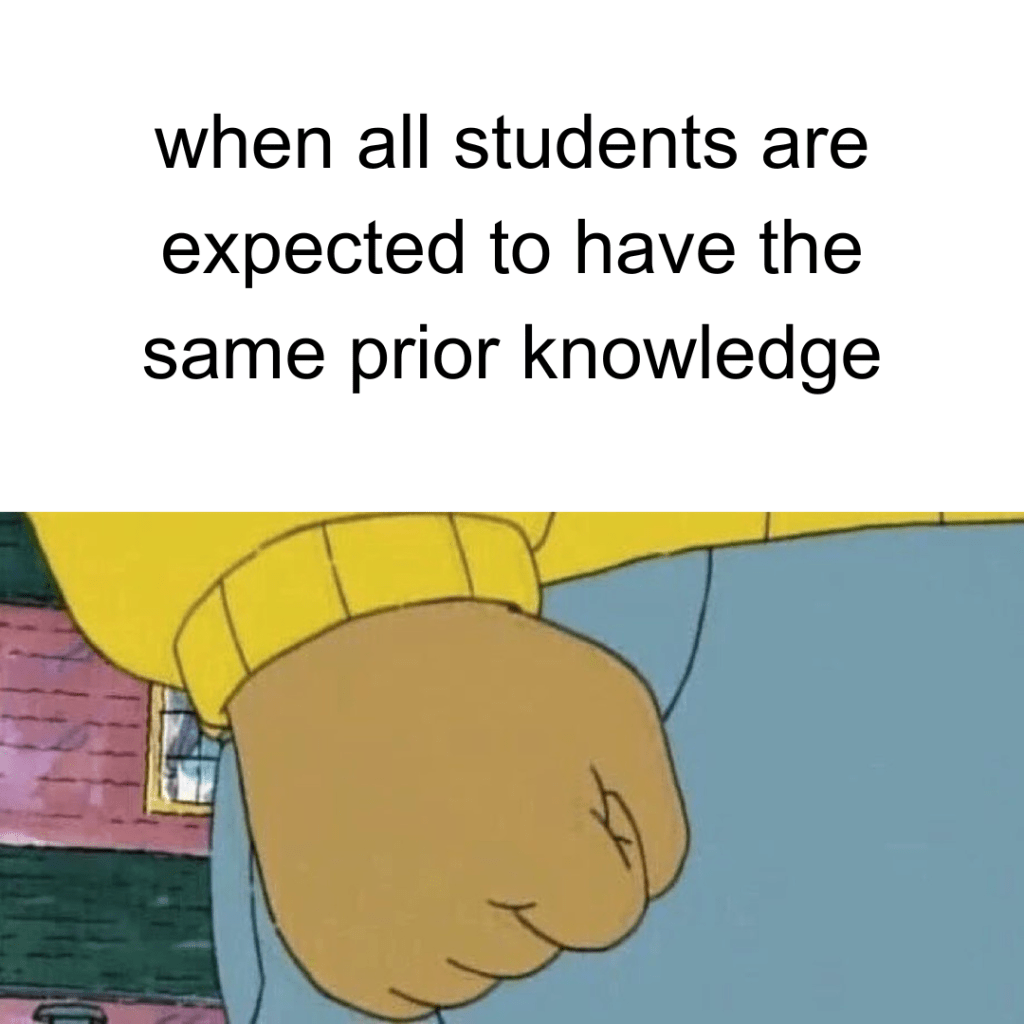
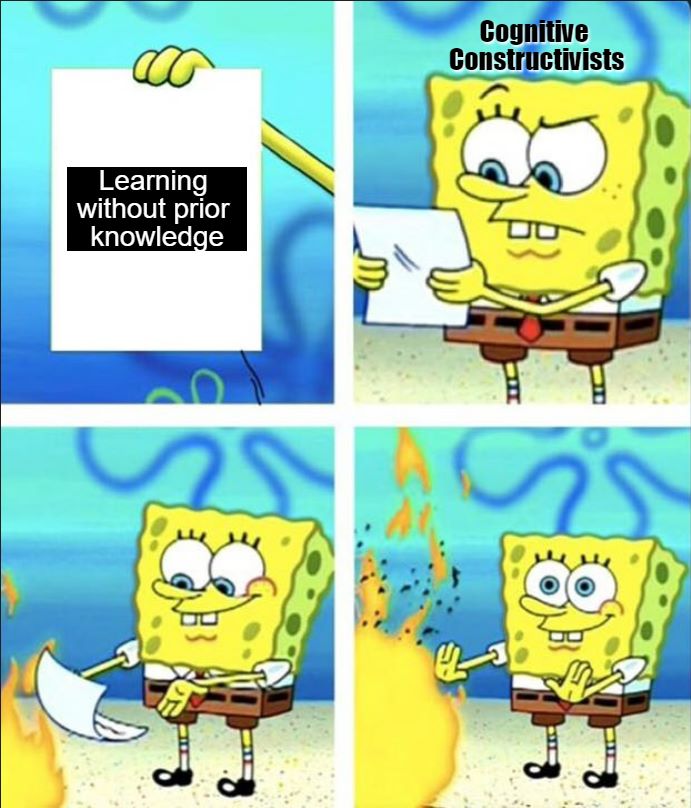
Please enjoy these memes that I created based on constructivist principles and in synthesis of course readings.
References
Cobb, P. (2005). Where is the mind? A coordination of sociocultural and cognitive constructivist approaches. In Constructivism : Theory, Perspectives, and Practice. Teachers College Press.
Fosnot, C. T., & Perry, R. S. (2005). Constructivism: A psychological theory of learning. In Constructivism : Theory, Perspectives, and Practice. Teachers College Press.
Pritchard, D. (2018). What is this thing called knowledge? Routledge.
Taber, K. (2020). Constructivism – the good; the bad; and the abhorrent? In edcp.educ.ubc.ca. https://edcp.educ.ubc.ca/constructivism-the-good-the-bad-and-the-abhorrent/
 themarksey blog