
; bringing the @aallibrary reference collection into modernity and relevance
Reference collections and services are an integral part of any Library Learning Commons. The collection itself has traditionally been defined as a physical section of the library that holds print copies of materials that are not allowed to circulate outside of the library, to keep them on hand for client questions and research (University of British Columbia, n.d.). Services include helping define the information needs of users, creating environments for learning and collaboration, teaching students how to use reference resources, and differentiating good reference materials from bad ones (Riedling & Houston, 2018, p. 2). Good reference services require access to a reference collection that meets the needs of a building’s clientele, and the development of all good services is done through conscientious observation, user feedback, planning, and execution. While reference services have been more static over the last 20 years, the reference collection has changed drastically. So how do we support developing library users into informationally literate citizens? The first step is to ensure the building and maintenance of a collection of physical and virtual materials that are responsive to the needs of our school communities. What follows is a plan for the continued development of the AAL Library Learning Commons reference collection in a way that will help guide students towards becoming informationally literate citizens.
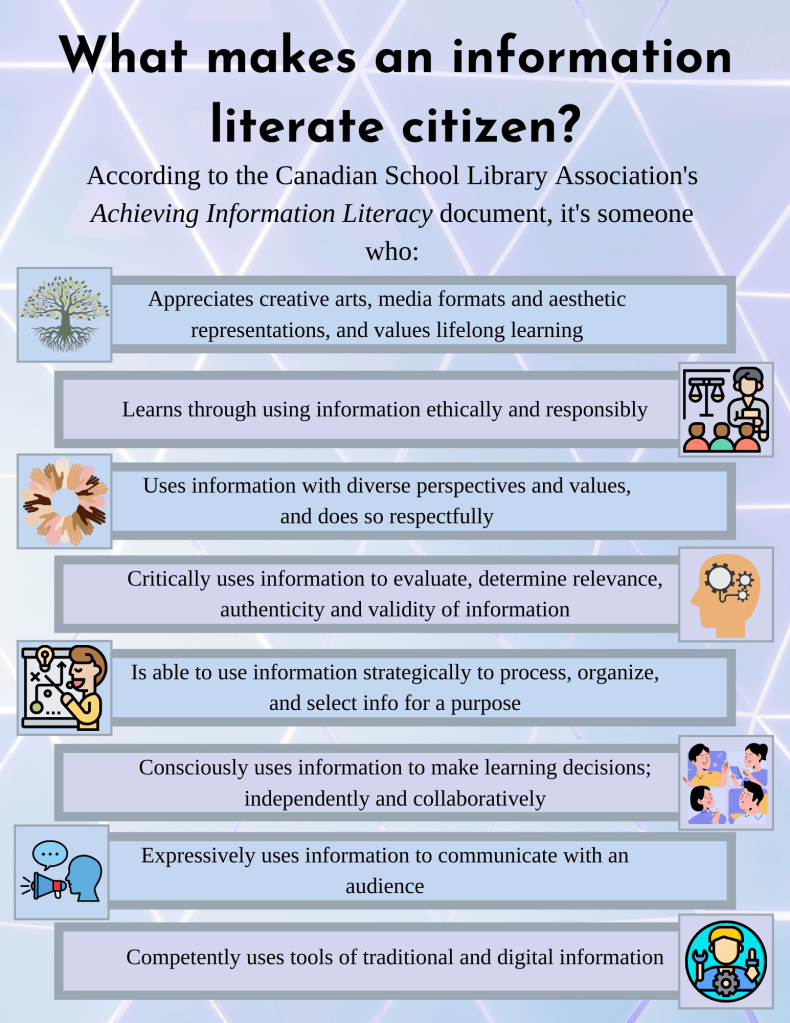
When this kind of work is being done, we refer to various standards set by professional organizations that help inform our practice; in this case the Canadian School Library Association’s Achieving Information Literacy (AIL), which sets standards for School Library collections, including reference ones. Another document heavily used in this plan is Riedling and Houston’s 2019 Reference Skills for the School Librarian (Fourth Edition).
Where We Are At Currently
The Physical Reference Collection
Riedling and Houston include the following materials as important to a reference collection; bibliographies; factbooks, directories, almanacs, yearbooks, and handbooks; biographical sources; dictionaries; encyclopedias; geographical sources; periodicals and specialized databases. Only several are present in our current physical reference collection, which has mostly been disbanded over the past five years. Most materials have had their spine labels edited to remove REF and been shelved in the appropriate Dewey section – most notably factbooks like our Guinness Book of World Records. 101 items remain with a REF spine label, which are kept on a bottom shelf at the end of the non-fiction collection. Highlights of this section include,
- A Time for Kids Almanac (2017) *
- A book on birthdays (2006)*
- The Globe illustrated Shakespeare; the complete works annotated (1979)
- An unabridged Collins English Dictionary (2011) and abridged Junior Dictionary (2006)*
- Several visual dictionaries (1989 – 2011) *
- A set of Rand McNally Classroom atlas of Canada and the World (2008)*
- A sizeable National Geographic atlas of the world: Eighth edition that invites group viewing (2007)*
- An eight-volume set on Diseases, by Grolier Academic Reference (2006)*
- A six-volume set, Exploring the World of Mammals, by Chelsea House Publishing (2008)*
- Several historical Atlases of Manitoba
This seems to be a mishmash of materials that have been missed during previous weeding or relocations. Those marked with an asterisk are in need of replacing as they exceed CREW criteria for their Dewey number. For example, the CREW manual recommends that Almanacs should remain in the reference collection for a year, then be moved to the circulating collection for a year and then discarded (2012, p. 39). Only the historical atlases and Shakespeare seem like they deserve to remain.
We have let materials from Reference circulate outside of the library. The sizable (but hopelessly outdated) National Geographic atlas has circulated 12 times, the collection of Shakespeare 15 times, and the unabridged Collins 17 times. The rest show 2 or fewer circulations.
The Virtual Reference Collection
Our virtual reference collection is housed in two separate locations, one mandated by our school division, and the other chosen because of ease of access for students. It provides links to our school catalog and other digital subscriptions, some of which would be considered reference materials.
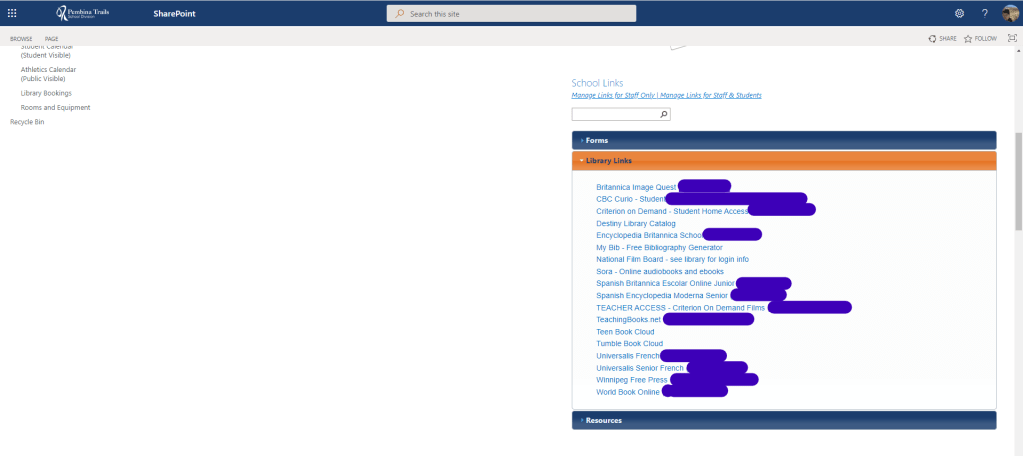

Available to access through these two locations are the following:
- Encyclopedia Britannica School (along with French and Spanish editions)
- Britannica Image Quest
- World Book Online
- Teachingbooks.net (teacher reference)
- NFB Canvas
- Criterion on Demand
- CBC Curio
- Destiny Collections built on curricular topics/interest
- Magazines through our Overdrive/SORA subscription
- Digital access to the Winnipeg Free Press
Areas of Improvement
User Feedback
“Libraries build collections based on what they think faculty and students need”
(Riedling & Houston, 2019, p. 4).
If this is to be truly the case, more time collecting feedback from clientele (both students and faculty) needs to become a focus. This will allow us to meet their needs and encourage growth and development of pedagogy and information literacy more adequately.
Weeding and Collection Development
The average age of materials remaining in the reference collection is 17 years (Follett Destiny, 2022). While this is okay for materials of historical relevance, for most this is inappropriate. Those marked above should be weeded from the collection and replaced if there is adequate demand and/or an online option is not suitable. New materials should be purchased based on user feedback, with emphasis placed on highly browsable ones. Popular titles, like the Guinness Book of World Records should be bought in duplicate – one for the circulating collection, and the other for Reference. When considerations are being made for adding resources to our collection, Riedling and Houston’s criteria for that format will be utilized.
Location and Physical Space
Currently, the remaining parts of the reference collection sit on the bottom of a shelf at the end of the non-fiction collection; a nondescript and unmarked location, suitable for a part of the collection that has been sadly left behind. According to AIL criteria, this meets ‘below standard’ criteria (Canadian Association of School Libraries, 2006, p. 42). While virtual materials are available, they should be curated and advertised more prominently, which could be a prominent feature in a designated reference section.
Philosophy
The most utilized materials in the reference collection are the ones that encourage discovery and collaborative use. Physical materials should be selected to encourage and inspire inquiry and research on topics of student interest. Materials (both physical and digital) should be selected to inspire “questioning, thoughtful investigating, making sense of new information, and developing new understandings.” A section that encourages inquiry also supports a pedagogical shift towards constructivism, where learners build their own meaning through a teacher supported environment that motivates students to question and discover rather than simply retain information (Stripling, 2008, p. 50).
Effective Collaboration at Division Level
Many virtual reference resources are prohibitively expensive. Access to Middle School Databases would best (and more equitably) be achieved if purchased at a division level, rather than on a per school basis.
Digital Curation
For parts of the collection that are best served by digital means, these should be curated and organized in a way that allows for easy access by both teachers and students. This allows our clientele to access vetted materials that they might not discover on their own. Curation is about getting our students to quality content without throwing them into the wilds of the internet (Valenza, 2017). Students are familiar with Destiny Collections from genre-study collections, so this could easily be carried forward into content area pathfinders.
Connect with the Public Library
The pandemic has been challenging in a lot of ways, but one benefit has been that the Winnipeg Public Library have created an online membership option that does not require going in to a branch to complete. This gives students access to all virtual databases, audiobooks and eBooks offered by the WPL (Winnipeg Public Library, n.d. – b).
Where We Will Be – The Improvement Plan
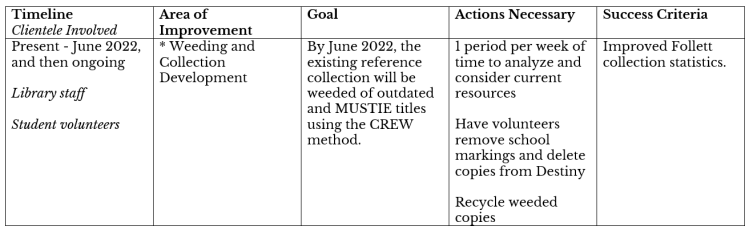
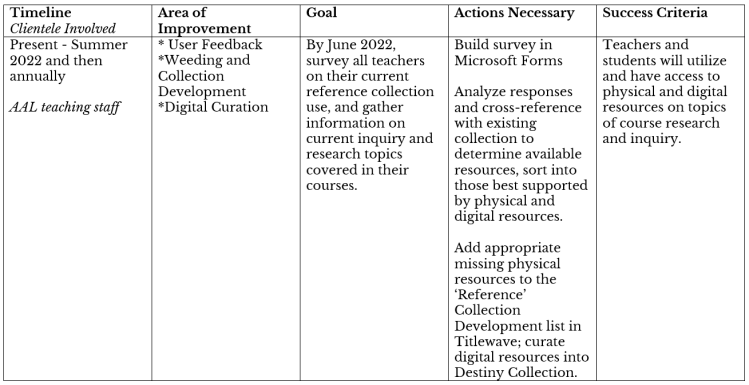

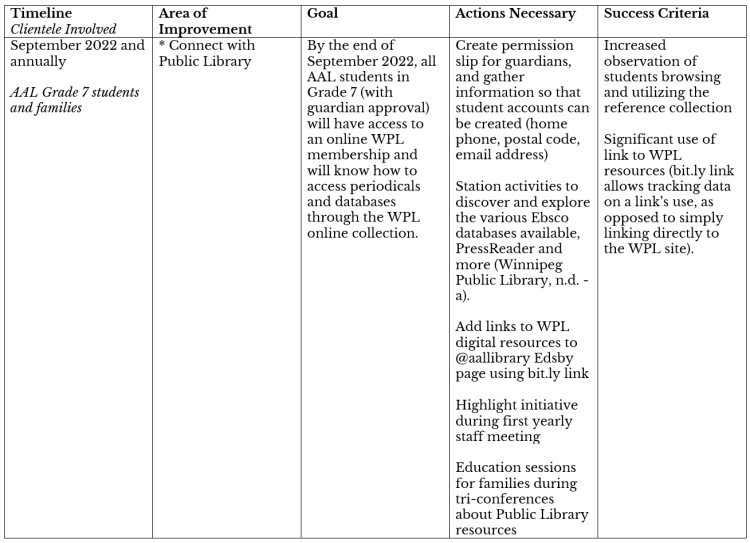
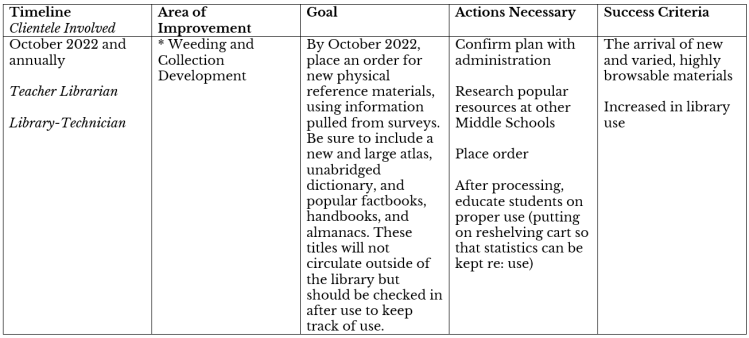
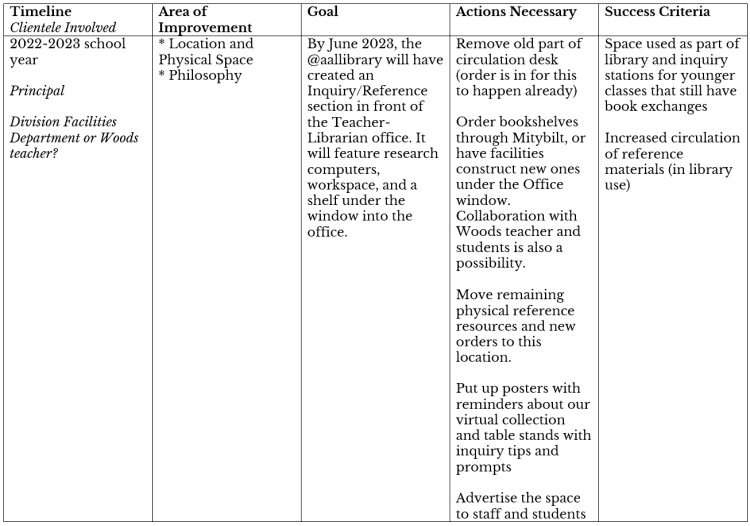
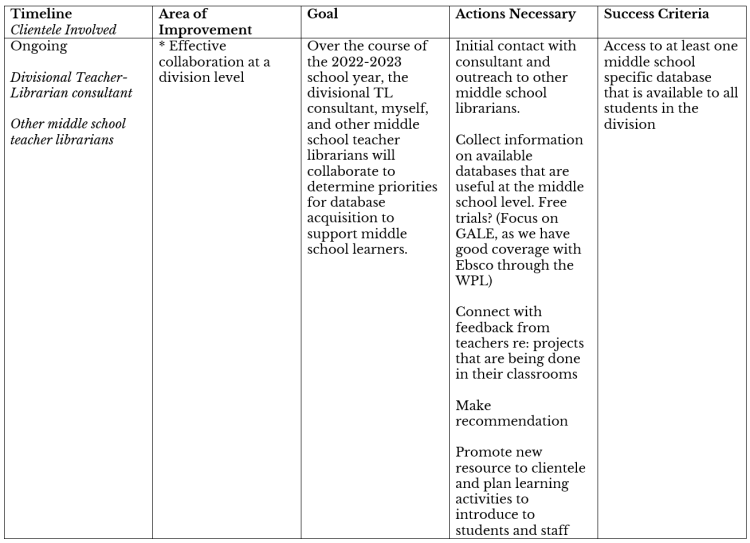
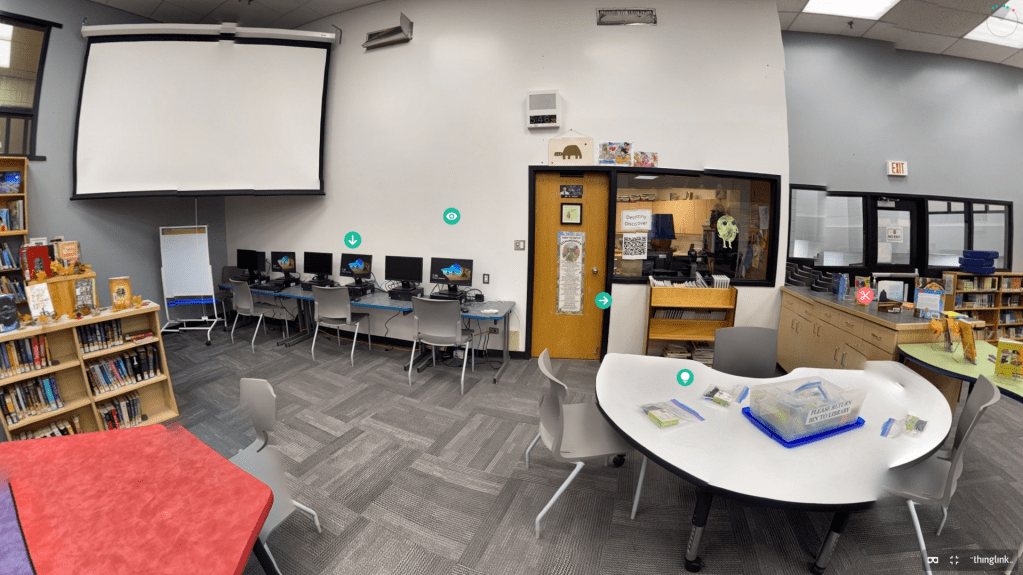
Follow the link in the caption below to view an interactive vision for what an Inquiry and Reference Station (goal 6) could look like in the @aallibrary! Click on the green and red buttons to learn more about what this will look like in the future.
Conclusion
The @aallibrary has significant room for improvement in terms of its reference collection. The above seeks to balance the importance of physical browsing, opportunities for collaboration, curricular demands, student interest, and financial constraints into a plan that once implemented will ensure the continued development of informationally literate community members with access to both a strong reference collection and reference services. From next year forward, an annual budget line will be established to continually enrich the physical collection. The only one time expense is the building/purchasing of shelves to house our new Inquiry and Reference section prominently. These steps will help ensure that Reference doesn’t fall into disrepair again.
References
Canadian Association for School Libraries. (2006). Achieving information literacy; standards for school library programs in Canada (M. Asselin, J. L. Branch, & D. Oberg, Eds.). https://accessola.com/wp-content/uploads/2020/08/2003-AchievingInfoLiteracy.pdf
Follett Destiny. (2022). Collection Statistics – Summary.
Stripling, B. (2008). Inquiry: Inquiring minds want to know. School Library Media Activities Monthly, 25(1), 50–52.
Texas State Library and Archives Commission, & Larson, J. (2012). CREW: A weeding manual for modern libraries. https://www.tsl.texas.gov/sites/default/files/public/tslac/ld/ld/pubs/crew/crewmethod12.pdf
University of British Columbia. (n.d.). [Lecture notes Lesson 1: Information Literacy and Reference Services in Schools]. Teacher-Librarianship, University of British Columbia. https://canvas.ubc.ca
Valenza, J. (2017, July 5). Curation situations: Let us count the ways. NeverEndingSearch Blog; School Library Journal. https://blogs.slj.com/neverendingsearch/2017/07/05/curation-situations-let-us-count-the-ways/
Winnipeg Public Library. (n.d.-a). A-Z Digital Library services. WPL InfoGuides. Retrieved March 30, 2022, from https://guides.wpl.winnipeg.ca/az.php
Winnipeg Public Library. (n.d.-b). Online Registration. Retrieved March 30, 2022, from https://winca.ent.sirsidynix.net/client/en_US/default/search/registration/mill/HZWS/true?dt=list
 themarksey blog