; guiding our peers towards growth in their reference collection use
Teacher-Librarians are not just student educators – they also help lead their peers to growth and development in their own practice. But just like student learning, this can be a sensitive task. Our students come to us with a wide range of background knowledge, experiences, interests, and skillsets, and so do all teachers. We know that there is no such thing as a one size fits all approach to student learning, and thus it should be no shock that we cannot develop a OSFA approach to teacher learning either.
But often, with the blinders of our daily lives and the heavy demands of education, we want to describe how to do something before thinking about whether teachers are ready and comfortable to push their practice (Loucks-Horsley, 1996 as cited in “The Concerns-Based Adoption Model”). Change is a slow process, and what one teacher is ready for, another will find inconceivable. Barriers can exist regarding teaching experience, content area knowledge, technological proficiency, on top of each person’s own learning experiences or what is going on in their lives outside of school. Pushing people to try and do things that they are not ready for is an invitation for stalling growth in practice.
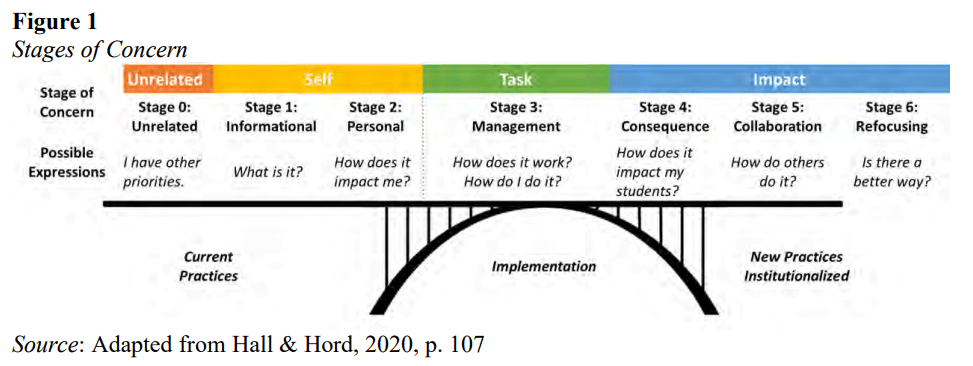
So, how do we apply this knowledge to encourage teacher growth in the use of our library reference collections? Fortunately, we have the Concerns-Based Adoption Model to guide us in building effective coaching and growth opportunities for teachers across a wide range of readiness for innovation.
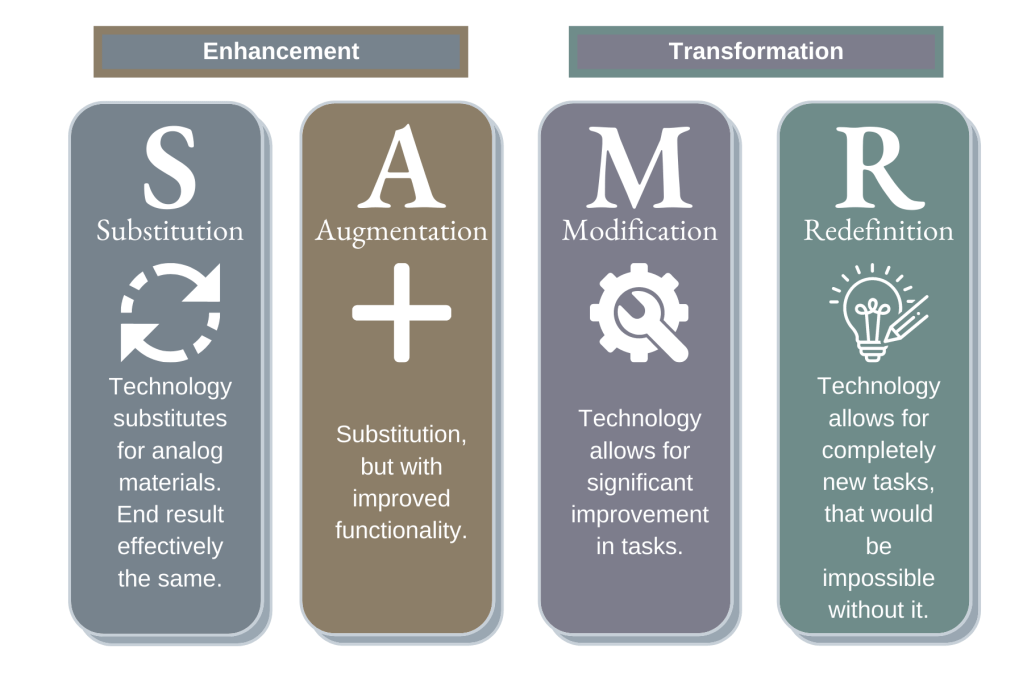
Also worth considering when planning teacher learning is Dr. Ruben Puentedura’s SAMR model.
These two models have been considered when designing personalized learning opportunities for the two fictional staff below.
Teacher A
Who is Teacher A?
Teacher A has been teaching Grade 7-9 students at Imaginary School for close to 40 years. Almost all that time has been spent as a math and science teacher. Generations of community families have had A as a math/science teacher and for the most part, students have all done the same assignments across that time. Their teaching style matches a more traditional lecture method, and many of the learning resources that they use for their courses have not changed dramatically over the decades – their motto being “if it’s not broke, don’t fix it.” Their walls are lined with out-of-date textbooks, from which they will still occasionally pull a page or two – last week we chatted in the office while they were photocopying from a textbook with a copyright date of 1984. All students in their classroom receive the same learning materials. Teacher A has strong classroom management skills and an engaging personality that helps them connect with students despite the sometimes-dry nature of their materials. While not an adept user of technology, A has shown significant growth over the pandemic, and it has made them more likely to incorporate what they know into their teaching. They have five laptops in their classroom that students use for basic research and typing up documents and making posters. When materials, resources and information are shared by e-mail, Teacher A does not respond.
Because of the sharing of project ideas between members of the Grade 7 and 9 Teams, small projects have been incorporated into most of the year’s science units, and students are expected to use digital resources to complete their research. Previously Teacher A reports using physical copies of encyclopedias that were in our collection, but since these materials have been weeded, they have not moved to their digital counterparts, and they are not using print resources in our general collection either. When asked, they were unable to identify any virtual resources. However, students are often left to ‘Google’ on their own, with little guidance on how to effectively find reliable information online or how to navigate various websites.
Evaluation
CBAM
In terms of ‘Stage of Concern’, Teacher A sits at the Awareness stage of development, as outside of the things that they know and are aware of, they have little interest in learning more about a resource.
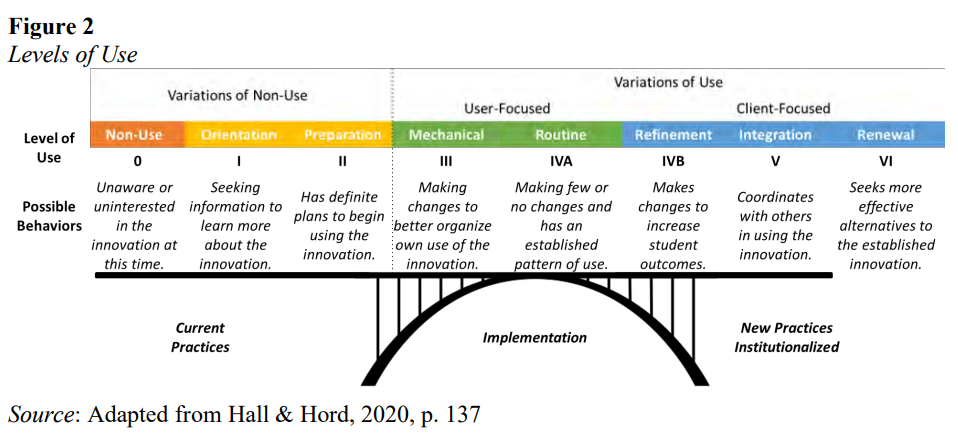
Regarding their ‘Levels of Use of Innovation,’ they sit at the Non-Use level, showing no interest and action towards expanding their use of our reference collection.
SAMR
While Teacher A does have his students use technology in his classes it is usually done at the Substitution level, where students are simply typing up written work or collating materials for posters that will be printed out and displayed in the classroom.
Evolution Plan
Because presentations introducing materials or new technologies at staff meetings and occasional email updates have not pulled Teacher A towards freshening their practice, a more direct approach will be necessary. Based on my observations, our online encyclopedia subscriptions would be most useful, but pathfinders (Centeno, 2021) or other collections of materials may prove to be just as practical. Making a point to pop in and see the teacher during their prep time and discover what units and projects their students have upcoming is a first step to determining what parts of our reference collection will be useful to support them and their classes. Once this has been determined, I can provide them with a brief overview of what is in the collection that will be of best use to their students and offer to provide support for them and their students when it comes time to research by booking the library as a research space for their class. These small workshops using pre-existing assignments will provide an opportunity to tweak Teacher A’s practice without having them completely redesign their practice. These actions should help move Teacher A from the Non-Use level to the orientation level of CBAM’s eight Levels of Use.
While this assignment is regarding the Reference Collection, I think a similar model can be used to move Teacher A’s use of technology to a level of Augmentation. Because the teacher is not comfortable with technology themself, pulling a small group of students and providing instruction on a graphic design platform like Canva, which allows for embedding videos and other multimedia, could be a useful way to nudge them towards transforming their use of technology. Students can then present and share their projects and lead their peers in utilizing the technology on other assignments. I would also suggest the work of Fontichiaro to nudge A’s worksheets towards inquiry, without requiring a complete overhaul of their practice.
Teacher B
Teacher B has been teaching Grade 5/6 students at Imaginary School for the last 4 years, with several years of experience in other schools on term contracts previously. As a core teacher, they are responsible for teaching ELA, Social Studies, Science, Math, and Art. Teacher B is adventurous and willing to try new things without necessarily having proficiency in the skill themselves, and student learning is often guided by students’ own interests. While there are textbooks available to use in the classroom for Social Studies class, B does not use them often, as they find that they are often much too advanced for many students in the class to understand. Their class actively uses their small set of laptops and iPads, and frequently borrows from others as they need them over the course of each day. Teacher B reaches out to the Teacher-Librarian for collaboration and unit planning, often inviting them in for small group instruction or other lessons. Materials shared in staff meetings, PD, or emails are often seen incorporated into this teacher’s practice.
While aware of our digital encyclopedia collections, Teacher B had less awareness of other reference materials in our collection like CBC Curio, NFB Campus and teachingbooks.net
Evaluation
CBAM
In relation to the parts of reference collection they use and the CBAM ‘Stages of Concern’ Teacher B is at the Collaboration stage, where they are mostly comfortable with the resources but are considering how others are using these resources to improve their own practice.
In terms of ‘Levels of Use of Innovation’ they would be at the Routine level, where they are using the reference materials, they are aware of regularly but are making few changes to that use.
SAMR
I would assess Teacher B’s technology integration at the Redefinition level, where they are using technology to create transformative learning experiences like podcasts or multimedia presentations that would have been impossible (or much more difficult) 20 years ago.
Evolution Plan
Because Teacher B tries new things and collaborates frequently with their team, they will need less guided support to evolve their practice. One suggestion I have is to book a weekly collaboration time where B and I can discuss their current and upcoming needs and to co-assess student learning using our reference resources. What is working and what is not? What kinds of materials are we missing? Another suggestion is providing coverages, or requesting release time from administration, for Teacher Bs so that they can go and observe other teachers and their use of reference materials and technology. To raise awareness of the other reference materials in our collection, lunch and learn sessions can be provided to provide brief overviews of what these materials are and some short examples of ready-to-use activities utilizing them.
References
Centeno, K. (2021, October 8). LibGuides: Library and Information Studies: Pathfinders and content curation. Guides.lib.odu.edu. https://guides.lib.odu.edu/c.php?g=743626&p=6849679
Fontichiaro, K. (2009). Nudging toward Inquiry: Re-envisioning Existing Research Projects. School Library Monthly, 26(1), 17–19. https://search.ebscohost.com/login.aspx?direct=true&AuthType=shib&db=eue&AN=502986054&site=ehost-live&scope=site&custid=s5672194
Huang, P.-S. (n.d.). Levels of use – Concerns-Based Adoption Model. Sites.google.com. Retrieved March 6, 2022, from https://sites.google.com/site/ch7cbam/home/levels-of-use
Olson, K., Lannan, K., Cumming, J., Macgillivary, H., & Richards, K. (2020). The concerns-based adoption model and strategic plan evaluation: Multiple methodologies to understand complex change. Theory and Practice, 31(3), 49–58. https://files.eric.ed.gov/fulltext/EJ1274351.pdf
The Concerns-Based Adoption Model (CBAM): A model for change in individuals. (n.d.). https://s3.wp.wsu.edu/uploads/sites/731/2015/07/CBAM-explanation.pdf
 themarksey blog